4.7.1.3 - Biotic factors
A community contains all the populations of different species living in the same habitat. A biotic factor is a living factor that can affect those populations. In this lesson, the focus is how changes in food, predators, pathogens and competition can change numbers of organisms in a community, especially when you are given data or a short context.
Biotic factors and communities
An ecosystem includes both living organisms and non-living conditions. This lesson is only about the living side: biotic factors. A change in a biotic factor can affect one population directly, then affect other populations because organisms in a community depend on each other.
Biotic factor
A living factor that can affect organisms in a community.
That means the factor comes from organisms in the habitat, rather than from physical conditions such as temperature or light.
Community
All the populations of different species living in the same habitat at the same time.
The official biotic factors for this point are:
| Biotic factor | What changes in the community |
|---|---|
| Availability of food | How much food is available for a population |
| New predators arriving | A predator begins to kill and eat prey in the community |
| New pathogens | Disease-causing microorganisms or viruses infect organisms |
| One species outcompeting another | One species uses limited resources more successfully than another species |
[DIAGRAM: asset_name: biotic-factor-effects-map - diagram 1; asset_slug: 097_4_7_1_3_biotic_factors_diagram1; file: diagram_assets/imagegen_regen_all/097_4_7_1_3_biotic_factors_diagram1_imagegen.png; recommended_method: codex_image_gen; description: Monochrome concept map showing the four in-scope AQA biotic factors and their possible effects on population size and breeding within a community.]
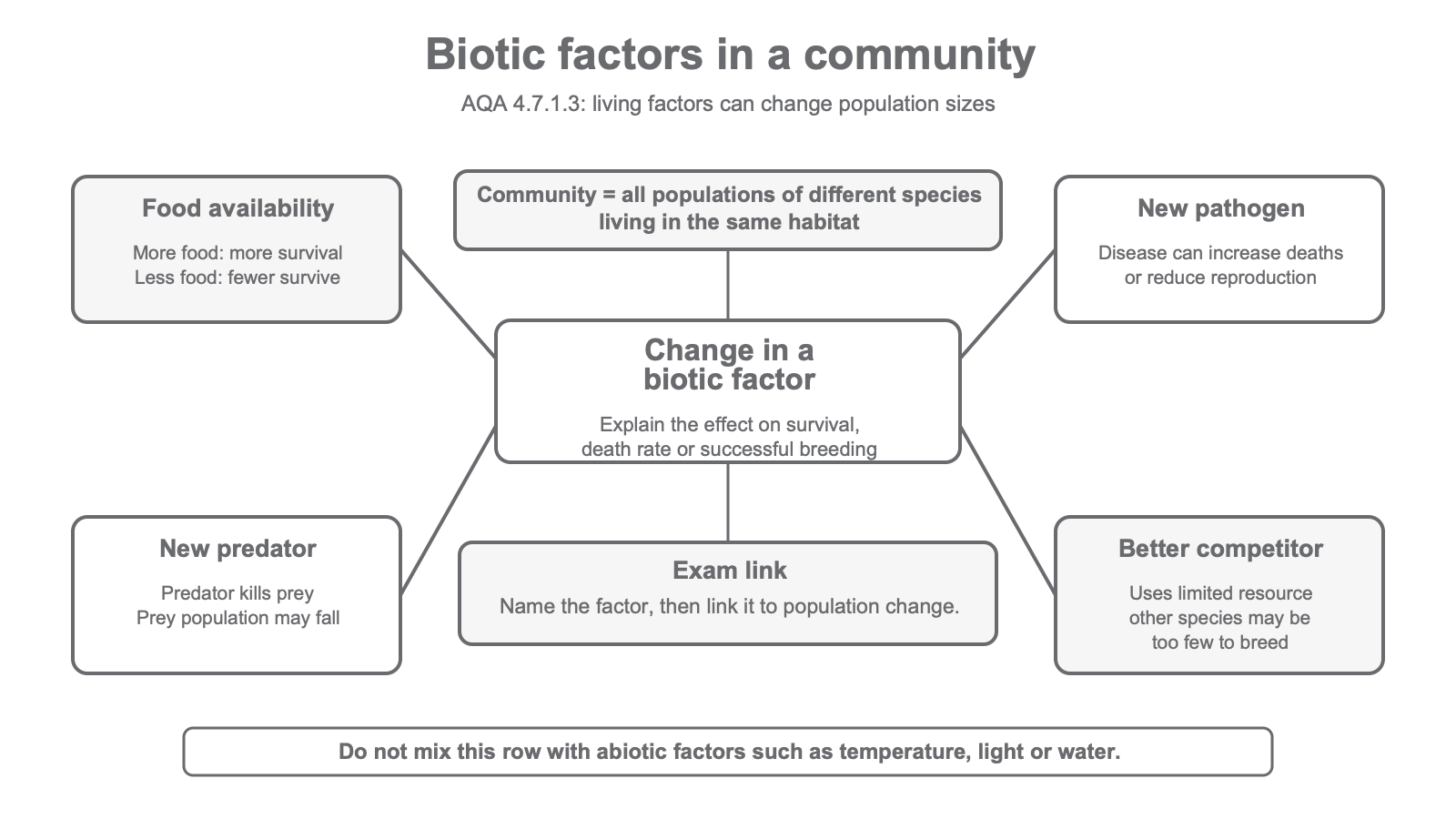
Use the word biotic carefully. A predator, a food plant, a pathogen and a competing species are biotic because they are living organisms, or in the case of viruses are treated here as disease-causing biological agents. Temperature, light and water are not biotic factors in this lesson.
Food and predators
Food availability can limit population size. If food becomes more available, more individuals may survive and reproduce, so the population can increase. If food becomes less available, more individuals may die or fail to reproduce successfully, so the population can decrease.
Predators affect prey populations by killing and eating prey. If a new predator arrives, the prey population may decrease because more prey are being eaten. The effect may also spread through the community: if the prey population falls, other predators that depend on the same prey may have less food.
A strong explanation links the factor to survival or reproduction:
| Change | Immediate effect | Possible population effect |
|---|---|---|
| Less food available | More individuals fail to get enough food | Fewer survive and reproduce, so population decreases |
| New predator arrives | More prey are killed | Prey population decreases |
Avoid writing that a population changes "because the ecosystem changes". That is too vague. Name the biotic factor, then explain the effect on survival, death rate or reproduction.
Pathogens and competition
A pathogen is a microorganism or virus that causes disease. If a new pathogen enters a community, some organisms may become ill, die or reproduce less successfully. This can reduce the population of the infected species.
Pathogen
A microorganism or virus that causes disease.
Competition happens when organisms need the same limited resources. If one species is better at getting those resources, it may outcompete another species. The weaker competitor may fall to such low numbers that there are not enough individuals to breed successfully, so that species may disappear from the community.
Competition
The interaction between organisms that need the same limited resource.
For this lesson, keep competition explanations at the population level. You do not need to describe adaptations or natural selection here. The key GCSE Biology idea is that the better competitor gets more of the limited resource, so the other species has fewer survivors and fewer successful breeders.
Continue this lesson.
You’re previewing NovaLearn without an account. Create a free account to read the rest.
Create free account