4.3.1.2 - Viral Diseases
Viral diseases are communicable diseases caused by viruses. In this AQA section, the named examples are measles, HIV and tobacco mosaic virus. For each one, you need the key symptoms or effects, the route of spread, and any control point named in the specification.
The three named viral diseases
A pathogen is a microorganism that causes disease. A viral disease is a disease caused by a virus. Viruses can infect humans or plants, so AQA uses one plant example as well as two human examples.
Viral disease
A disease caused by a virus.
The safest way to learn this row is not just to remember the names. Link each virus to the host it affects, the main symptom or effect, and how it spreads.
| Viral disease | Host affected | Main AQA symptom or effect | Spread or control point |
|---|---|---|---|
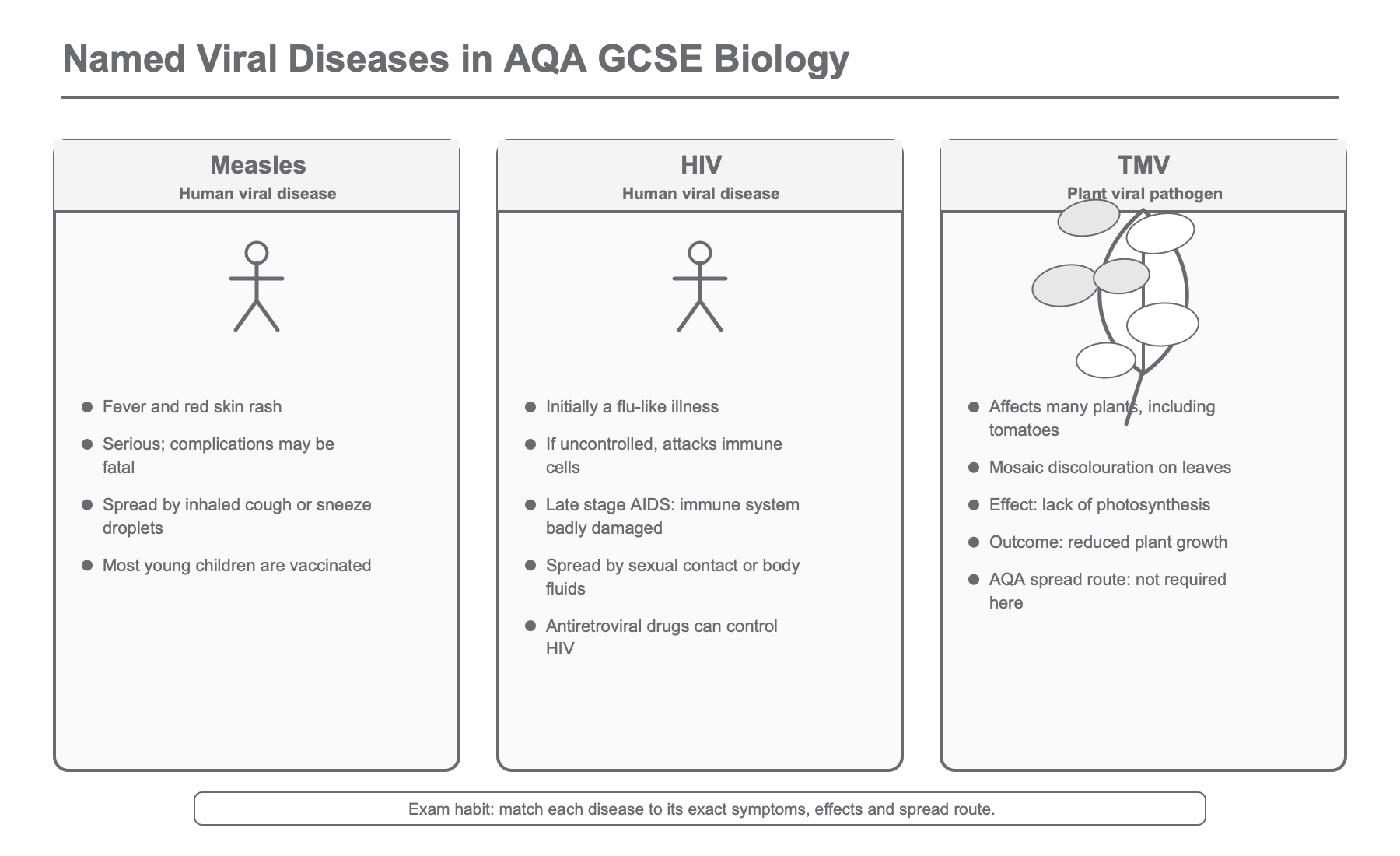
| Measles | Humans | Fever and a red skin rash; serious and sometimes fatal if complications arise | Spread by inhaling droplets from sneezes and coughs; most young children are vaccinated |
| HIV | Humans | Initially flu-like illness; later attacks immune cells if not controlled | Spread by sexual contact or exchange of body fluids such as blood |
| Tobacco mosaic virus, TMV | Plants, including tomatoes | Mosaic leaf discolouration; reduced growth due to lack of photosynthesis | Plant viral pathogen; no spread route is required in this row |
[DIAGRAM: asset_name: viral-disease-comparison - diagram 1; asset_slug: 031_4_3_1_2_viral_diseases_diagram1; file: diagram_assets/imagegen_regen_all/031_4_3_1_2_viral_diseases_diagram1_imagegen.png; recommended_method: codex_image_gen; description: Monochrome three-column comparison diagram for measles, HIV and TMV showing host, key symptoms/effects, spread route and the AQA control or treatment phrase where included.]
Measles
Measles is a viral disease in humans. The AQA symptoms to know are fever and a red skin rash. It is not just a mild rash illness: measles is a serious illness and can be fatal if complications arise.
Measles spreads when an infected person coughs or sneezes. The virus is carried in droplets, and another person may inhale those droplets. In an exam answer, make the route clear: measles is spread by inhalation of droplets from coughs and sneezes.
Most young children are vaccinated against measles because the disease can be serious. This lesson does not need the mechanism of vaccination; the required point here is that vaccination is used against measles because of the risk from the disease.
HIV and AIDS
HIV is a virus that infects humans. It initially causes a flu-like illness, so early symptoms may not look very specific. The important AQA idea is what can happen if HIV is not successfully controlled.
Antiretroviral drugs can control HIV. If HIV is not successfully controlled, the virus attacks the body's immune cells. These cells are needed to deal with infections, so damaging them makes the body less able to defend itself.
AIDS
A late stage of HIV infection when the immune system is so badly damaged that the body can no longer deal with other infections or cancers.
Continue this lesson.
You’re previewing NovaLearn without an account. Create a free account to read the rest.
Create free account