4.7.3.3 - Land Use
Humans need land for homes, roads, materials, food production and waste disposal. The GCSE Biology problem is that land used in these ways is often no longer available as habitat for wild plants and animals. This lesson focuses on the AQA land-use examples and the special case of peat bogs, where habitat loss is also linked to carbon dioxide release.
How humans use land
Land use
Land use means the way humans use an area of land, such as for buildings, quarries, farms or waste disposal.
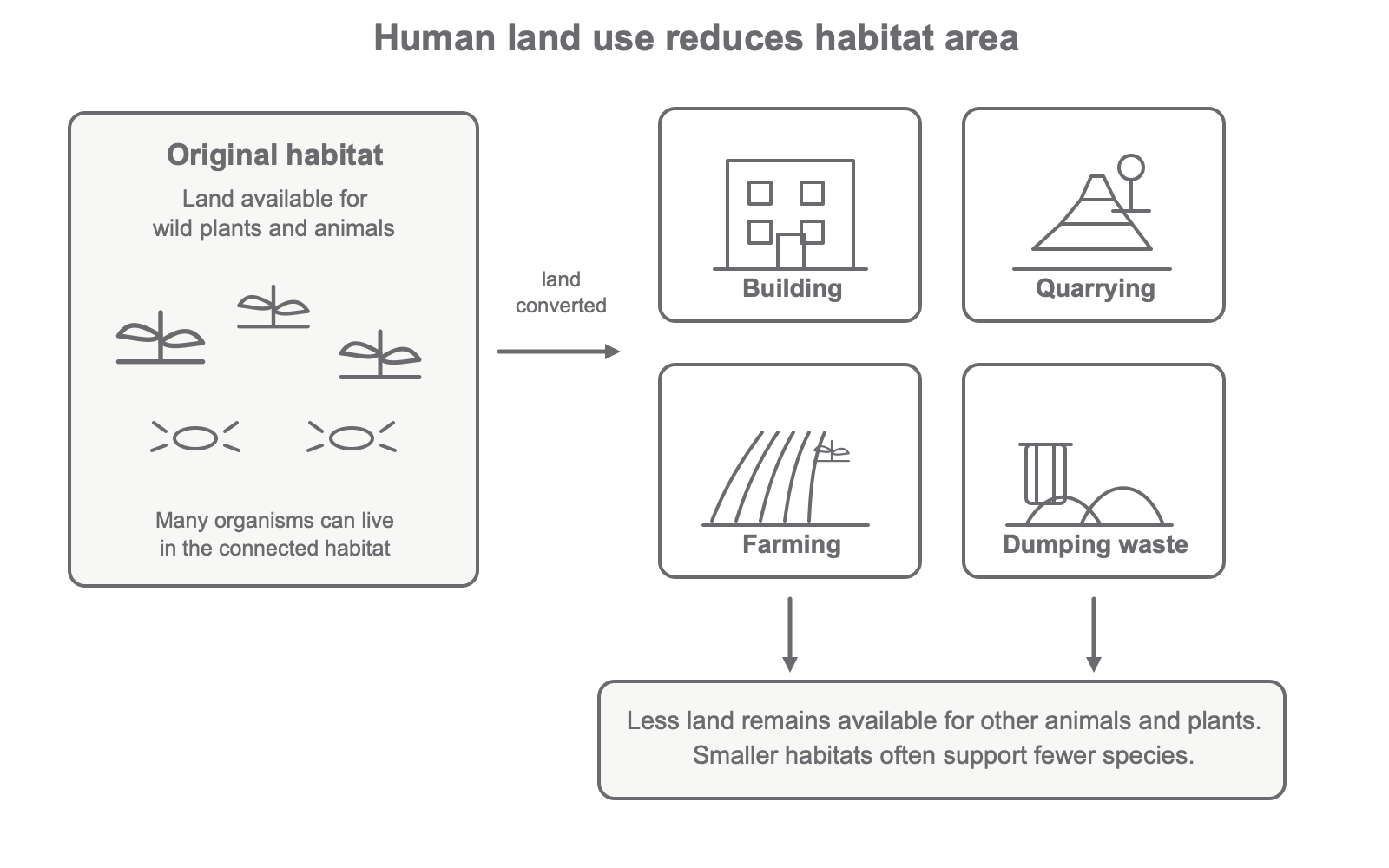
An area of land can provide habitat for wild organisms, or it can be converted for human use. AQA names four examples: building, quarrying, farming and dumping waste. These uses reduce the amount of land available for other animals and plants because the original habitat is removed, covered, dug out, cultivated or occupied by waste.
Building can cover soil with roads and buildings. Quarrying removes rock and soil to obtain useful materials. Farming changes land so crops or livestock are produced. Dumping waste uses land as a place to store unwanted materials, often in landfill sites.
[DIAGRAM: asset_name: Human land use reduces habitat area - diagram 1; asset_slug: 107_4_7_3_3_land_use_diagram1; file: diagram_assets/imagegen_regen_all/107_4_7_3_3_land_use_diagram1_imagegen.png; recommended_method: codex_image_gen; description: Monochrome schematic showing one original habitat being converted into building, quarrying, farming and dumping waste, with the result that less land remains available for other animals and plants.]
Habitat loss and biodiversity
Biodiversity
Biodiversity is the variety of different species of organisms on Earth, or within an ecosystem.
Habitat loss can reduce biodiversity because fewer species have the space, food sources, shelter and physical conditions they need. A small or damaged habitat may support fewer plant species, fewer animal species and fewer microorganism species than the original habitat.
Peat bogs are important examples in this section. A peat bog is a wet habitat with waterlogged peat. It is not just a pile of soil: it is a living ecosystem where particular plants, animals and microorganisms are adapted to the conditions.
Peat
Peat is partly decayed plant material that builds up slowly in waterlogged conditions.
When peat bogs and other areas of peat are destroyed to produce garden compost, the area of this habitat is reduced. That reduces the variety of different plants, animals and microorganisms that live there, so biodiversity falls.
Peat and carbon dioxide
Peat contains carbon from dead plant material. In a healthy peat bog, waterlogged conditions slow decay because there is little oxygen available for decomposers. This means carbon can remain stored in peat for a very long time.
When peat is dug up, drained or dried, more oxygen can reach it. Microorganisms can then decay the peat faster, and this releases carbon dioxide into the atmosphere. If peat is burned, carbon in the peat also reacts with oxygen and forms carbon dioxide.
Carbon dioxide is a greenhouse gas. For this lesson, the key AQA link is simple: decay or burning of peat releases carbon dioxide into the atmosphere. The wider biological consequences of global warming belong to a neighbouring lesson.
Continue this lesson.
You’re previewing NovaLearn without an account. Create a free account to read the rest.
Create free account