4.7.4.1 - Trophic levels
Trophic levels describe the feeding positions of organisms in an ecosystem. This Biology-only lesson focuses on how to number the levels in a food chain, how to name producers and different consumers, and how decomposers feed on dead material. The important exam skill is to use the right name for each position without drifting into pyramids of biomass or biomass-transfer calculations.
Feeding positions
A trophic level is the position of an organism in a food chain. The first trophic level is always the organisms that make their own food. Each later trophic level is one feeding step further along the chain.
Trophic level
The feeding position of an organism in a food chain.
In this lesson, a food chain is a simple sequence showing which organism is eaten by which other organism. For example:
pond algae -> water flea -> small fish -> heron
The arrow means is eaten by, so the pond algae are eaten by the water flea. The water flea is then eaten by the small fish, and the small fish is eaten by the heron.
Do not number trophic levels from the largest organism, the strongest organism or the organism at the top of the chain. Number them by feeding position, starting with the plant or alga at level 1.
Numbered levels
Trophic levels can be represented by numbers. Level 1 contains plants and algae because they make their own food. They are called producers.
Producer
An organism, such as a plant or alga, that makes its own food.
Level 2 contains herbivores that eat plants or algae. These organisms are called primary consumers. The word primary means first, so a primary consumer is the first consumer in the chain.
Level 3 contains carnivores that eat herbivores. These organisms are called secondary consumers. Level 4 contains carnivores that eat other carnivores. These organisms are called tertiary consumers.
[DIAGRAM: asset_name: numbered-trophic-level-food-chain - diagram 1; asset_slug: 111_4_7_4_1_trophic_levels_diagram1; file: diagram_assets/imagegen_regen_all/111_4_7_4_1_trophic_levels_diagram1_imagegen.png; recommended_method: codex_image_gen; description: Monochrome food-chain diagram showing four numbered trophic levels: level 1 pond algae as producer, level 2 water flea as primary consumer/herbivore, level 3 small fish as secondary consumer/carnivore eating herbivores, and level 4 heron as tertiary consumer/carnivore eating carnivores and apex predator for this chain. Arrows labelled "is eaten by".]
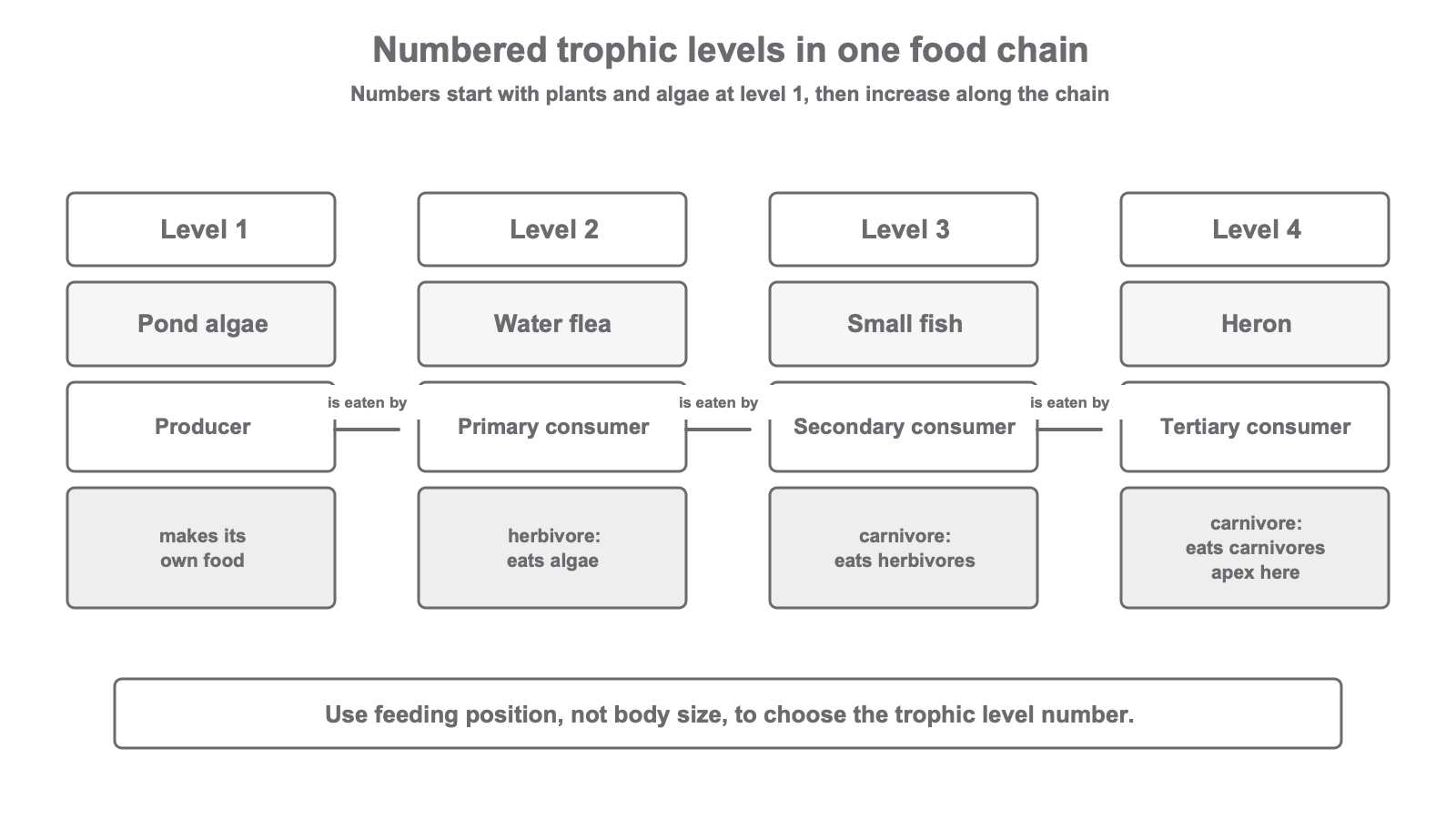
| Trophic level | Organism type | Feeding description |
|---|---|---|
| Level 1 | Producer | Plant or alga makes its own food |
| Level 2 | Primary consumer | Herbivore eats plants or algae |
| Level 3 | Secondary consumer | Carnivore eats herbivores |
| Level 4 | Tertiary consumer | Carnivore eats other carnivores |
The names are not random labels to memorise separately. They describe what the organism eats. If a carnivore eats a herbivore, it is a secondary consumer in that chain. If a carnivore eats another carnivore, it is a tertiary consumer in that chain.
Consumers and apex predators
A consumer is an organism that gets food by eating other organisms. Herbivores are consumers because they eat plants or algae. Carnivores are consumers because they eat animals.
Consumer
An organism that gets food by eating other organisms.
Primary, secondary and tertiary consumers are named from their position after the producer. The producer is not a consumer because it makes its own food.
An apex predator is a carnivore with no predators. It is not defined by being the biggest organism or by having a particular trophic-level number. The key idea is that no other predator normally eats it in that ecosystem.
Apex predator
A carnivore with no predators.
In a four-step chain, the tertiary consumer may also be the apex predator if nothing eats it. In a shorter chain, the top carnivore could still be an apex predator if it has no predators. Always use the food chain information given to you.
Continue this lesson.
You’re previewing NovaLearn without an account. Create a free account to read the rest.
Create free account