4.7.5.3 - Sustainable fisheries
Fish stocks in the oceans are declining, so fisheries need to be managed in a way that lets fish populations keep breeding. This Biology-only lesson focuses on two specified techniques: controlling net size and using fishing quotas. The key idea is simple but important: a fishery is sustainable only if enough fish survive to reproduce and replace the fish that are caught.
Fish stocks and sustainability
A fish stock is the population of a particular fish species in a particular area. It can be measured in different ways, such as the number of fish or the total mass of fish. Fish stocks matter because humans remove fish from those populations for food.
Sustainable fishery
A fishery is sustainable when fish are caught at a rate that still leaves enough fish to breed and replace the fish removed.
For this specification point, the word sustainable is not just a general "good for the environment" label. It means the stock is kept at a level where breeding continues. If too many fish are caught, especially before they reproduce, the stock can fall so low that the species disappears from that area.
This is a local population idea. A species disappearing from one area does not always mean global extinction, but it is still a serious conservation problem because that fish stock may no longer support the ecosystem or the people who depend on it.
Why stocks decline
Fish stocks decline when fish are removed faster than the population can replace them by breeding. This is often called overfishing. The problem is strongest when mature breeding fish are removed in large numbers or when young fish are caught before they have reproduced.
If fewer adult fish survive, fewer eggs are produced. If fewer young fish survive to adulthood, the next generation is smaller. The smaller stock then produces fewer breeding adults again, so the stock can keep falling.
[DIAGRAM: asset_name: sustainable-stock-recovery - diagram 1; asset_slug: 116_4_7_5_3_sustainable_fisheries_diagram1; file: diagram_assets/116_4_7_5_3_sustainable_fisheries_diagram1.png; recommended_method: deterministic_drawn; description: Monochrome graph showing fish stock over time with a dashed breeding level. One line shows uncontrolled overfishing falling below the breeding level; another shows controlled fishing with net-size rules and quotas staying above the breeding level while recovering.]
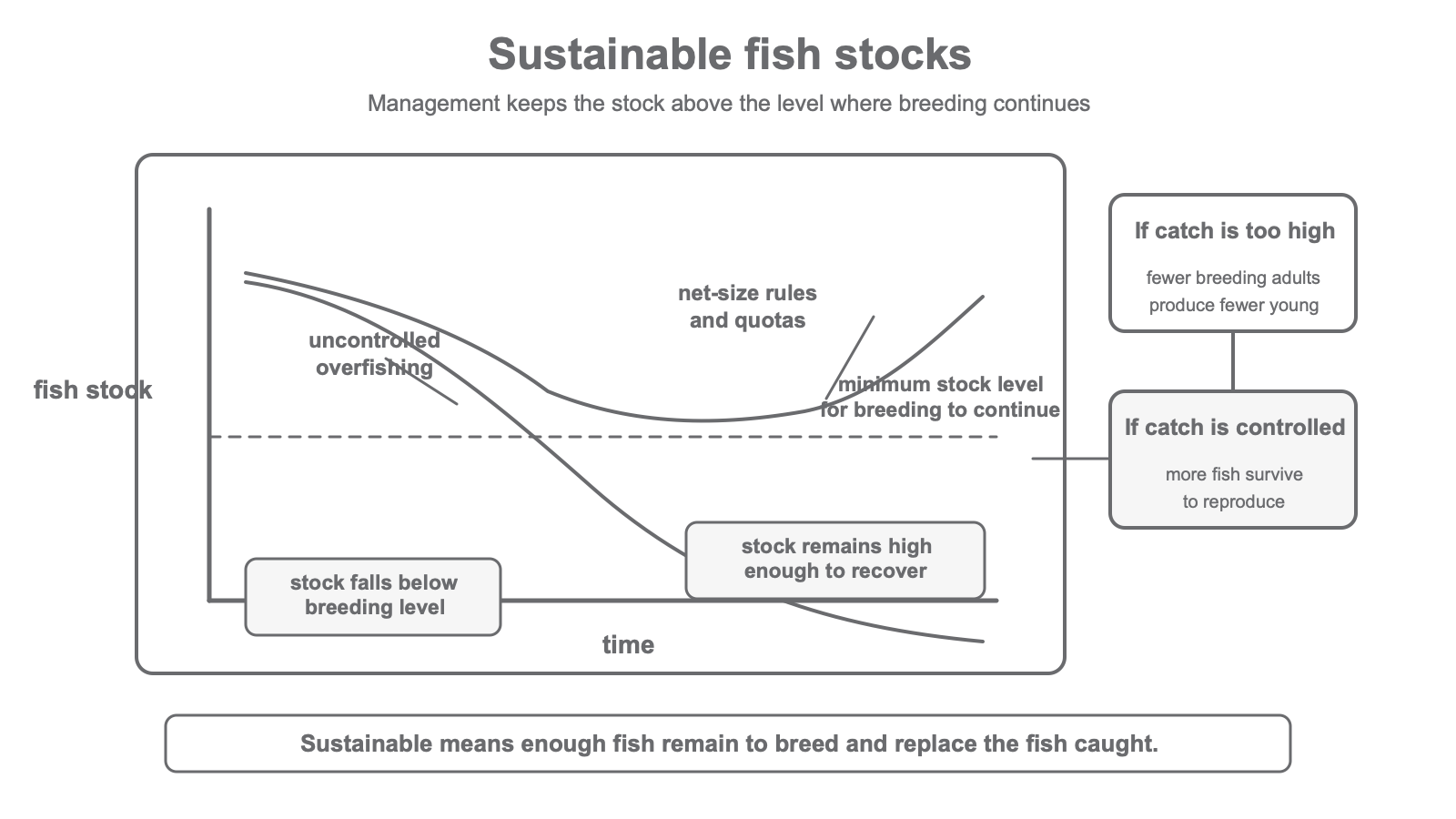
The important GCSE link is between population size and breeding. Management is not just trying to "save fish" in a vague way. It is trying to keep enough breeding individuals in the stock so that recovery can happen.
Net size control
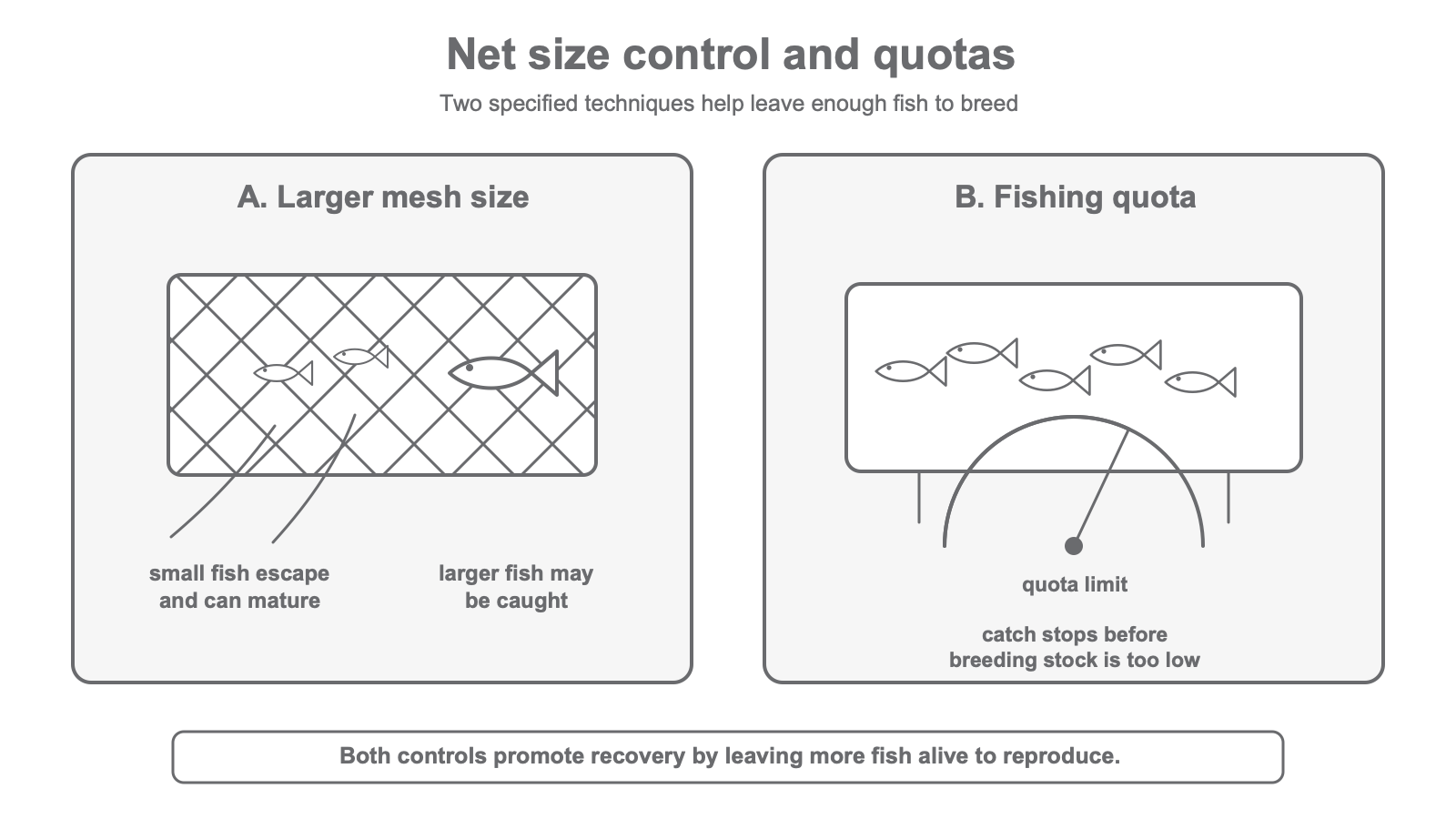
In this topic, control of net size usually means control of mesh size: the size of the holes in the fishing net. If the mesh is too small, very young or small fish can be caught. Many of these fish may not have reproduced yet, so removing them reduces the future breeding population.
Larger mesh lets smaller fish escape. Those fish can continue growing, reach sexual maturity, and reproduce before they are caught later. This helps keep the fish stock at a sustainable level.
[DIAGRAM: asset_name: net-size-and-quota-controls - diagram 2; asset_slug: 116_4_7_5_3_sustainable_fisheries_diagram2; file: diagram_assets/imagegen_regen_all/116_4_7_5_3_sustainable_fisheries_diagram2_imagegen.png; recommended_method: codex_image_gen; description: Monochrome two-panel schematic. Panel A shows a large-mesh net allowing small fish to escape while larger fish are retained. Panel B shows a quota limit stopping catch before all breeding adults are removed.]
Continue this lesson.
You’re previewing NovaLearn without an account. Create a free account to read the rest.
Create free account