4.5.2.3b - Vision Defects And Their Correction
Vision depends on light rays being refracted so that they focus on the retina at the back of the eye. In myopia and hyperopia, the rays do not focus on the retina, so the image is blurred. This lesson is about the two defects, how spectacle lenses correct them, and the other correction technologies named in the AQA Biology specification.
Focus And Refraction
The retina is the light-sensitive layer at the back of the eye. For clear vision, light rays from an object must be refracted so that they focus on the retina.
Refraction
Refraction is the change in direction of light as it passes from one material into another.
The eye refracts light mainly at the cornea and the lens. For this lesson, the important target is the retina: if rays focus in front of the retina or behind it, the person does not see the object clearly.
Vision defect
A problem in which light rays entering the eye do not focus on the retina.
You may already have met accommodation: the way the eye normally changes lens shape for near and distant objects. Here, the question is different: what happens when rays still do not focus on the retina, and how correction lenses fix that?
Myopia: Short Sightedness
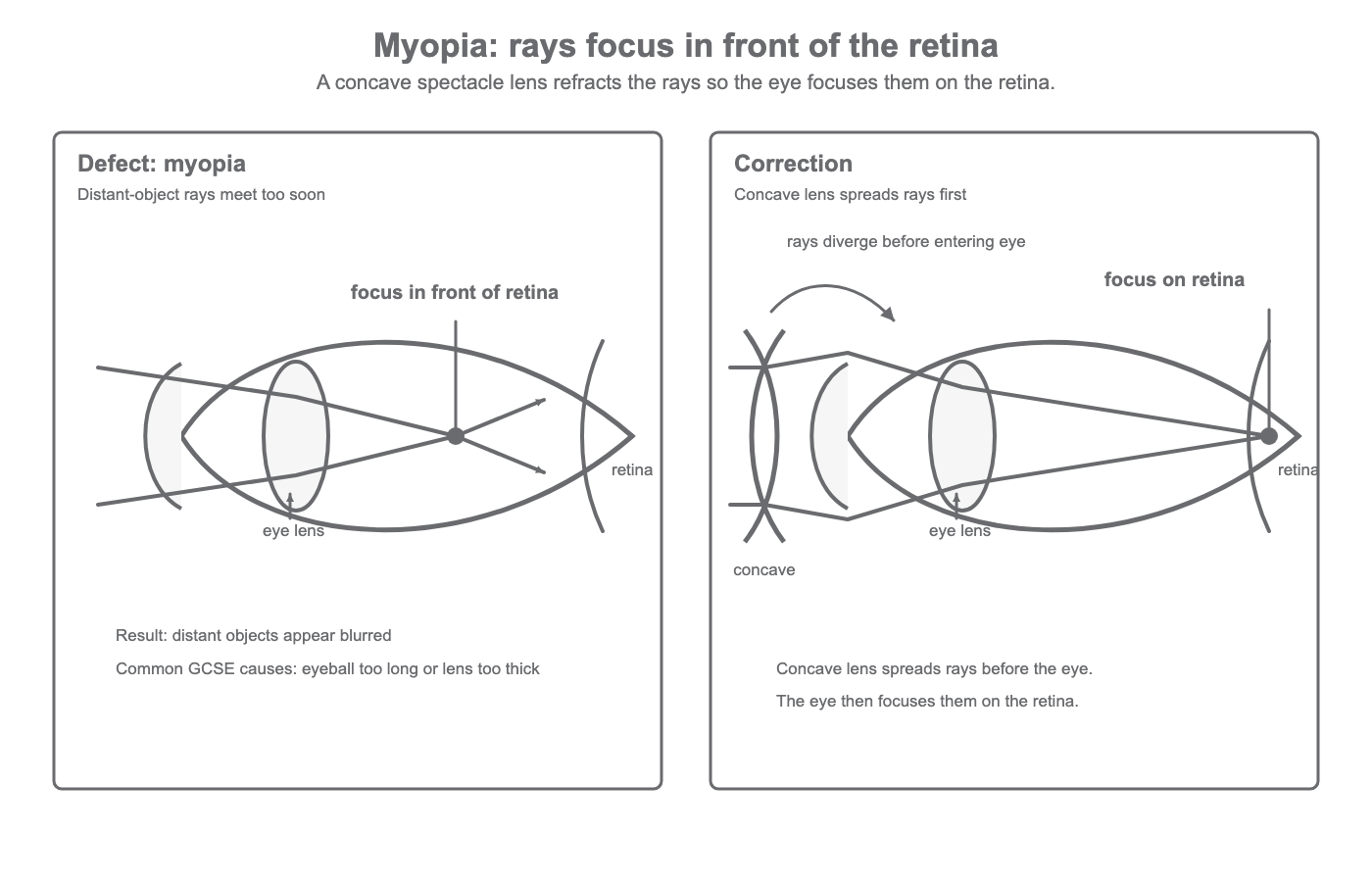
Myopia is short sightedness. A person with myopia can usually see close objects more clearly than distant objects. Distant objects are blurred because light rays focus in front of the retina instead of on it.
This can happen if the eyeball is too long from front to back, or if the eye lens is too thick or refracts light too strongly. In either case, the rays meet too soon.
Myopia
Short sightedness, where light rays focus in front of the retina.
Myopia is usually corrected with a concave spectacle lens. A concave lens is thinner in the middle than at the edges. It refracts the incoming rays so they are spread out slightly before they enter the eye. The eye then brings the rays to a focus further back, on the retina.
[DIAGRAM: asset_name: myopia-and-concave-correction - diagram 1; asset_slug: 056_4_5_2_3b_vision_defects_and_their_correction_diagram1; file: diagram_assets/056_4_5_2_3b_vision_defects_and_their_correction_diagram1.png; recommended_method: deterministic_drawn; description: Monochrome two-panel ray diagram showing myopia with parallel rays focusing in front of the retina, and correction using a concave spectacle lens so the rays focus on the retina.]
Hyperopia: Long Sightedness
Hyperopia is long sightedness. A person with hyperopia usually has more difficulty seeing nearby objects clearly than distant objects. Nearby objects are blurred because light rays would focus behind the retina instead of on it.
This can happen if the eyeball is too short from front to back, or if the eye does not refract the light strongly enough. In either case, the rays have not met by the time they reach the retina.
Hyperopia
Long sightedness, where light rays would focus behind the retina.
Hyperopia is usually corrected with a convex spectacle lens. A convex lens is thicker in the middle than at the edges. It refracts the incoming rays so they start converging before they enter the eye. The eye then brings the rays to a focus sooner, on the retina.
Continue this lesson.
You’re previewing NovaLearn without an account. Create a free account to read the rest.
Create free account