4.3.2.1 - Producing Monoclonal Antibodies
This is Biology-only Higher tier content. A monoclonal antibody is useful because every antibody molecule is the same, so it binds to one specific target. In this lesson the focus is production only: how mouse lymphocytes and tumour cells are used to make hybridoma cells, then how a single hybridoma is cloned to produce and purify large amounts of one antibody.
Monoclonal and specific
An antibody is a protein made by lymphocytes. Antibodies bind to antigens. In this specification point, the important idea is that a monoclonal antibody is not a mixture of different antibodies.
Monoclonal antibody
A monoclonal antibody is an antibody produced from a single clone of cells.
The word mono means one. A clone is a group of genetically identical cells produced from one original cell. So monoclonal antibodies come from one cloned cell line and are identical to each other.
Antigen
An antigen is a molecule, often a protein on the surface of a cell or pathogen, that antibodies can bind to.
A monoclonal antibody is specific to one binding site on one protein antigen. That precise shape match means it can target a specific chemical or specific cells in the body. Do not write only "it is specific" and stop; a stronger answer says what it is specific to.
Stimulating mouse lymphocytes
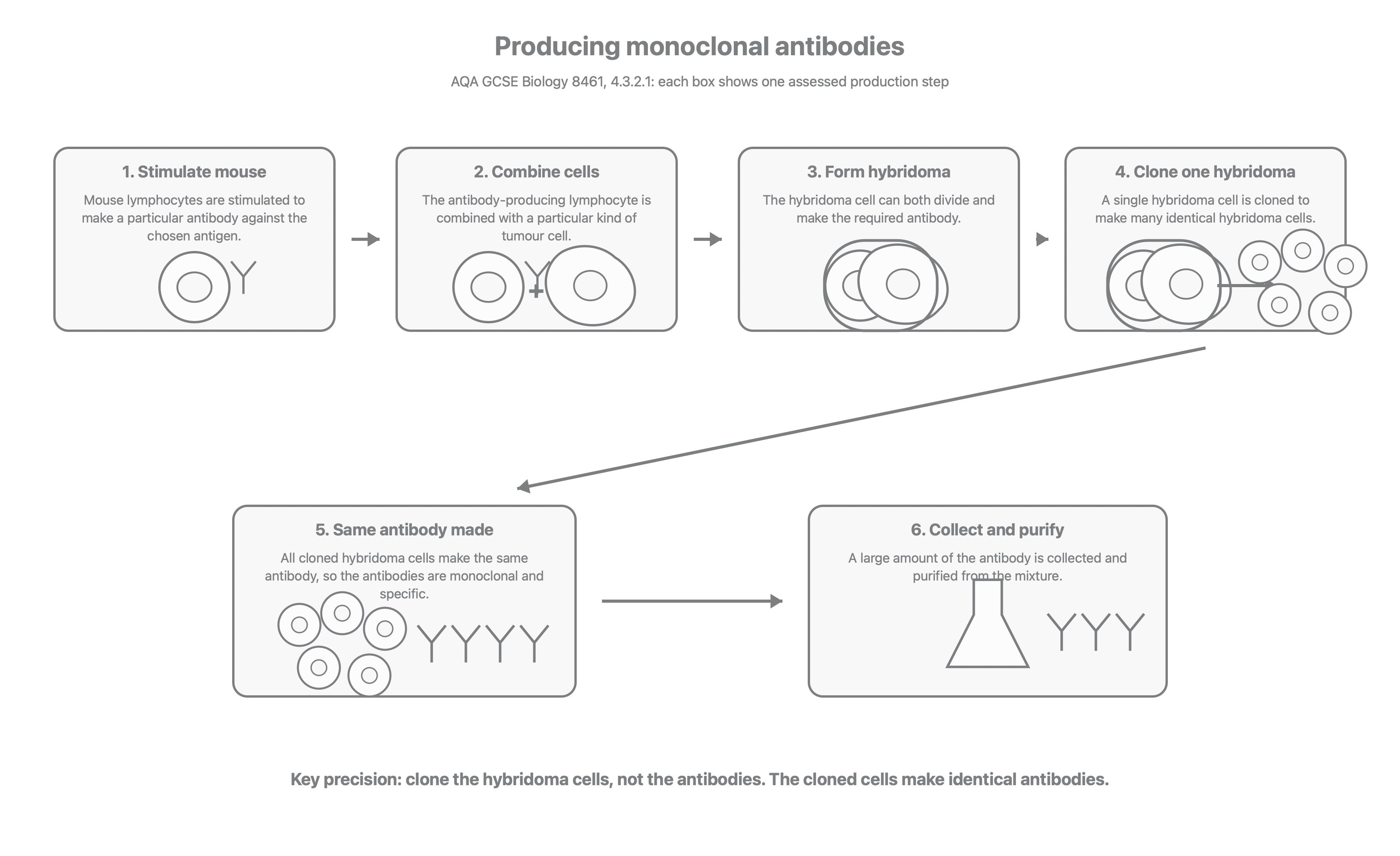
The first production step is to get lymphocytes that make the antibody wanted. A mouse is stimulated so that its lymphocytes make a particular antibody against the chosen antigen. In exam answers this is often described as injecting the chosen antigen or protein into a mouse, then collecting lymphocytes that produce the specific antibody.
A lymphocyte is a type of white blood cell. Here its useful feature is that it can make a particular antibody. Its problem is that lymphocytes do not divide endlessly in culture, so they are not enough on their own for large-scale antibody production.
Keep the target precise. The mouse is not just given "a disease" and the antibodies themselves are not made into hybridomas. The useful cells at this stage are lymphocytes that make the required antibody.
Forming hybridomas
The collected mouse lymphocytes are combined with a particular kind of tumour cell. This makes a hybridoma cell.
Hybridoma cell
A hybridoma cell is made by combining an antibody-producing lymphocyte with a tumour cell.
The hybridoma has the useful features of both starting cells. From the lymphocyte, it can make the required antibody. From the tumour cell, it can divide repeatedly. That combination is the reason hybridomas are used.
If the question asks what cell is formed when a mouse lymphocyte and a tumour cell combine, the answer is hybridoma. If the question asks why that cell is useful, say it can both divide and make the antibody.
[DIAGRAM: asset_name: monoclonal-antibody-production-flow - diagram 1; asset_slug: 039_4_3_2_1_producing_monoclonal_antibodies_diagram1; file: diagram_assets/imagegen_regen_all/039_4_3_2_1_producing_monoclonal_antibodies_diagram1_imagegen.png; recommended_method: codex_image_gen; description: Monochrome flowchart of monoclonal antibody production: stimulate mouse lymphocytes to make a particular antibody, combine lymphocyte with tumour cell, form hybridoma cell, clone a single hybridoma, many identical hybridoma cells make the same antibody, collect and purify the antibody.]
Continue this lesson.
You’re previewing NovaLearn without an account. Create a free account to read the rest.
Create free account