4.7.5.4 - Role of Biotechnology
Biotechnology uses living organisms, cells or biological processes to make useful products. In this biology-only section, AQA wants you to describe and explain how biotechnology and agriculture can help meet the demands of a growing human population. The named examples are mycoprotein from Fusarium, human insulin from a genetically modified bacterium, and GM crops such as golden rice.
Why biotechnology helps
As the human population grows, there is more demand for food, protein and medical products. Traditional farming can meet some of this demand, but it uses land, water, energy and time. Biotechnology can help because microorganisms grow quickly and can be cultured in controlled conditions.
Biotechnology
Biotechnology is the use of living organisms, cells or biological processes to make useful products.
The exam word solution needs careful handling. A biotechnical solution does not mean a perfect answer to every food or health problem. It means a possible way of reducing a demand problem, such as making more protein-rich food, producing a useful medicine, or improving the amount or nutritional value of crops.
AQA's three examples fit this pattern:
| Demand from a growing population | Biotechnology or agricultural solution | What the solution provides |
|---|---|---|
| More protein-rich food | Culture the fungus Fusarium | Mycoprotein for food |
| More reliable medicine supply | Use a genetically modified bacterium | Human insulin for diabetes treatment |
| More food or more nutritious food | Use GM crops | Higher yield or improved nutritional value, such as golden rice |
[DIAGRAM: asset_name: biotechnology-solutions-flow - diagram 1; asset_slug: 117_4_7_5_4_role_of_biotechnology_diagram1; file: diagram_assets/imagegen_regen_all/117_4_7_5_4_role_of_biotechnology_diagram1_imagegen.png; recommended_method: codex_image_gen; description: Monochrome flow diagram linking the demands of a growing human population to three GCSE examples: Fusarium grown on glucose syrup in aerobic conditions to produce harvested and purified mycoprotein, a GM bacterium producing human insulin that is harvested and purified to treat diabetes, and GM crops providing more food or improved nutritional value such as golden rice.]
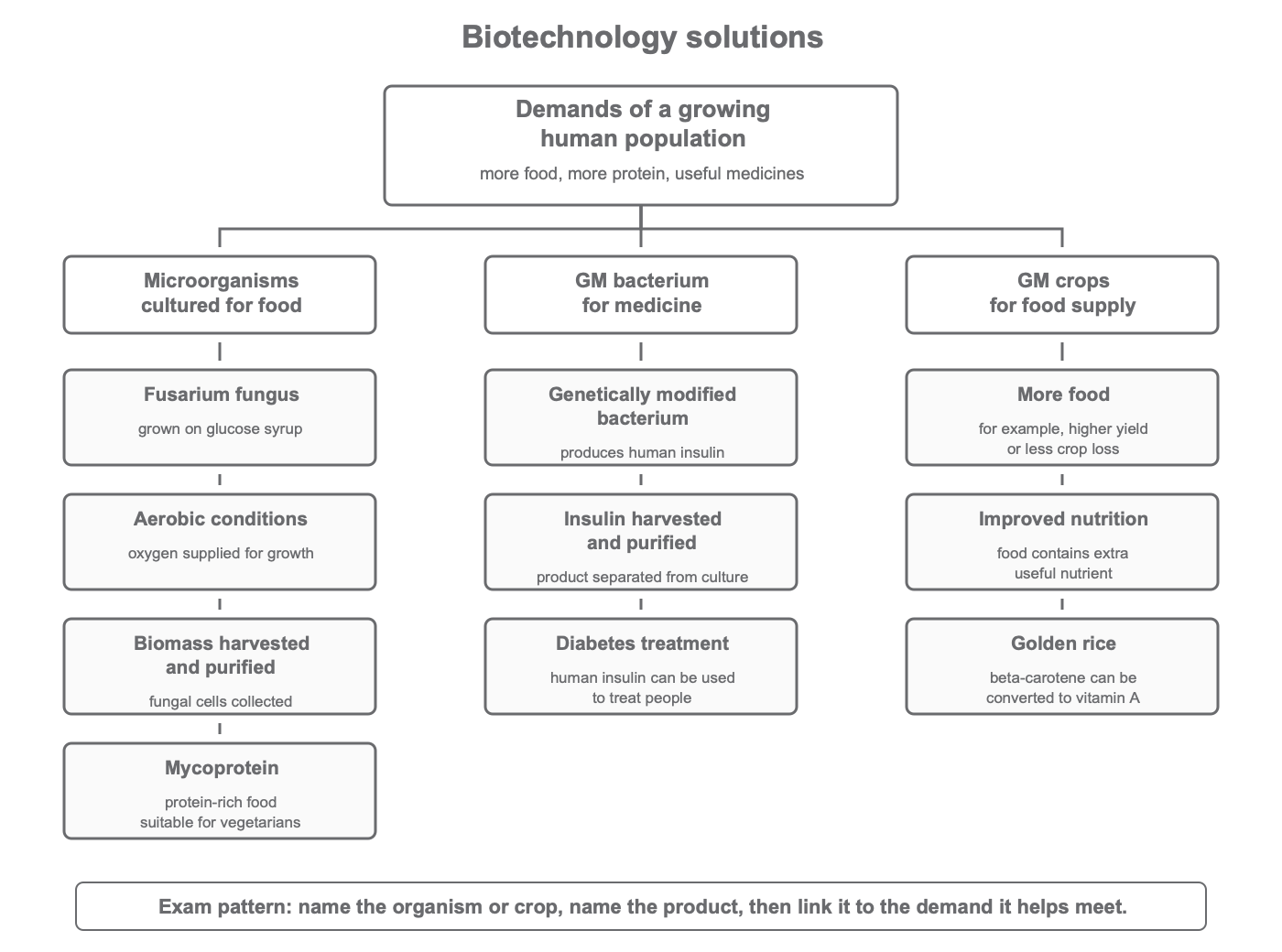
The best answers name the organism or crop, describe what is produced, and explain how that product helps with demand. Vague statements like "biotechnology makes food better" are usually too weak.
Fusarium and mycoprotein
Fusarium is a fungus used to produce mycoprotein. Mycoprotein is a protein-rich food, so it can be useful as an alternative source of dietary protein and is suitable for vegetarians.
Mycoprotein
Mycoprotein is a protein-rich food made from the biomass of a fungus.
The process starts by growing the fungus on glucose syrup. The glucose provides a food source for the fungus. The culture is kept in aerobic conditions, which means oxygen is supplied so the fungus can respire aerobically and grow.
As the fungus grows, it makes more fungal biomass. Biomass means the mass of living material. In this example, the biomass is mainly fungal cells. The biomass is then harvested and purified before being processed into food.
Do not describe mycoprotein as "mushrooms being picked". The GCSE process is controlled culture of a fungus, using glucose syrup and oxygen, followed by harvesting and purification of the fungal biomass.
GM bacteria and insulin
Another biotechnology example is a genetically modified bacterium that produces human insulin. Insulin is a hormone used to treat people with diabetes.
Genetically modified
An organism is genetically modified if its genetic material has been changed, often so that it has a useful characteristic or produces a useful substance.
The detailed genetic-engineering method belongs to the earlier genetics section. For this lesson, the required idea is the application: a bacterium has been genetically modified so that it produces human insulin. The bacteria can be grown in large quantities, and the insulin can then be harvested and purified.
Insulin
Insulin is a hormone that can be used as a medicine to treat people with diabetes.
The insulin example is a medicine-production solution, not a food-production solution. The patient is not genetically modified by taking insulin. The bacterium is genetically modified, the human insulin is collected and purified, and the purified insulin is used as a treatment.
Continue this lesson.
You’re previewing NovaLearn without an account. Create a free account to read the rest.
Create free account