4.7.5.1 - Factors affecting food security
Food security is about whether a population has enough food. This Biology-only topic asks you to describe the main biological and environmental factors that can threaten food security, and to interpret simple population and food production statistics. The important exam skill is linking a factor to its effect on food availability, not just naming a problem.
Meaning of food security
Food security means a population has enough food. A population could be the people in a country, region or the world as a whole.
Food security
Food security is having enough food to feed a population.
Food security is threatened when demand for food increases, when food production decreases, or when food and water cannot reach the people who need them. These three ideas often overlap. For example, a country may produce some food but still have food insecurity if conflict stops people transporting food or if drought reduces water available for crops.
[DIAGRAM: asset_name: food-security-factor-map - diagram 1; asset_slug: 114_4_7_5_1_food_security_factors_diagram1; file: diagram_assets/imagegen_regen_all/114_4_7_5_1_food_security_factors_diagram1_imagegen.png; recommended_method: codex_image_gen; description: Monochrome concept map with central definition "Food security: enough food to feed a population". Surrounding labelled boxes show the AQA factors: increasing birth rate in some countries, changing diets in developed countries and transport of scarce food resources, new pests and pathogens, environmental changes such as failed rains, cost of agricultural inputs, and conflicts affecting water or food availability. Include a final note that sustainable methods are needed. Do not include detailed farming techniques, fisheries management or biotechnology.]
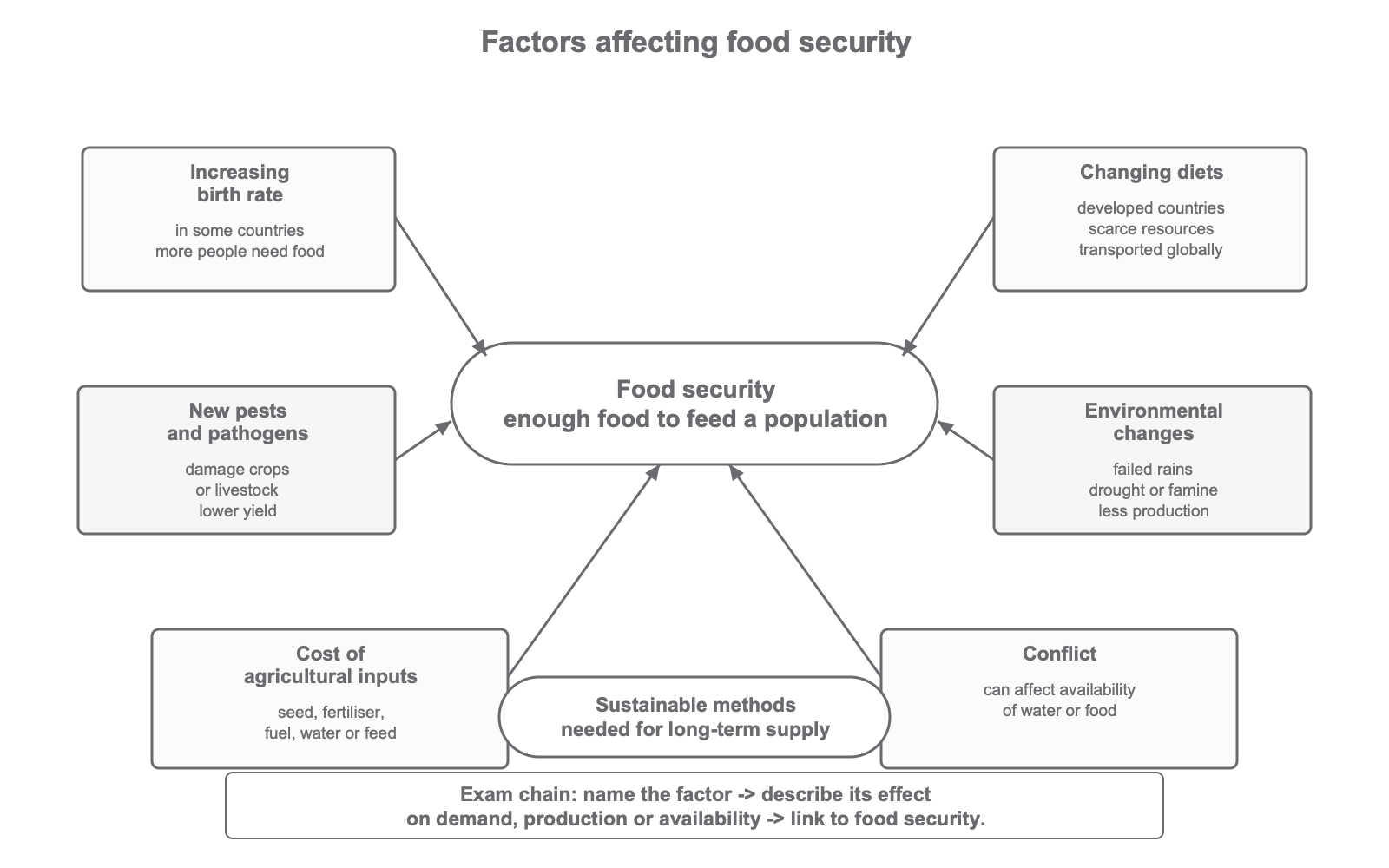
In an answer, avoid writing only "there is not enough food". AQA wants causes. Say which factor is acting and how it changes food demand, production or availability.
Demand from population and diets
One threat to food security is an increasing birth rate in some countries. If more babies are born, the population can grow. A larger population needs more food, so food production has to increase just to keep the same amount of food per person.
This does not mean every country has the same problem. The specification says increasing birth rate has threatened food security in some countries. A strong answer keeps that phrase, because birth rates and food supply differ between countries.
Changing diets in developed countries can also affect food security. Developed countries may demand more foods that use scarce resources, such as animal feed, land, water or food products transported over long distances. Scarce food resources being transported around the world can increase pressure on global food supply, especially if people with less money cannot access the food they need.
The exam link is simple: demand changes. If demand for food rises faster than the food available to a population, food security decreases.
Threats to food production
Food security also depends on how much food farming can produce. New pests and pathogens that affect farming can reduce crop yield or livestock productivity.
A pest is an organism that damages crops, stored food or farm animals. A pathogen is a microorganism or virus that causes disease. If a new pest or pathogen spreads into an area, farmers may lose part of a harvest, animals may grow more slowly, or more food may be unsafe to use.
Environmental changes can also reduce production. AQA gives the example of widespread famine occurring in some countries if rains fail. Failed rains can cause drought, so crops have too little water for photosynthesis and growth. Other environmental changes, such as flooding, temperature changes or damaged soil, can also reduce the amount of food produced.
Do not drift into detailed farming solutions here. The point for this lesson is the threat: pests, pathogens and environmental changes can lower food production, which means less food is available for the population.
Inputs, conflict and availability
Agricultural inputs are the resources farmers need to produce food. They can include seed, fertiliser, pesticides, animal feed, fuel, machinery, labour and water for irrigation. If the cost of agricultural inputs rises, farmers may not be able to buy enough of them.
Lower use of inputs can reduce food production. For example, if farmers cannot afford fertiliser, crop growth may be limited by mineral ion supply. If fuel or transport costs rise, food may also become more expensive to move to markets.
Continue this lesson.
You’re previewing NovaLearn without an account. Create a free account to read the rest.
Create free account