4.6.2.2 - Evolution
Evolution is a change in the inherited characteristics of a population over time. In AQA GCSE Biology, you explain this mainly through natural selection: variants with phenotypes better suited to their environment are more likely to survive, reproduce and pass on inherited characteristics. This lesson keeps to that mechanism and the limited new-species endpoint in the specification.
Inherited population change
Evolution happens to populations, not to single organisms. An individual organism can grow, learn or be damaged during its lifetime, but the population evolves only when inherited characteristics become more or less common over generations.
Evolution
Evolution is a change in the inherited characteristics of a population over time through natural selection.
A population is a group of organisms of the same species living in the same area. An inherited characteristic is a characteristic passed from parents to offspring in genetic information. Characteristics acquired during life, such as a scar or extra muscle from training, are not inherited characteristics in this GCSE explanation.
The word over time matters. Natural selection may affect which individuals survive in one generation, but evolution is seen as the inherited characteristics of the population changing across generations.
Theory and time scale
The theory of evolution by natural selection states that all species of living things have evolved from simple life forms. AQA gives the time scale as simple life forms that first developed more than three billion years ago.
This does not mean that each species turns into another species in a straight line. It means that, over very long periods of time, populations can change as inherited characteristics are selected in different environments. Many changes are small from one generation to the next, but the cumulative effect across many generations can be large.
The word theory in science does not mean a guess. It means a well-developed scientific explanation. In this lesson, the assessable explanation is the mechanism of natural selection.
Natural selection process
Natural selection begins with variation in a population. Different individuals may have different variants, meaning forms of a characteristic. These variants can give rise to different phenotypes, which are the observable characteristics of organisms.
Phenotype
The phenotype is the observable characteristics of an organism, produced by its genetic information and its environment.
In a particular environment, some phenotypes may be better suited than others. For example, a phenotype might help an organism avoid predators, compete for food, survive disease, tolerate temperature change or reproduce successfully. A better-suited phenotype does not make an organism perfect; it increases the chance that the organism survives and reproduces in that environment.
If the useful characteristic is inherited, the organisms with that phenotype are more likely to pass it to their offspring. Over generations, the inherited characteristic becomes more common in the population. That population has evolved because its inherited characteristics have changed over time.
[DIAGRAM: asset_name: evolution-by-natural-selection-flow - diagram 1; asset_slug: 081_4_6_2_2_evolution_diagram1; file: diagram_assets/imagegen_regen_all/081_4_6_2_2_evolution_diagram1_imagegen.png; recommended_method: codex_image_gen; description: Monochrome flow diagram showing inherited variation and variants in a population leading to different phenotypes, environmental selection, better-suited phenotypes surviving and reproducing more, inherited characteristics becoming more common over generations, and the population evolving. Include the required endpoint that if two populations become so different in phenotype that they can no longer interbreed to produce fertile offspring, two new species have formed. Keep to the natural selection mechanism and fertile-offspring endpoint only.]
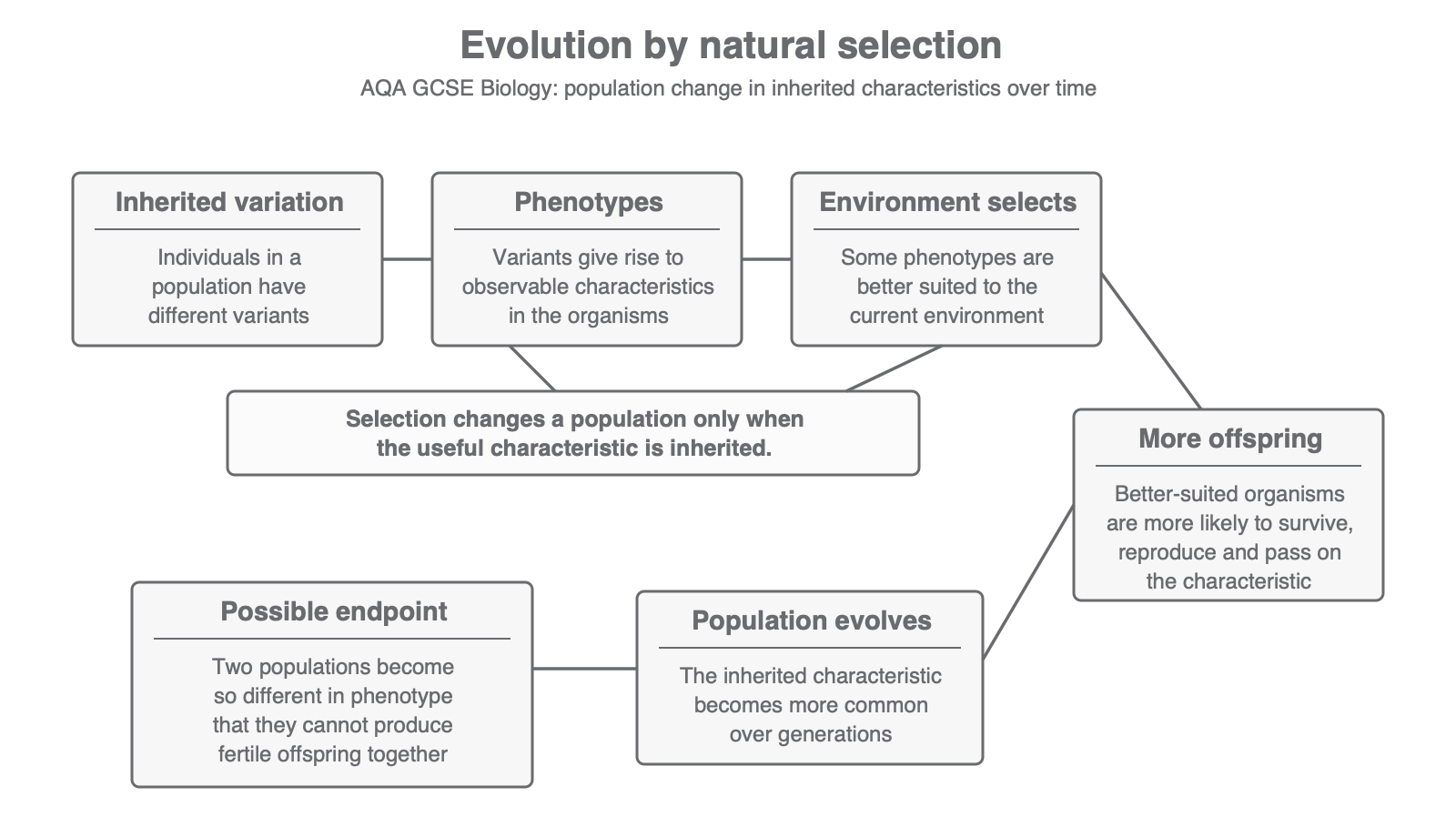
The key link is not just survival. For natural selection to change a population, better-suited organisms must also reproduce and pass the inherited characteristic to offspring.
After your explanation, check that it includes both parts: the environment selects between existing variants, and inheritance passes useful characteristics to the next generation.
Continue this lesson.
You’re previewing NovaLearn without an account. Create a free account to read the rest.
Create free account