4.7.1.4 - Adaptations
Organisms survive in different natural environments because they have features called adaptations. In this lesson, the important skill is not memorising a long list of animals and plants; it is explaining how a feature helps survival in a particular set of conditions. AQA can give you information about an organism and ask you to use it, so your answer needs a clear link between the environment, the adaptation and the survival advantage.
What adaptations do
An adaptation is a feature that helps an organism survive in the conditions in which it normally lives. The feature only counts as useful because of the environment. Thick fur may help in a cold environment, but the same feature would not be helpful for an animal trying to lose heat in a hot desert.
Adaptation
An adaptation is a feature that enables an organism to survive in the conditions in which it normally lives.
Good adaptation answers usually follow a chain:
- State the environmental condition.
- Name or describe the feature.
- Explain the effect of the feature.
- Link that effect to survival.
[DIAGRAM: asset_name: adaptation-explanation-chain: Explaining how an adaptation helps survival - diagram 1; asset_slug: 098_4_7_1_4_adaptations_diagram1; file: diagram_assets/imagegen_regen_all/098_4_7_1_4_adaptations_diagram1_imagegen.png; recommended_method: codex_image_gen; description: Monochrome flow diagram showing the GCSE explanation chain from environmental condition to adaptation to effect to survival advantage, with a short desert example and no natural-selection mechanism.]
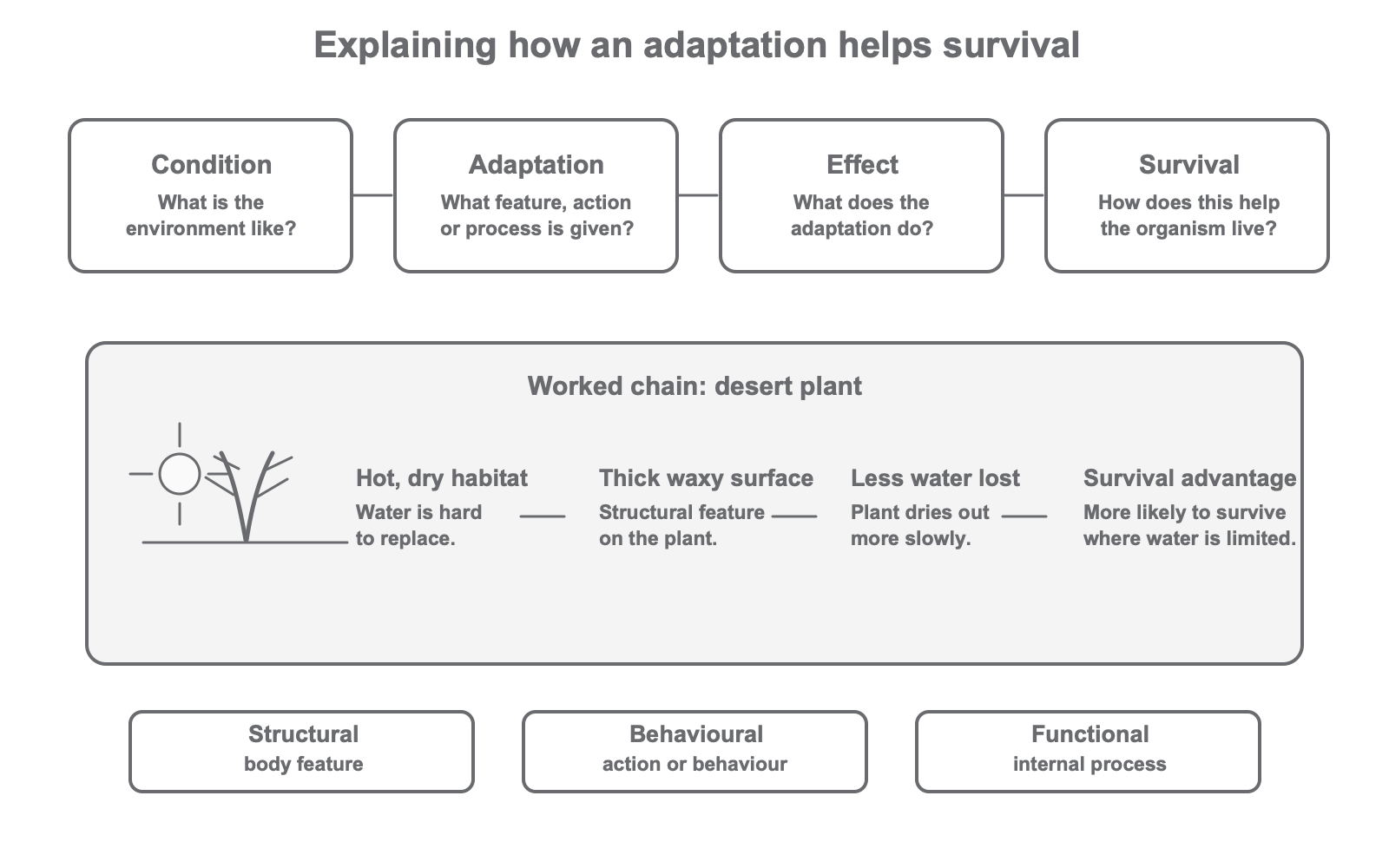
For example: in a hot dry habitat, a plant with a thick waxy covering loses less water from its surface. This helps it survive because it is less likely to dry out.
Three types of adaptation
AQA groups adaptations into three types: structural, behavioural and functional. The type matters because it helps you describe the feature precisely.
A structural adaptation is a body feature. Examples include body shape, a covering, roots, leaves, ears, teeth, fur, blubber or a beak. If you can point to the physical part or shape, it is usually structural.
Structural adaptation
A structural adaptation is a physical feature of an organism's body.
A behavioural adaptation is something an organism does. Migration, hiding, basking in the sun, being active at night, huddling together or opening flowers at a particular time are behaviours.
Behavioural adaptation
A behavioural adaptation is a way an organism acts that helps it survive.
A functional adaptation is a process inside the organism. These are sometimes called physiological adaptations. Examples include making concentrated urine to reduce water loss, producing venom, or having cell processes that continue to work in extreme conditions.
Functional adaptation
A functional adaptation is an internal process that helps an organism survive.
The same organism can have more than one type of adaptation. A desert animal might have large ears as a structural adaptation, be active at night as a behavioural adaptation, and produce very concentrated urine as a functional adaptation.
Using given information
The specification says students should explain adaptations given appropriate information. That means a question may describe an unfamiliar organism, then expect you to use the information rather than rely on a memorised example.
Look for clues about the environment first. Is it hot, cold, dry, salty, dark, high pressure, low in food, full of predators, or competitive? Then link a named feature to that condition.
Avoid answers that only repeat the feature. "The animal has large ears because it is adapted" does not explain anything. A stronger answer says what the large ears do, such as increasing the surface area for heat loss, and why that helps in a hot environment.
Continue this lesson.
You’re previewing NovaLearn without an account. Create a free account to read the rest.
Create free account