4.4.1.2b - Required Practical - Light Intensity and Photosynthesis
In this required practical, you investigate how light intensity affects the rate of photosynthesis in an aquatic plant such as pondweed. The plant produces oxygen during photosynthesis, so the rate can be estimated by counting oxygen bubbles or measured more directly by collecting the volume of gas produced in a fixed time. The exam focus is practical precision: method, variables, rate calculations, repeats, graphs and valid conclusions from data.
Aim and rate
The aim is to investigate the effect of light intensity on the rate of photosynthesis using an aquatic organism such as pondweed. Pondweed is useful because oxygen produced during photosynthesis leaves the plant as visible bubbles in water.
Rate of photosynthesis
The amount of photosynthesis happening per unit time. In this practical it is estimated from oxygen produced per unit time.
You are not measuring glucose directly. You are using oxygen production as evidence for photosynthesis because oxygen is one of the products of the reaction. A faster rate of oxygen production means a faster rate of photosynthesis in the pondweed.
The dependent variable can be recorded as:
- number of oxygen bubbles produced per minute
- volume of oxygen gas collected per minute, for example in
cm^3 min^-1
Bubble counting is easy, but bubbles may not all be the same size. Measuring gas volume is usually a better measure of the amount of oxygen, although it can be harder to collect enough gas in a short lesson.
Apparatus and method
[DIAGRAM: asset_name: pondweed-light-intensity-apparatus - diagram 1; asset_slug: 045_4_4_1_2b_required_practical_6_light_intensity_and_photosynthesis_diagram1; file: diagram_assets/imagegen_regen_all/045_4_4_1_2b_required_practical_6_light_intensity_and_photosynthesis_diagram1_imagegen.png; recommended_method: codex_image_gen; description: Monochrome labelled apparatus layout for Required Practical 6 showing a lamp at measured distances from pondweed in sodium hydrogencarbonate solution, beaker of water as heat shield/water bath, thermometer, ruler, stopwatch, oxygen bubbles from the cut end, and a small alternative gas-volume collection inset with funnel and measuring cylinder.]
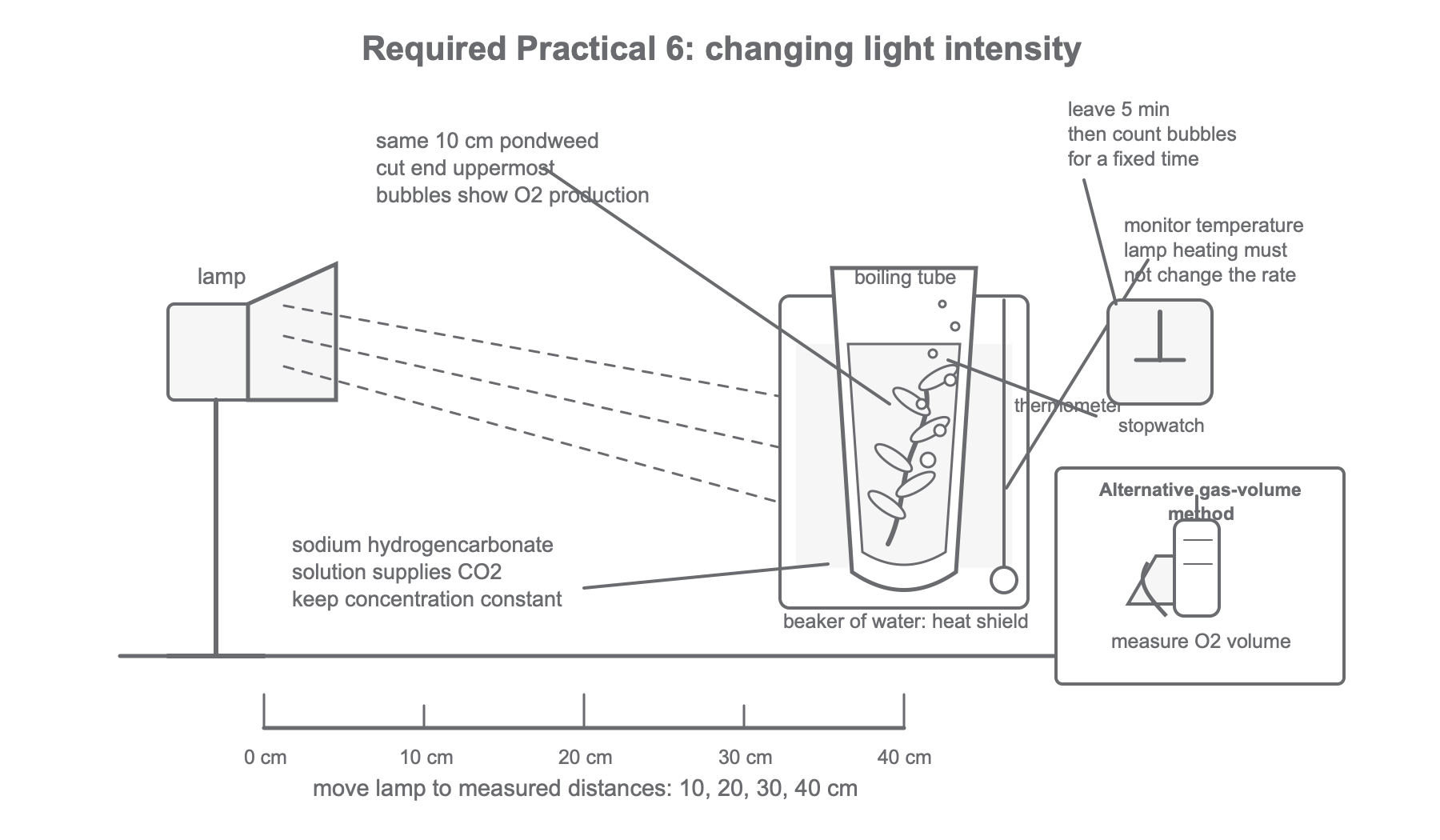
A common bubble-count method is:
- Place a freshly cut piece of pondweed in sodium hydrogencarbonate solution in a boiling tube or beaker.
- Put the cut end of the pondweed uppermost so bubbles can leave clearly.
- Put the tube or beaker in a larger beaker of water and use a thermometer to monitor the temperature.
- Place a lamp at a measured distance from the pondweed, for example
10 cm. - Leave the apparatus for about
5 minutesso the pondweed adjusts to that light intensity. - Count the oxygen bubbles produced in a fixed time, for example
1 minute. - Repeat the bubble count at the same distance, calculate a mean, then move the lamp to other distances such as
20 cm,30 cmand40 cm.
Sodium hydrogencarbonate solution provides carbon dioxide. This helps keep carbon dioxide concentration high enough that light intensity is the factor being tested.
An alternative method collects the oxygen gas. Put pondweed under an inverted funnel in a beaker of water and collect the gas in a water-filled measuring cylinder or gas syringe. The dependent variable is then volume of oxygen produced per unit time, for example cm^3 min^-1. This is often more valid than counting bubbles because it measures gas volume rather than assuming all bubbles are equal.
Variables, validity and safety
The independent variable is light intensity. In a school lab, light intensity is usually changed by changing the distance between the lamp and the pondweed. The dependent variable is the rate of oxygen production.
Control variables are important because photosynthesis is affected by more than light intensity. Keep these the same as far as possible:
- temperature of the water
- carbon dioxide concentration, using the same sodium hydrogencarbonate solution
- length, species and condition of the pondweed
- time allowed before counting and time spent counting
- lamp type and background light
- volume of solution and position of the pondweed
The beaker of water around the tube can act as a heat shield, and the thermometer checks that the lamp is not warming the water. If the temperature rises, the rate may change because of temperature rather than light intensity, making the investigation less valid.
Repeats improve reliability. At each distance or light intensity, take several readings, identify any anomalous result that does not fit the pattern, and calculate a mean from the reliable readings.
Safety and ethics matter because this practical uses water, electricity, glassware and living pondweed. Keep water away from electrical supplies, let hot lamps cool before moving them, handle glassware carefully, and dispose of pondweed according to local instructions rather than releasing it into the environment.
That is the logic of validity: change only the independent variable, then measure the effect on the dependent variable.
Continue this lesson.
You’re previewing NovaLearn without an account. Create a free account to read the rest.
Create free account