4.7.4.3 - Transfer of Biomass
Biomass is transferred along a food chain when one organism eats another, but most of the biomass at one trophic level is not passed to the next. This biology-only lesson explains why pyramids of biomass get smaller higher up the food chain, how biomass is lost, and how to calculate transfer efficiency using percentages or fractions of mass.
Biomass and pyramids
Biomass is the mass of biological material in organisms. In food-chain questions, it usually means the total mass of organisms at one trophic level, not the mass of one individual organism.
Biomass
Biomass is the mass of living biological material in an organism or group of organisms.
A pyramid of biomass represents the relative amount of biomass at each trophic level in a food chain. Trophic level 1, the producers, is at the bottom. Higher levels are stacked above it.
In this lesson, a useful example is:
grass -> rabbits -> foxes
The grass is the producer level. The rabbits are primary consumers because they eat the producer. The foxes are secondary consumers because they eat the primary consumers. A pyramid of biomass for this chain normally has the widest bar for the grass, a narrower bar for the rabbits, and an even narrower bar for the foxes.
[DIAGRAM: asset_name: biomass-transfer-pyramid - diagram 1; asset_slug: 113_4_7_4_3_transfer_of_biomass_diagram1; file: diagram_assets/113_4_7_4_3_transfer_of_biomass_diagram1.png; recommended_method: deterministic_drawn; description: Monochrome pyramid of biomass for a four-level food chain. Show producers at trophic level 1 as the widest bottom bar, then primary consumers, secondary consumers and tertiary consumers as progressively smaller bars. Include example masses 1000 kg, 100 kg, 10 kg and 1 kg, arrows labelled approximately 10 percent transfer between levels, and a note that producers transfer about 1 percent of incident light energy for photosynthesis. Keep the visual to biomass transfer and pyramid description only.]
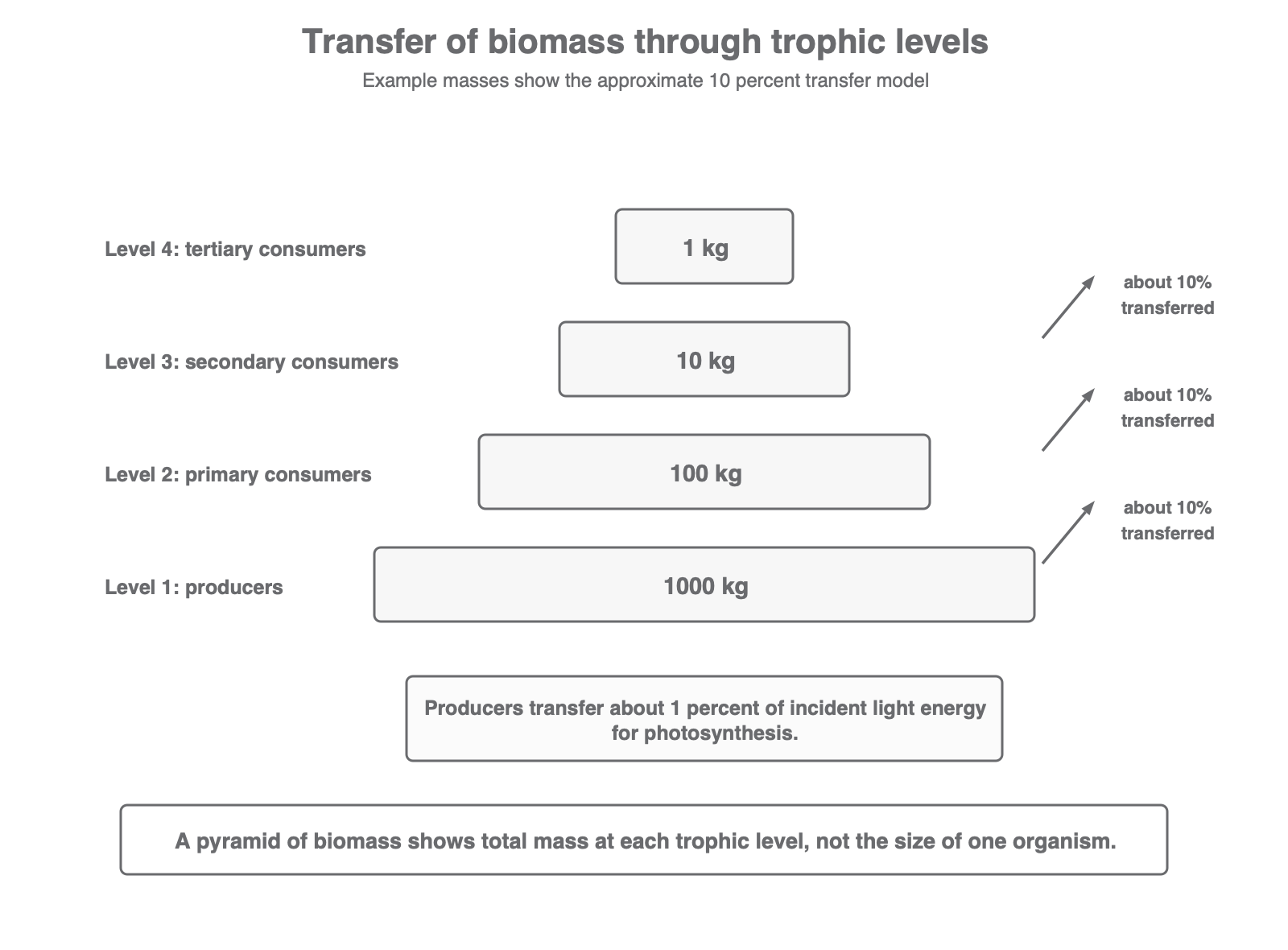
Do not confuse a pyramid of biomass with a pyramid of numbers. A pyramid of biomass is about total mass at each trophic level. One fox may have a greater mass than one rabbit, but the total biomass of all the rabbits in the ecosystem is usually greater than the total biomass of the foxes.
Biomass transfer between levels
Producers are mostly plants and algae. They use photosynthesis to transfer energy from light into glucose and then into biomass. AQA gives the approximate figure that producers transfer about 1% of the incident energy from light for photosynthesis.
Only about 10% of the biomass from each trophic level is transferred to the trophic level above it. This means that if the producer level has 1000 kg of biomass, about 100 kg is transferred into primary consumer biomass. About 10 kg may then be transferred into secondary consumer biomass.
The word approximately matters. Real ecosystems vary, but GCSE Biology questions often use the idea that transfer is low and often close to 10%. The reason is that most biomass is not turned into new biomass in the next consumer.
Most biomass at one trophic level is not transferred to the next; about 10% is transferred on average in the AQA GCSE model.
Use transfer language carefully. Biomass is not "created" by consumers when they eat. Consumers digest food, absorb useful molecules, use much of that material in respiration and other life processes, and only some becomes new biomass in their bodies.
Why biomass is lost
Biomass is lost between trophic levels because not all the material that is eaten becomes new biomass in the consumer.
[DIAGRAM: asset_name: biomass-loss-pathways - diagram 2; asset_slug: 113_4_7_4_3_transfer_of_biomass_diagram2; file: diagram_assets/113_4_7_4_3_transfer_of_biomass_diagram2.png; recommended_method: deterministic_drawn; description: Monochrome flow diagram showing ingested biomass entering a consumer. One branch shows not absorbed material being egested as faeces. A second branch shows absorbed material being used in respiration, producing carbon dioxide and water, and some absorbed material leaving as water and urea in urine. A small branch shows the remaining absorbed material becoming new consumer biomass available to the next trophic level. Include a note that large amounts of glucose are used in respiration.]
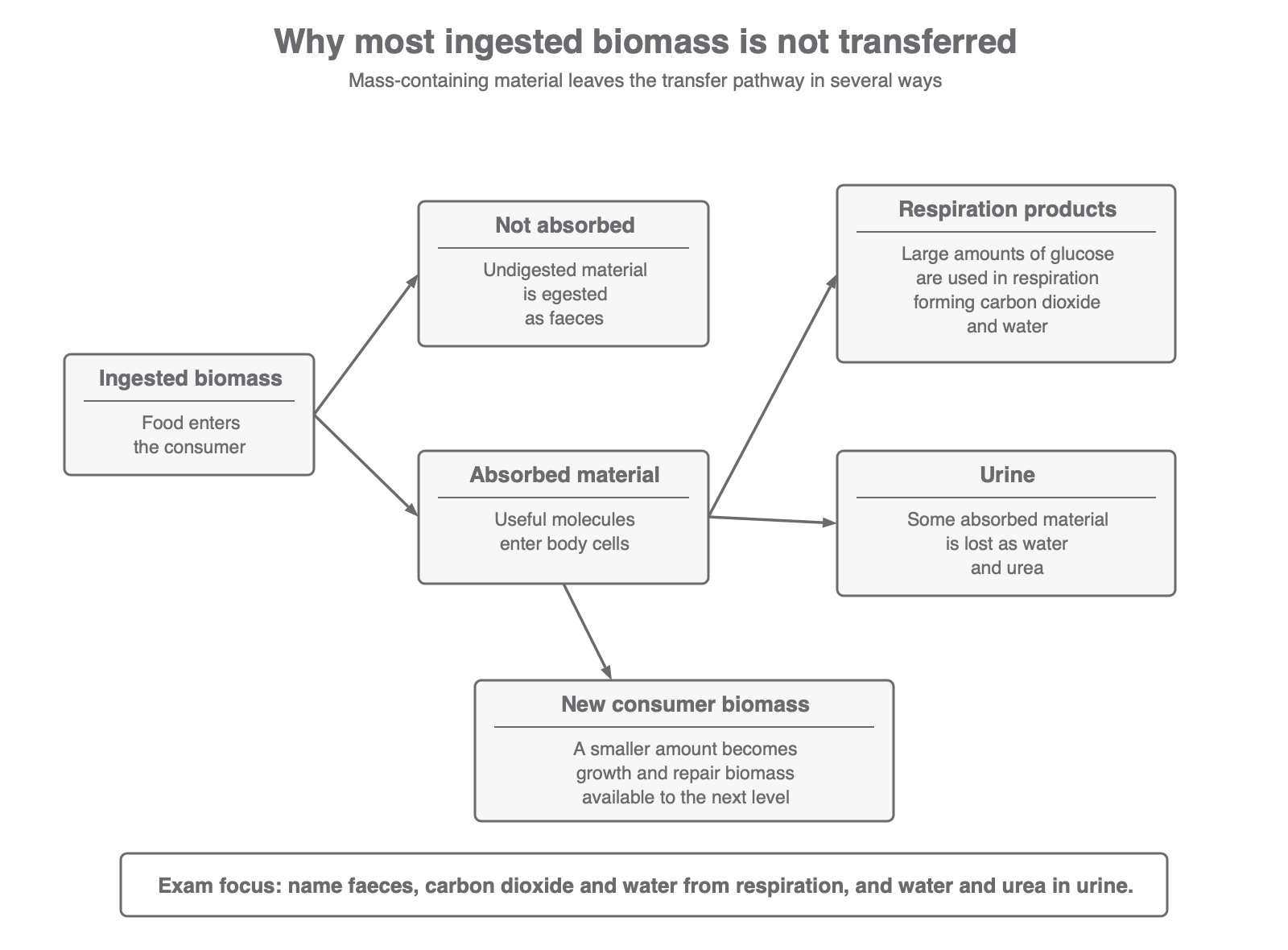
There are two main AQA loss routes to name.
First, not all ingested material is absorbed. Material that passes through the digestive system without being absorbed is egested as faeces. Egestion is not the same as excretion: faeces are material that was not absorbed into the body.
Egestion
Egestion is the removal of undigested, unabsorbed material from the digestive system as faeces.
Second, some absorbed material is lost as waste. Large amounts of glucose are used in respiration. Respiration transfers energy for life processes, but it also produces carbon dioxide and water, so carbon-containing biomass leaves the organism as waste products. Water and urea are also lost in urine.
Excretion
Excretion is the removal of waste products made by the body, such as carbon dioxide, water and urea.
This is a common exam trap. If a question asks how biomass is lost, a vague answer such as "energy is lost" is usually not enough. Name the route or waste product: faeces, carbon dioxide and water from respiration, or water and urea in urine.
After your explanation, check that you have talked about biomass or mass-containing substances, not just "energy disappearing".
Continue this lesson.
You’re previewing NovaLearn without an account. Create a free account to read the rest.
Create free account