4.7.2.3a - Decomposition and Decay Factors
Decomposition is the breakdown of biological material such as dead organisms, fallen leaves and waste. In AQA GCSE Biology, this Biology-only lesson focuses on how microorganisms carry out decay and how temperature, water and oxygen availability change the rate of decay. It also shows how to calculate and interpret simple rate changes using generic decay data.
Microorganisms and decay
Decay and decomposition both mean the breakdown of biological material. The most important decomposers in this lesson are microorganisms, especially bacteria and fungi.
Decomposition
The breakdown of biological material, such as dead organisms and waste, by decomposers.
Microorganisms do not simply "eat" dead material in the way an animal does. Bacteria and fungi release enzymes onto the biological material. The enzymes digest large biological molecules into smaller soluble substances, which can then be absorbed by the microorganisms and used in growth and respiration.
This matters in an ecosystem because useful materials are not locked away forever in dead organisms and waste. At this lesson's level, the key exam phrase is that microorganisms decay biological material and return substances such as carbon dioxide and mineral ions to the environment.
Temperature and decay rate
Temperature affects decay because microorganisms and their enzymes work at different speeds at different temperatures. At low temperatures, enzyme-controlled reactions are slower and microorganisms are less active, so biological material decays slowly.
As temperature rises towards a suitable optimum, enzyme reactions happen faster and microorganisms can grow and reproduce more quickly. This usually increases the rate of decay. If the temperature becomes too high, enzymes can denature and microorganisms may die, so decay slows or stops.
The best GCSE answer is not just "hotter means faster". A stronger answer says "higher temperature increases decay up to an optimum, but very high temperature reduces decay because enzymes denature or microorganisms are killed."
Water, oxygen and decay
Water is needed for decay because microorganisms need water to survive and because enzyme digestion works best in moist conditions. If biological material is too dry, enzymes cannot digest it effectively and microorganisms cannot grow or reproduce quickly, so decay is slow.
Oxygen availability matters because many decomposing microorganisms respire aerobically. Aerobic respiration transfers energy that microorganisms need for growth, reproduction and enzyme production. If there is plenty of oxygen, aerobic decay can be rapid.
Too much water can make a compost heap or soil waterlogged. Water fills air spaces, so less oxygen is available. Low oxygen conditions reduce aerobic decay and allow anaerobic decay to happen.
[DIAGRAM: asset_name: conditions-affecting-decay-rate - diagram 1; asset_slug: 102_4_7_2_3a_decomposition_and_decay_factors_diagram1; file: diagram_assets/imagegen_regen_all/102_4_7_2_3a_decomposition_and_decay_factors_diagram1_imagegen.png; recommended_method: codex_image_gen; description: Monochrome three-panel teaching diagram showing how temperature, water and oxygen affect decay rate. Temperature shows cold slow decay, warm optimum rapid decay and very hot conditions denaturing enzymes or killing microorganisms. Water shows dry slow decay, moist rapid decay and waterlogged conditions reducing air spaces. Oxygen shows aerated aerobic decay as rapid and little or no oxygen as anaerobic decay producing methane.]
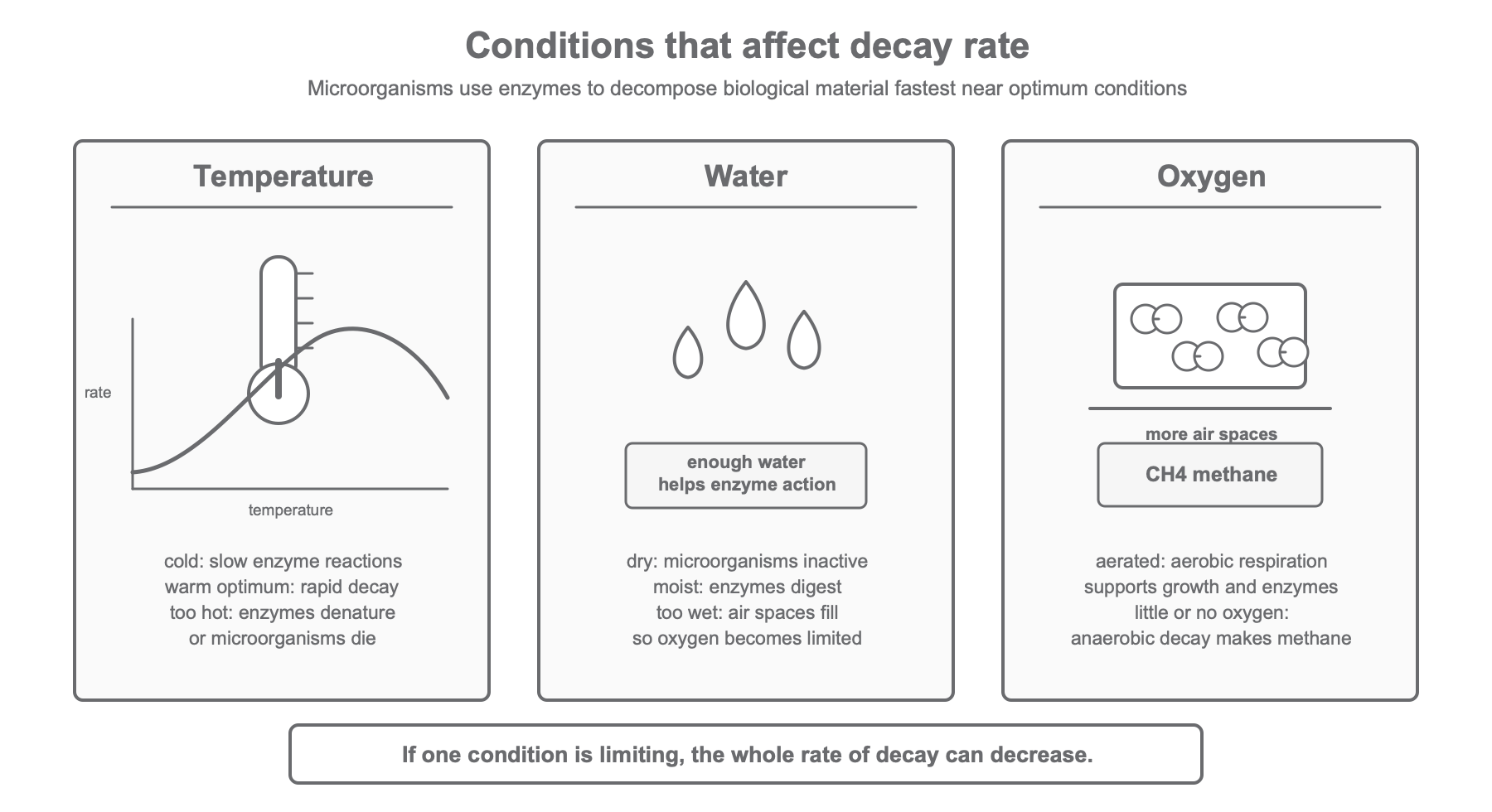
The safest way to compare the three factors is to use optimum conditions. Rapid decay needs a suitable temperature, enough water and enough oxygen. If any one of these is limiting, the whole decay process can slow down.
When oxygen is not available, some microorganisms can break down material anaerobically. Anaerobic decay is important in this specification because it produces methane gas.
Continue this lesson.
You’re previewing NovaLearn without an account. Create a free account to read the rest.
Create free account