4.6.1.5 - DNA structure
DNA stores genetic information in a sequence of bases. In this biology-only lesson, the important structure is not a detailed chemical formula: it is the repeating nucleotide pattern, the sugar-phosphate strands, and how the order of bases can control the order of amino acids in a protein. Higher Tier students also need the simple link between DNA structure, protein synthesis, mutations and phenotype.
DNA as a polymer
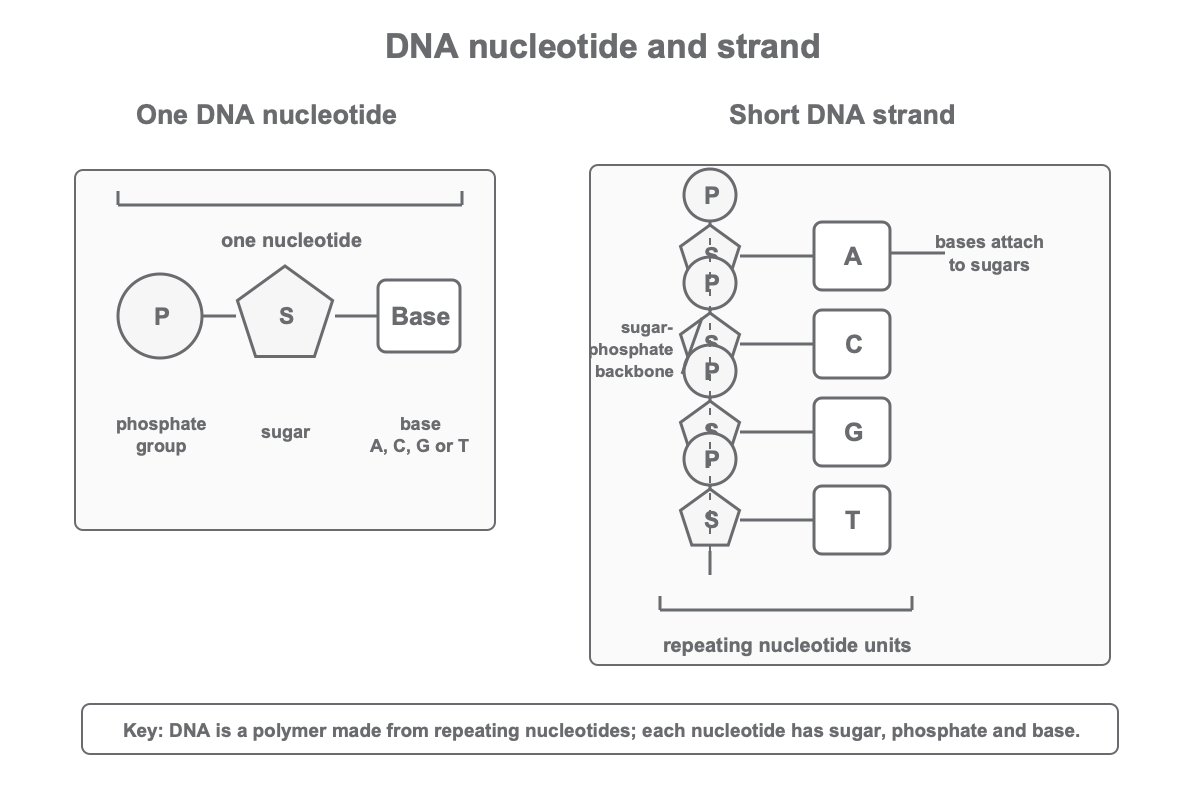
A polymer is a large molecule made from many smaller repeating units joined together. DNA is a polymer because it is made from many repeating units called nucleotides.
Nucleotide
A repeating unit of DNA made from a sugar, a phosphate group and one base attached to the sugar.
Each DNA nucleotide has the same basic pattern: a common sugar, a phosphate group, and one base. The part that can differ between DNA nucleotides is the base.
DNA contains four bases, shown by the letters A, C, G and T. At GCSE, these letters are usually enough; you do not need to draw their chemical structures.
[DIAGRAM: asset_name: dna-nucleotide-and-strand - diagram 1; asset_slug: 074_4_6_1_5_dna_structure_diagram1; file: diagram_assets/imagegen_regen_all/074_4_6_1_5_dna_structure_diagram1_imagegen.png; recommended_method: codex_image_gen; description: Monochrome labelled diagram showing one DNA nucleotide made from a phosphate group, sugar and base, plus a short DNA strand made from repeating nucleotide units with an alternating sugar-phosphate backbone and bases A, C, G and T attached to sugars.]
Sugar-phosphate strands
In a long strand of DNA, the sugar and phosphate parts alternate. This means the strand can be described as:
sugar -> phosphate -> sugar -> phosphate -> sugar -> phosphate
Attached to each sugar is one of the four bases. This is a useful exam pattern because it separates the support structure from the information-carrying part. The alternating sugar-phosphate sections make the strand, while the sequence of bases carries the code.
The DNA polymer is therefore made from repeating nucleotide units, but the bases do not have to be in a repeating order. A short section might be A C T G A A; another section might be G T C C T A. The order of bases matters because different base sequences can code for different amino acid sequences.
DNA has an alternating sugar-phosphate strand, with one base attached to each sugar.
Base sequence and the protein code
The order of bases in DNA is a code. A sequence of three bases codes for a particular amino acid. For example, in a simplified GCSE model, a triplet such as A T G represents one three-base code.
Amino acid
A small molecule used to build proteins.
Proteins are made by joining amino acids in a particular order. The order of bases in DNA controls the order in which amino acids are assembled. If the amino acids are assembled in a different order, the protein produced may be different.
Be careful with wording. A base is not a nucleotide by itself. A nucleotide is the whole repeating unit: sugar, phosphate group and base. A sequence of bases is the code.
Interpreting DNA diagrams
You need to be able to interpret a diagram of DNA structure, but AQA does not require you to reproduce one from memory. In a diagram, look for the repeated nucleotide units first: sugar, phosphate and base.
[DIAGRAM: asset_name: dna-double-helix-interpretation - diagram 2; asset_slug: 074_4_6_1_5_dna_structure_diagram2; file: diagram_assets/imagegen_regen_all/074_4_6_1_5_dna_structure_diagram2_imagegen.png; recommended_method: codex_image_gen; description: Monochrome double helix interpretation diagram showing two twisted DNA strands, sugar-phosphate sections on the outside, bases pointing inward, and a note that students interpret rather than reproduce the structure.]
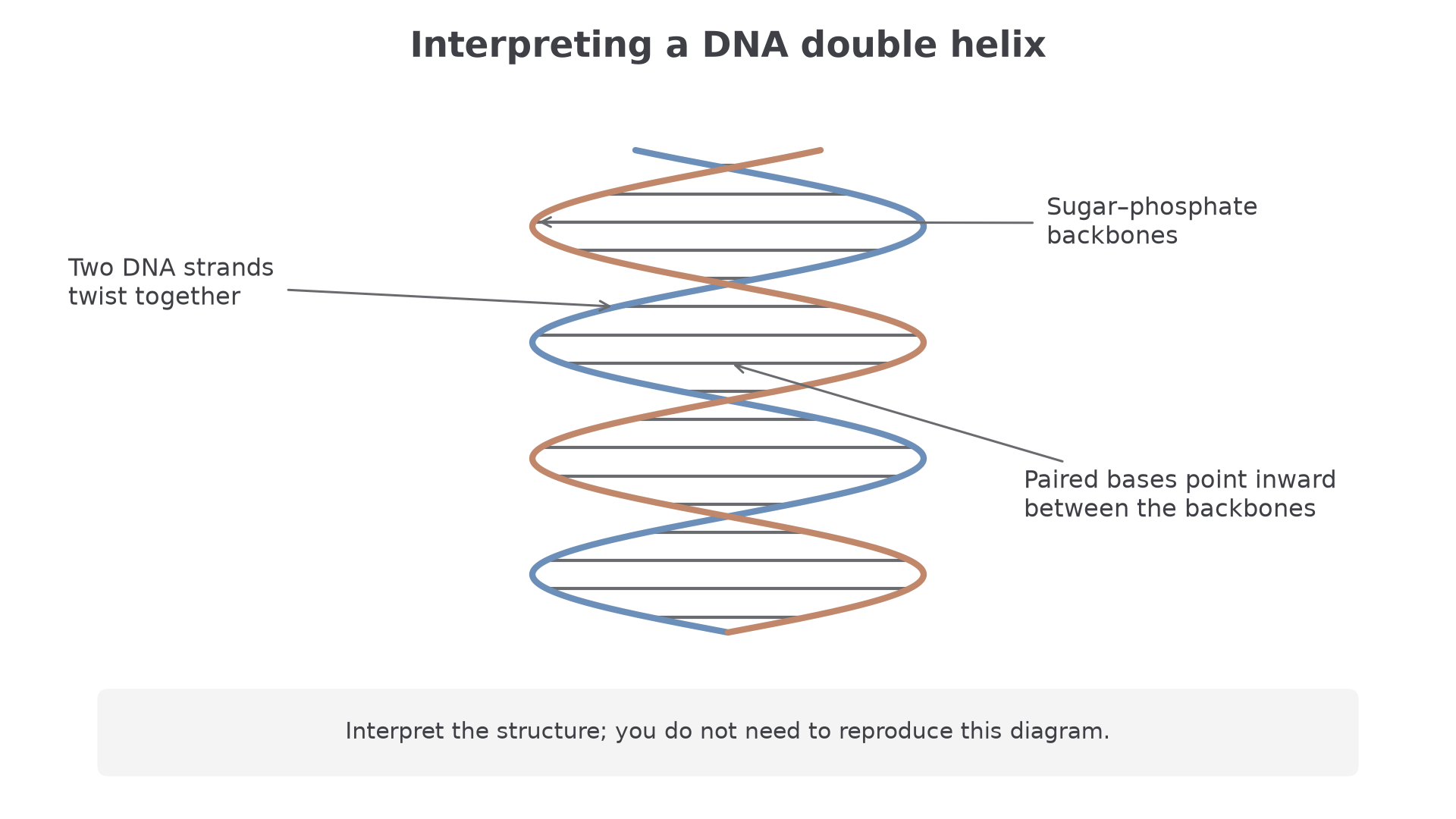
The double helix shape is often simplified as a twisted ladder. In that model, the sugar-phosphate strands form the sides, and the bases point inwards. For this lesson, the most important interpretation is to identify which parts are sugar-phosphate sections and which parts are bases.
This diagram skill is Working Scientifically skill WS 1.2 because a model or diagram represents a biological structure. The model helps you reason about DNA without needing the full chemical structure.
Continue this lesson.
You’re previewing NovaLearn without an account. Create a free account to read the rest.
Create free account