4.6.1.3 - Advantages and Disadvantages of Sexual and Asexual Reproduction
This is Biology-only content. The key idea is that neither sexual nor asexual reproduction is always "better"; each has advantages in different circumstances. You need to know the named examples in the specification, but the main exam skill is applying the trade-offs to an unfamiliar organism when you are given information.
The comparison frame
Sexual reproduction and asexual reproduction were introduced in the previous specification point. This lesson uses those definitions only as a starting point, then asks why an organism might benefit from one method rather than the other.
Sexual reproduction
Reproduction involving the joining of genetic information from two parents, producing offspring that are genetically different from each other.
The important result of sexual reproduction is variation. Variation means differences in the characteristics of individuals in a population. In this topic, variation matters because different offspring may have different chances of surviving if the environment changes.
Asexual reproduction
Reproduction involving one parent and no fusion of gametes, producing genetically identical offspring called clones.
The important result of asexual reproduction is speed and efficiency. If the parent organism is already well suited to the conditions, many identical offspring can be produced quickly.
[DIAGRAM: asset_name: reproduction-trade-offs - diagram 1; asset_slug: 072_4_6_1_3_advantages_and_disadvantages_of_sexual_and_asexual_reproduction_diagram1; file: diagram_assets/imagegen_regen_all/072_4_6_1_3_advantages_and_disadvantages_of_sexual_and_asexual_reproduction_diagram1_imagegen.png; recommended_method: codex_image_gen; description: Monochrome summary flowchart comparing sexual reproduction and asexual reproduction. Sexual reproduction branch links changing environments and selective breeding to variation, survival advantage by natural selection and increased food production. Asexual reproduction branch links favourable conditions to one parent, no mate needed, time and energy efficiency, faster reproduction and many identical offspring. A lower note shows that malaria parasites, fungi and some plants can use both methods depending on circumstances.]
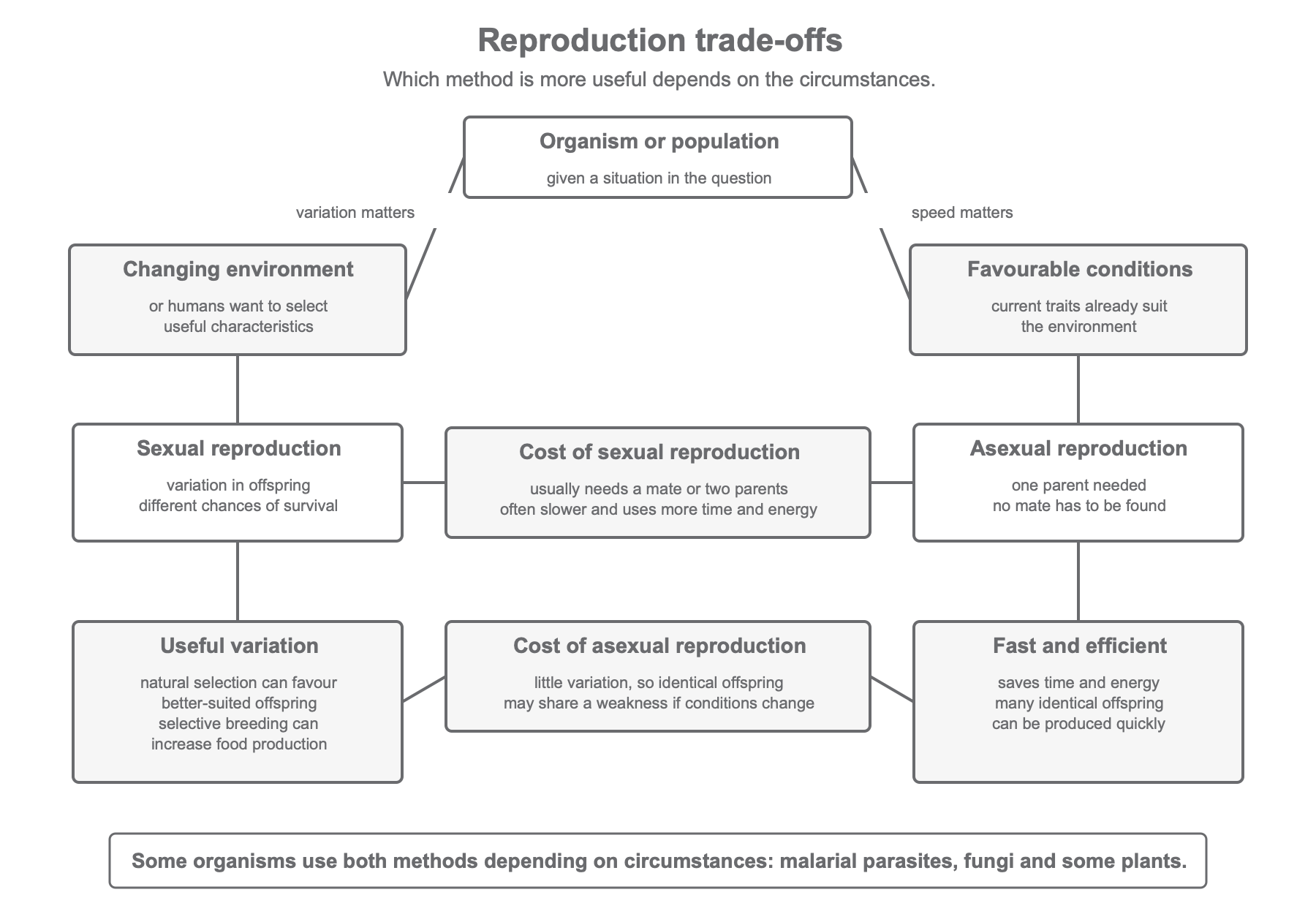
Use this trade-off throughout the lesson:
| Method | Main advantage | Main disadvantage |
|---|---|---|
| Sexual reproduction | Produces variation in offspring | Usually needs two parents or a mate, so it uses more time and energy |
| Asexual reproduction | Fast, efficient and needs only one parent | Produces genetically identical offspring, so there is little variation |
Sexual reproduction: advantages and costs
The main advantage of sexual reproduction is that it produces variation in the offspring. This does not mean every offspring will survive. It means there are differences for natural selection to act on.
Natural selection
A process in which individuals with characteristics that make them better suited to their environment are more likely to survive and reproduce.
If the environment changes, variation can give a survival advantage. For example, if a new disease, predator or environmental condition affects a population, some offspring may have characteristics that make them more likely to survive than others. Those survivors are more likely to reproduce and pass on the helpful characteristics.
This is why sexual reproduction is useful in changing conditions: it spreads risk. The offspring are not all genetically identical, so one harmful change is less likely to affect every offspring in exactly the same way.
Humans can speed up natural selection in selective breeding. In selective breeding, humans choose organisms with useful characteristics and breed from them. Because sexual reproduction produces variation, there can be individuals with characteristics humans want, such as higher yield, larger fruit, more milk, or faster growth. Selecting and breeding those individuals can increase food production.
The cost is that sexual reproduction usually needs a mate or two parents. Finding a mate, producing gametes, courtship or pollination can take time and energy. Sexual reproduction is often slower than asexual reproduction, so it may produce fewer offspring in the same time.
Sexual reproduction is valuable because variation can help a population survive change, and humans can use variation in selective breeding.
Asexual reproduction: advantages and costs
Asexual reproduction has four linked advantages in the AQA specification:
| Asexual reproduction advantage | Why it matters |
|---|---|
| Only one parent is needed | An isolated organism can reproduce without finding a mate |
| More time and energy efficient | The organism does not need to spend time or energy finding a mate |
| Faster than sexual reproduction | Offspring can be produced more quickly |
| Many identical offspring can be produced when conditions are favourable | If the parent's characteristics suit the environment, identical offspring may also be well suited |
This method is especially useful when conditions are favourable. Favourable conditions mean the current environment suits the organism: enough resources, suitable temperature or moisture, and no major new pressure that makes the parent's characteristics a problem.
The disadvantage is the same feature seen from the other side. Asexual reproduction produces genetically identical offspring. If conditions change, the offspring may all have the same weakness because there is little variation for natural selection to act on.
For example, if a population of identical organisms is affected by a new disease, many individuals may be equally vulnerable. A population with more variation has a better chance that some individuals will have characteristics that help them survive.
Organisms using both methods
Some organisms reproduce by both sexual and asexual methods depending on the circumstances. AQA restricts your required knowledge to the organisms named in this section.
Continue this lesson.
You’re previewing NovaLearn without an account. Create a free account to read the rest.
Create free account