4.3.2.2 - Uses of Monoclonal Antibodies
Monoclonal antibodies are useful because they bind to one specific target molecule. This biology-only Higher-tier lesson is about how that specificity is used in diagnosis, laboratory testing, research and some disease treatments. The production method belongs to the previous specification point, so here we only recall enough of it to explain the uses and limitations.
Specific binding
A monoclonal antibody is an antibody made from one clone of cells, so all the antibodies are identical. Each one is specific to one binding site on one protein antigen. This means a monoclonal antibody can be chosen to bind to one target chemical, one pathogen antigen, or a marker on a particular type of cell.
Monoclonal antibody
An antibody produced from a single clone of cells, so all the antibodies are identical and bind to the same specific antigen.
The important exam idea is specificity. A monoclonal antibody does not bind equally to all molecules. It binds only if its binding site is complementary to the target antigen or target molecule. This is why it can be used as a detector, a label, or a targeted carrier.
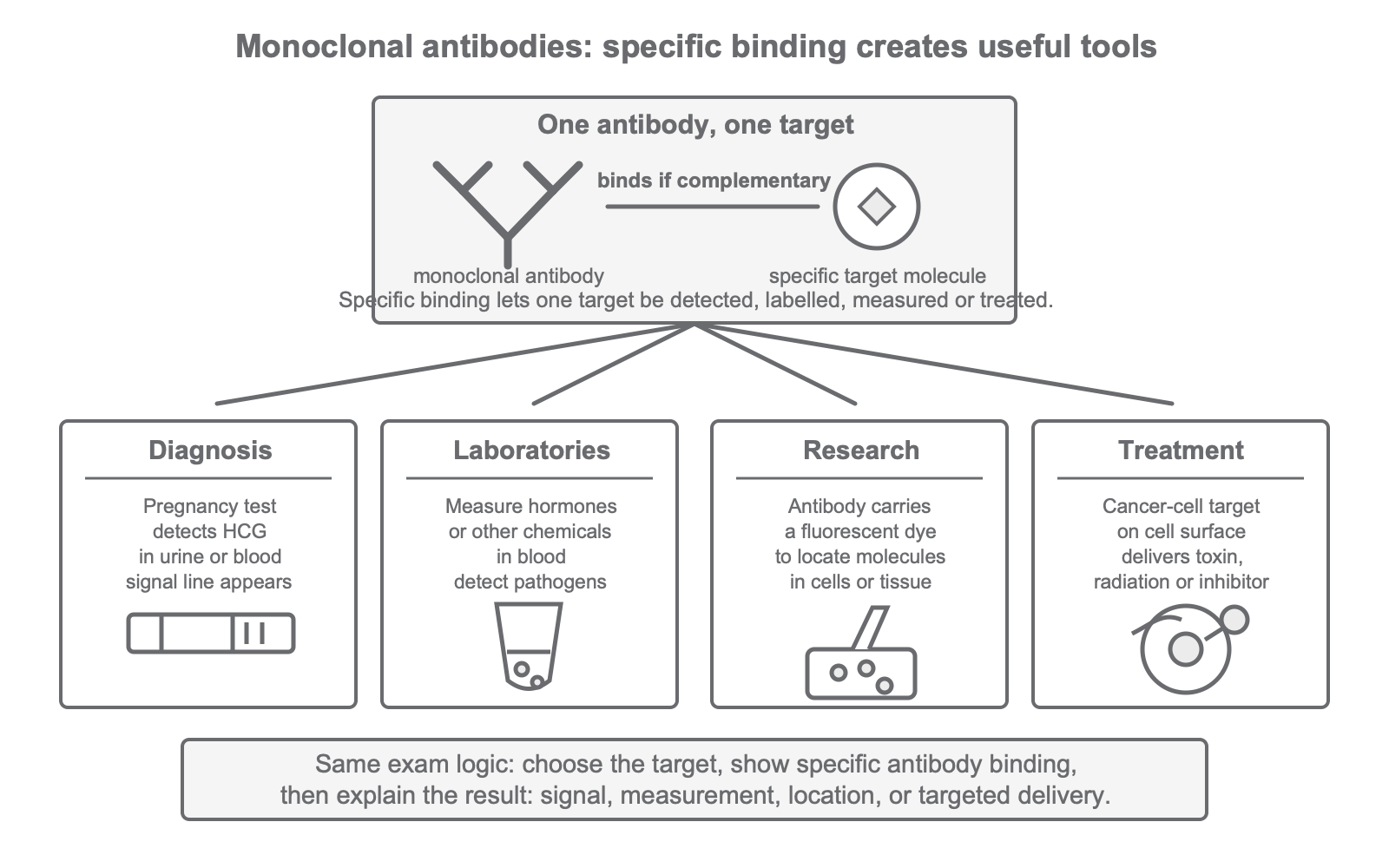
[DIAGRAM: asset_name: monoclonal-antibody-uses - diagram 1; asset_slug: 040_4_3_2_2_uses_of_monoclonal_antibodies_diagram1; file: diagram_assets/imagegen_regen_all/040_4_3_2_2_uses_of_monoclonal_antibodies_diagram1_imagegen.png; recommended_method: codex_image_gen; description: Monochrome concept diagram showing one monoclonal antibody binding a specific target, then four AQA uses branching from that specificity: pregnancy diagnosis, laboratory hormone/chemical/pathogen detection, fluorescent research location of molecules, and targeted cancer treatment delivery.]
Diagnosis and laboratory tests
One use of monoclonal antibodies is diagnosis. A pregnancy test is the example named in the specification. Pregnant women produce the hormone HCG, and HCG is excreted in urine. A pregnancy test can contain monoclonal antibodies that bind specifically to HCG.
In a simple test-strip explanation, urine moves along the strip. If HCG is present, it binds to mobile monoclonal antibodies. The HCG-antibody complex then binds to other antibodies fixed in the results zone, causing a visible line or colour change. A separate control zone shows that the liquid and antibodies moved through the strip properly.
The same basic idea is used in laboratories. Monoclonal antibodies can be used to measure levels of hormones or other chemicals in blood. They can also be used to detect pathogens, because the antibody can bind to a specific antigen on the pathogen.
| Use | Target detected | What the binding shows |
|---|---|---|
| Pregnancy diagnosis | HCG hormone | HCG is present in urine or blood |
| Laboratory measurement | A hormone or other chemical | The target chemical is present, and its level may be measured |
| Pathogen detection | A specific pathogen antigen | The pathogen, or evidence of it, is present in the sample |
Research with fluorescent dyes
In research, monoclonal antibodies can be used to locate or identify specific molecules in a cell or tissue. The antibody is attached to a fluorescent dye. The antibody binds to its specific target molecule, and the dye shows where that target is.
For example, if a scientist wants to find where a particular protein is in a tissue sample, they can use a monoclonal antibody that binds to that protein. Wherever the fluorescent dye is seen, the target protein is present. The antibody gives specificity; the fluorescent dye gives visibility.
This is not the same as saying the dye itself "knows" where to go. The dye is useful because it is carried by the monoclonal antibody.
Targeted cancer treatment
Monoclonal antibodies can be used to treat some diseases. The specification example is cancer treatment. Cancer cells may have specific antigens or proteins on their surface. A monoclonal antibody can be made to bind to a target on those cancer cells.
For cancer treatment, the antibody can be attached to a radioactive substance, a toxic drug, or a chemical that stops cells growing and dividing. The antibody binds to the cancer cell and delivers the attached substance to that cell. This targets the treatment towards cancer cells rather than spreading the harmful substance through the body in a less specific way.
Continue this lesson.
You’re previewing NovaLearn without an account. Create a free account to read the rest.
Create free account