4.7.3.4 - Deforestation
Deforestation means removing forest so the land can be used for something else. In this AQA Biology point, the focus is large-scale deforestation in tropical areas, especially to provide land for cattle, rice fields and crops grown for biofuels. The skill is not just to list these causes, but to evaluate their environmental implications.
What deforestation means
Forests are ecosystems with many plant, animal and microorganism species. Tropical forests are especially important because they contain high biodiversity and large amounts of carbon stored in tree biomass and soils.
Deforestation
The removal of forest so the land can be used for another purpose.
Large-scale deforestation means forest is cleared over a large area, not just a few trees being cut down. In tropical areas, this can happen when forest is cleared and replaced by agricultural land.
[DIAGRAM: asset_name: deforestation-causes-and-implications - diagram 1; asset_slug: 108_4_7_3_4_deforestation_diagram1; file: diagram_assets/imagegen_regen_all/108_4_7_3_4_deforestation_diagram1_imagegen.png; recommended_method: codex_image_gen; description: Monochrome flow diagram showing large-scale tropical forest clearing caused by cattle pasture, rice fields and biofuel crop production, leading to habitat loss, reduced biodiversity, carbon dioxide implications, methane implications, and an evaluation judgement.]
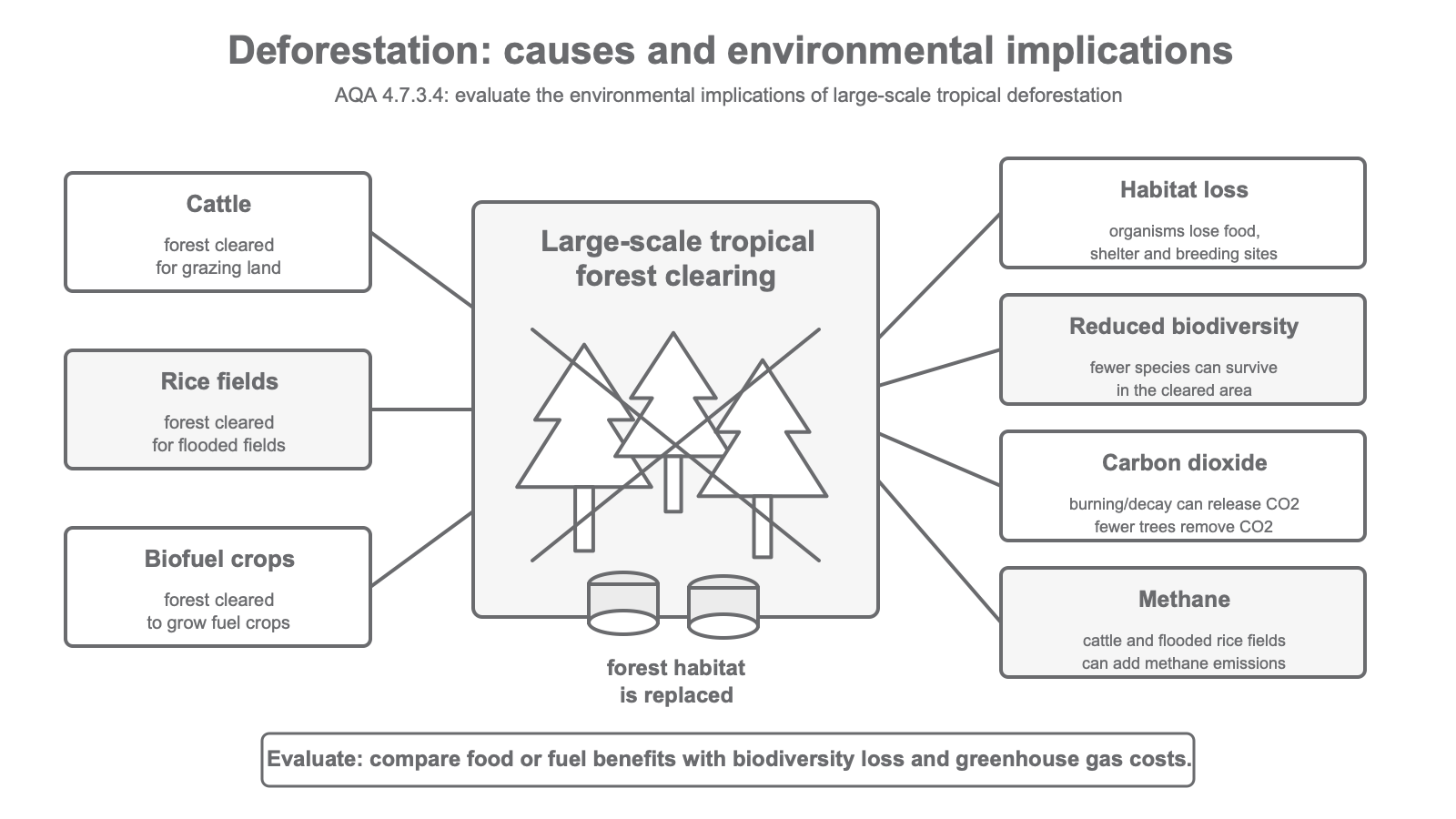
A precise answer should use the official examples: cattle, rice fields and biofuel crops. Other causes of forest loss can exist, but this lesson is about the AQA 4.7.3.4 boundary.
Why tropical forest is cleared
The official AQA examples are all linked to demand for food or fuel. Forest is cleared because the cleared land can be used directly for farming.
| Use of cleared land | Why it is wanted | Environmental issue to consider |
|---|---|---|
| Cattle | Produces meat and other animal products | Forest habitat is replaced by grazing land; cattle produce methane |
| Rice fields | Produces food for large populations | Forest habitat is replaced by flooded fields; rice fields can release methane |
| Biofuel crops | Produces plant material that can be made into fuel | Biofuels may reduce some fossil-fuel use, but clearing forest for crops can remove habitats and release stored carbon |
This is why exam answers often need balance. Food and fuel demand can explain why deforestation happens, but explaining why it happens is not the same as saying it has no environmental cost.
Environmental implications
An environmental implication is a consequence for the environment. For deforestation, the first implication is habitat loss. When a tropical forest is removed, organisms lose food sources, shelter, breeding sites and the physical conditions they are adapted to. This can reduce biodiversity because fewer species can survive in the area.
Biodiversity
The variety of different species of organisms on Earth, or within an ecosystem.
Deforestation can also affect greenhouse gas levels. Trees remove carbon dioxide from the atmosphere during photosynthesis. If trees are cut down, there are fewer trees removing carbon dioxide. If the cut trees are burned or left to decay, carbon stored in their biomass can be released as carbon dioxide.
Replacing forest with cattle or rice fields can add another implication. Cattle produce methane during digestion, and flooded rice fields can release methane from microorganisms in waterlogged soil. Carbon dioxide and methane are greenhouse gases, so this is an environmental cost of the land-use change.
Continue this lesson.
You’re previewing NovaLearn without an account. Create a free account to read the rest.
Create free account