4.6.3.4 - Evidence for evolution
The theory of evolution by natural selection is now widely accepted because scientists have evidence that supports it. For this AQA point, the evidence to describe is deliberately focused: characteristics are passed on in genes, the fossil record shows organisms from the past, and antibiotic resistance in bacteria shows evolution happening over a short time.
What evidence means
In science, a theory is accepted when evidence repeatedly supports it. Darwin proposed the theory of evolution by natural selection before scientists knew the detailed mechanism of genes, so early evidence was more limited. Modern evidence makes the theory much stronger.
Evolution
A change in the inherited characteristics of a population over time.
This lesson is about evidence for evolution, not every detail of natural selection. The key idea is that evidence comes from observations and data that match the prediction that populations can change over generations.
[DIAGRAM: asset_name: evidence-for-evolution-map - diagram 1; asset_slug: 090_4_6_3_4_evidence_for_evolution_diagram1; file: diagram_assets/imagegen_regen_all/090_4_6_3_4_evidence_for_evolution_diagram1_imagegen.png; recommended_method: codex_image_gen; description: Monochrome concept map showing Darwin's theory of evolution by natural selection supported by three AQA evidence lines: characteristics passed on in genes, fossil record evidence, and antibiotic resistance evolving in bacteria.]
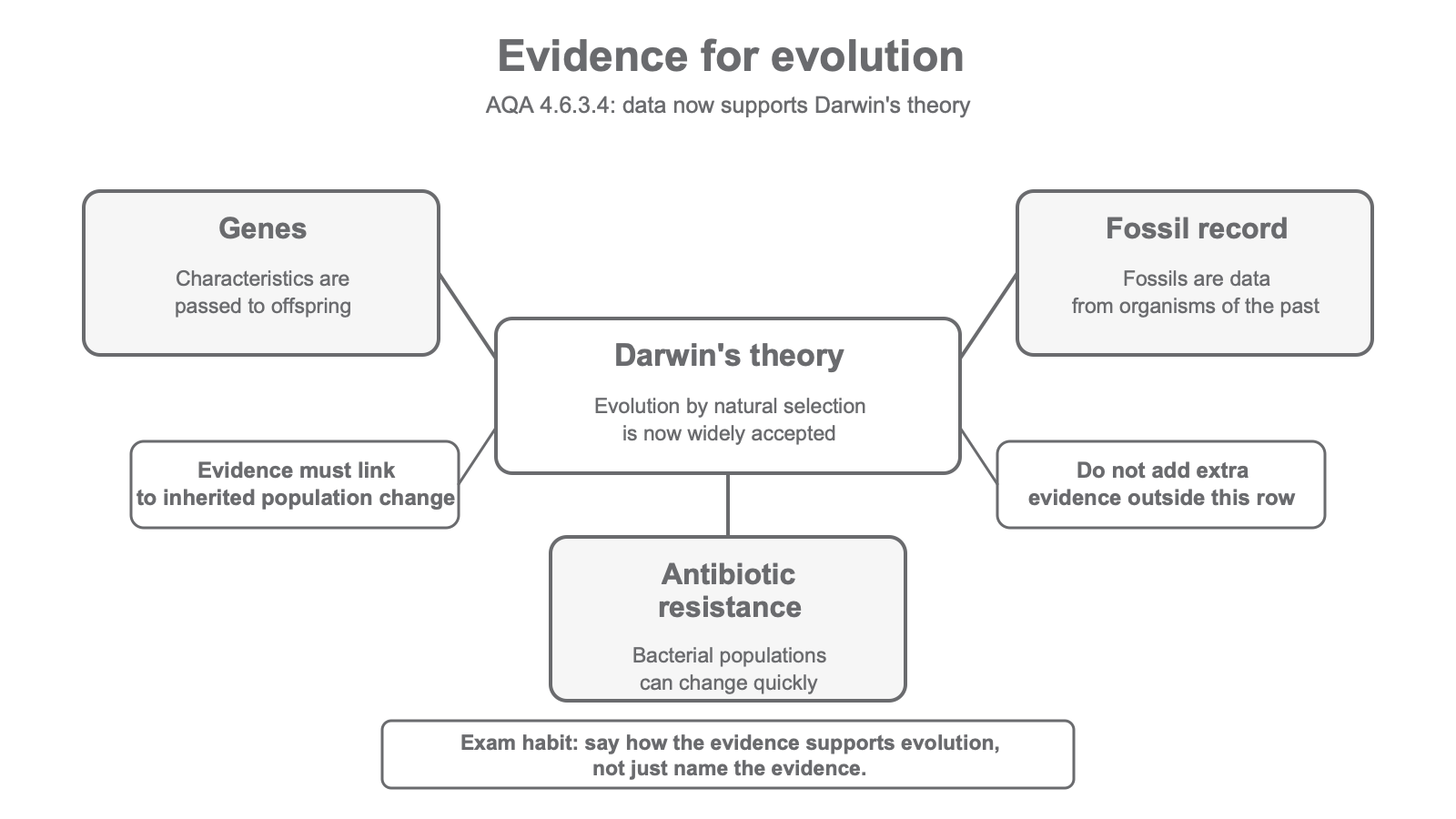
A safe GCSE answer does not say that one fossil or one resistant bacterium "proves" evolution by itself. Instead, say that each line of evidence supports the theory, and that more data is now available than when Darwin first published his ideas.
Genes and inheritance
Natural selection can only cause evolution if useful characteristics can be passed from parents to offspring. Modern genetics provides this missing mechanism: characteristics are passed on to offspring in genes.
Gene
A section of DNA involved in an inherited characteristic.
If a characteristic helps an organism survive and reproduce, the genes linked with that characteristic can be passed on to offspring. Over many generations, those inherited characteristics can become more common in the population.
This does not mean that individual organisms choose to change their genes during life. The important evidence point is inheritance: offspring can receive genetic information from their parents, so natural selection can change the inherited characteristics of a population over time.
Fossil record evidence
Fossils are evidence from organisms that lived in the past. When scientists compare fossils from rocks of different ages, they can see that the organisms found in older rocks are often different from those found in younger rocks.
Fossil record
The collection of fossil evidence found in rocks, which gives information about organisms that lived in the past.
The fossil record supports evolution because it shows change over time. Some fossils show organisms that are unlike organisms alive today, while other fossils show features that are similar to modern organisms. This fits the idea that populations and species have changed as life developed on Earth.
[DIAGRAM: asset_name: fossil-record-evidence - diagram 2; asset_slug: 090_4_6_3_4_evidence_for_evolution_diagram2; file: diagram_assets/imagegen_regen_all/090_4_6_3_4_evidence_for_evolution_diagram2_imagegen.png; recommended_method: codex_image_gen; description: Monochrome rock-layer diagram with older, middle and younger layers containing different fossil forms, a time arrow, and a conclusion that fossil data from different ages shows organisms changed over time.]
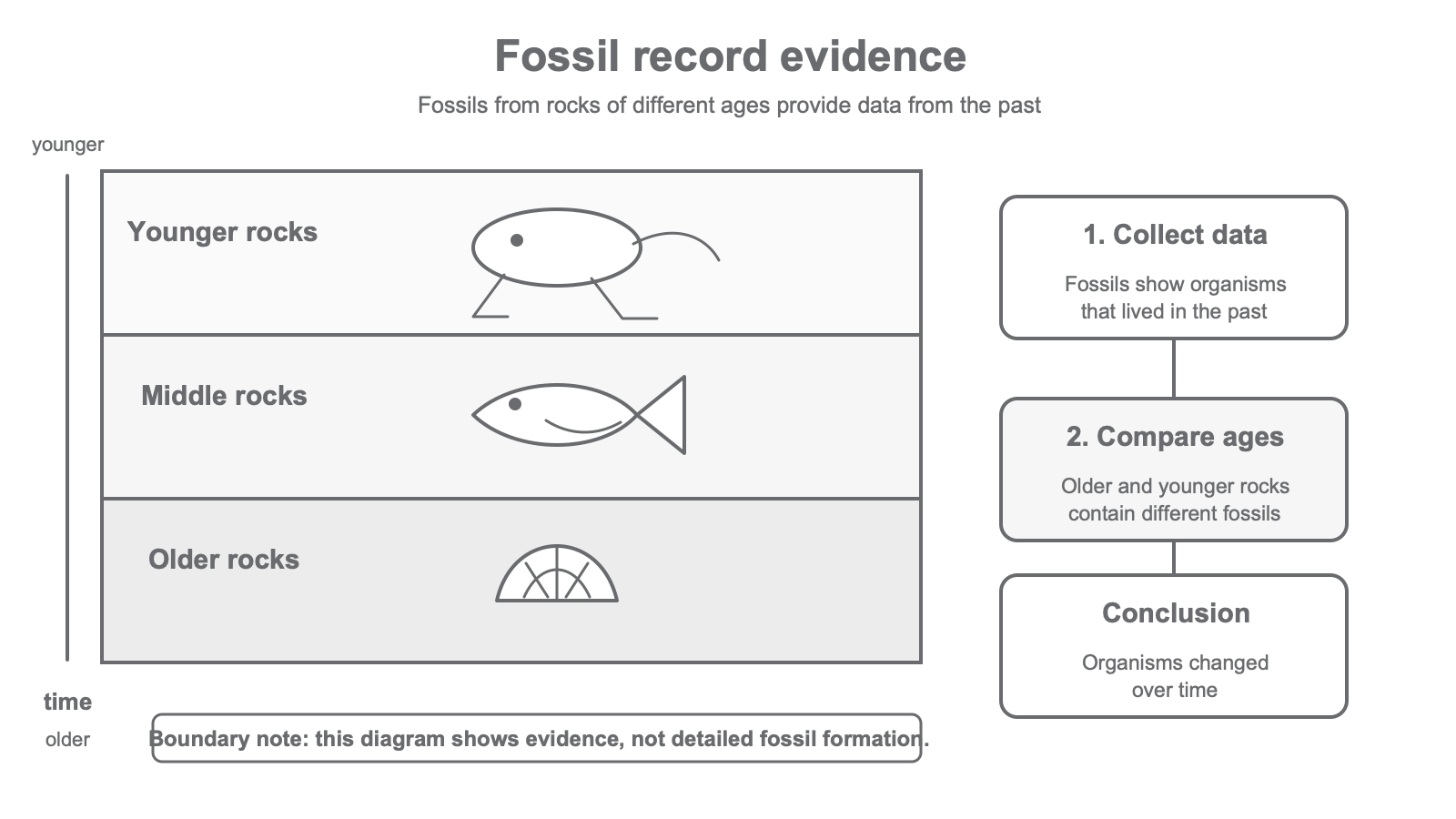
Keep the explanation at the correct boundary. You do not need to describe the detailed ways fossils form in this lesson. The evidence point is that fossils are data from the past, and comparing that data shows change over time.
Continue this lesson.
You’re previewing NovaLearn without an account. Create a free account to read the rest.
Create free account