4.6.2.4a - Genetic Engineering Process
Genetic engineering changes an organism's genome by adding a gene from another organism. The aim is that the added gene gives the recipient organism a desired characteristic. This lesson focuses on the process and vector use; evaluation of uses is treated in the next split lesson.
What genetic engineering means
A genome is all the genetic material in an organism. In genetic engineering, scientists modify that genome by introducing a gene from another organism.
Genetic engineering
Genetic engineering is a process that involves modifying the genome of an organism by introducing a gene from another organism to give a desired characteristic.
The gene is important because it carries instructions for a characteristic. If a useful gene is transferred successfully, the recipient organism may develop the desired characteristic. At GCSE level, describe this as a targeted change to the genome, not as random breeding.
Brief context helps the definition make sense: a crop might receive a gene linked to disease resistance, or bacteria might receive a gene linked to making a useful substance. This lesson stops at the process; judging those uses belongs to the applications lesson.
Genes are transferred
In genetic engineering, genes can be taken from the chromosomes of humans or other organisms. The required gene is then transferred to cells of another organism.
The exam phrase cut out means that the useful gene is separated from the donor DNA. The donor is the organism that has the gene wanted. The recipient is the organism whose cells receive the gene.
The process is specific: it is not a whole chromosome from the donor organism being moved. It is the required gene that is isolated and transferred. That precision matters because a gene is a section of DNA carrying instructions, while a chromosome contains many genes.
Higher tier process steps
The main process steps are Higher tier only. They turn the definition into a sequence that a student may be asked to describe.
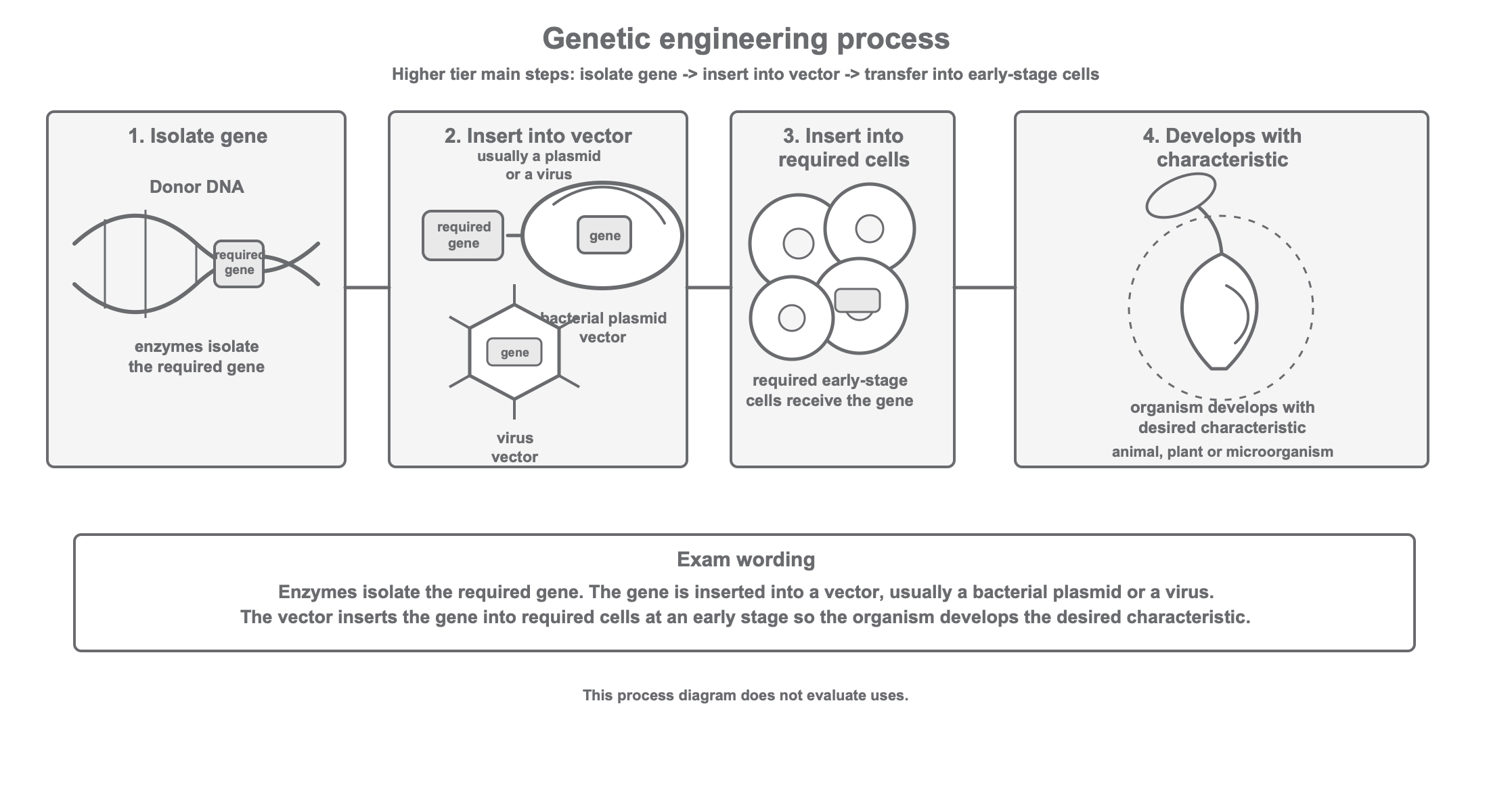
First, enzymes are used to isolate the required gene. In other words, enzymes separate the useful gene from the donor DNA. AQA does not require enzyme names here, so the safest GCSE wording is simply enzymes are used to isolate the required gene.
Next, the gene is inserted into a vector.
Vector
A vector is something used to transfer the required gene into the required cells, usually a bacterial plasmid or a virus.
A bacterial plasmid is a small loop of DNA found in bacterial cells. In genetic engineering, the plasmid can act as a carrier for the required gene. A virus can also be used as a vector because viruses naturally enter cells, but at this level the key idea is that the vector carries the gene into the required cells.
[DIAGRAM: asset_name: genetic-engineering-process-flow: Genetic engineering process - diagram 1; asset_slug: 083_4_6_2_4a_genetic_engineering_process_diagram1; file: diagram_assets/imagegen_regen_all/083_4_6_2_4a_genetic_engineering_process_diagram1_imagegen.png; recommended_method: codex_image_gen; description: Monochrome GCSE process flowchart showing enzymes isolating a required gene from donor DNA, the gene inserted into a vector such as a plasmid or virus, the vector delivering the gene into required early-stage cells, and the genetically modified organism developing the desired characteristic. The diagram avoids applications evaluation content reserved for lesson 084.]
Continue this lesson.
You’re previewing NovaLearn without an account. Create a free account to read the rest.
Create free account