4.5.3.5 - Contraception
Contraception means using methods to reduce the chance of pregnancy. Some methods use hormones to affect egg maturation or release, while others physically or chemically reduce the chance that sperm reach an egg or that an embryo implants. In this lesson, the key skill is evaluation: choosing useful evidence, comparing advantages and disadvantages, and recognising that contraception decisions cannot be answered by science alone.
Where methods act
Pregnancy can only begin if several steps happen in order: an egg matures and is released from an ovary, sperm reach the egg in the female reproductive system, fertilisation occurs, and the resulting embryo implants in the uterus lining. Contraception reduces the chance of pregnancy by interrupting one or more of these steps.
Contraception
A method used to reduce the chance of pregnancy.
The methods in this lesson can be grouped by the stage they affect. Hormonal methods mainly act before ovulation by stopping eggs maturing or being released. Barrier methods and spermicides act around the time sperm might reach an egg. Intrauterine devices act in the uterus, and sterilisation is a long-term surgical method that prevents sperm and eggs meeting.
[DIAGRAM: asset_name: contraception-method-map - diagram 1; asset_slug: 064_4_5_3_5_contraception_diagram1; file: diagram_assets/imagegen_regen_all/064_4_5_3_5_contraception_diagram1_imagegen.png; recommended_method: codex_image_gen; description: Monochrome flow diagram showing egg maturation, egg release into the oviduct, sperm reaching an egg and embryo implantation, with GCSE contraception method groups mapped to the stages they interrupt: hormonal oral contraceptives, slow-release progesterone injection/implant/patch, barrier methods, spermicidal agents, abstaining when an egg may be in the oviduct, intrauterine devices and sterilisation.]
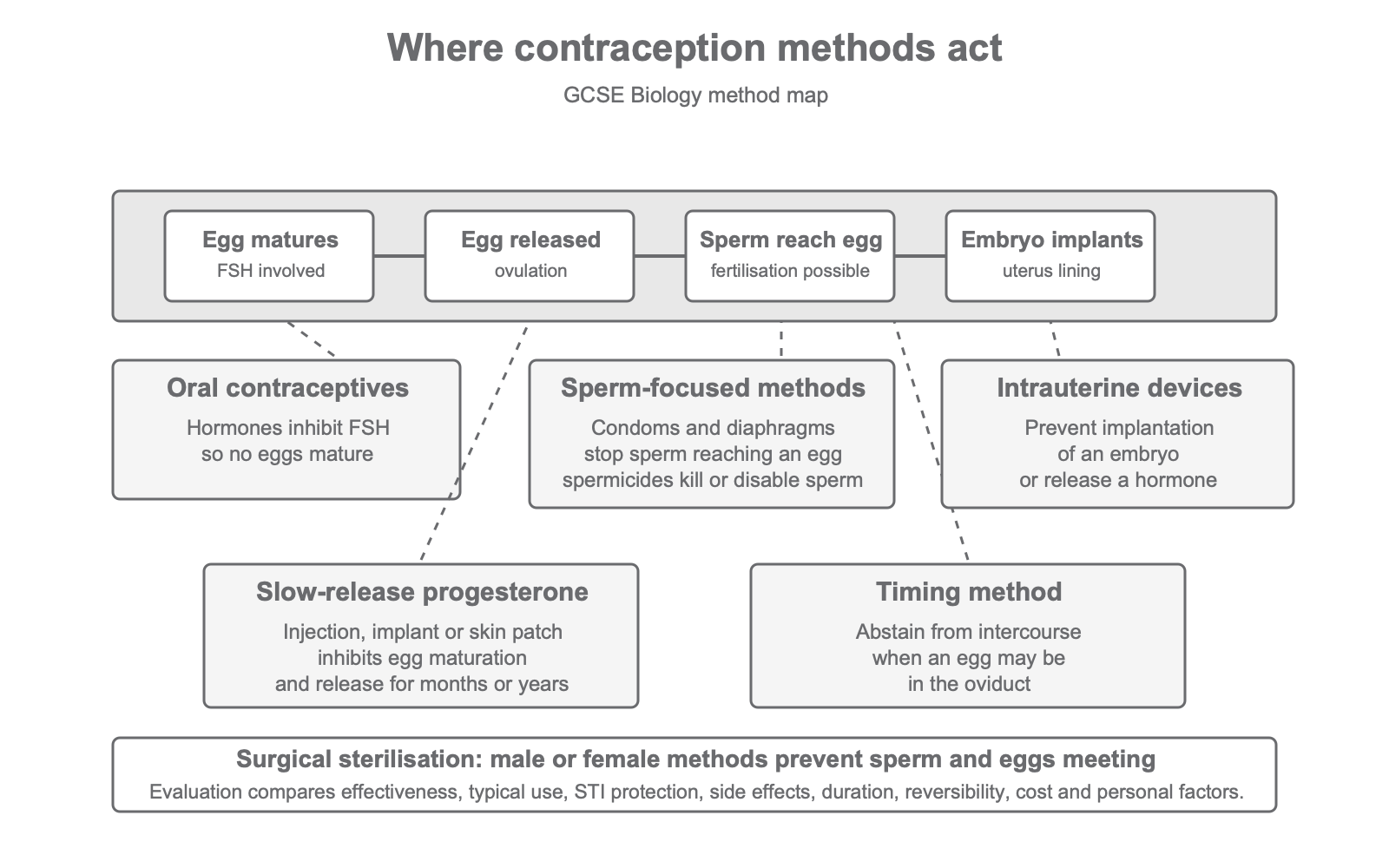
Keep the words egg, sperm and embryo precise. Contraception does not change inherited genetic information, and this lesson does not cover fertility treatment. It compares methods for preventing pregnancy.
Hormonal methods
A hormonal method contains hormones that change the normal reproductive hormone control system. In this specification point, the named hormonal methods are oral contraceptives and slow-release progesterone methods.
Hormonal contraception
Contraception that uses hormones to reduce the chance of pregnancy, usually by preventing egg maturation or release.
Oral contraceptives contain hormones that inhibit FSH production. FSH normally causes an egg to mature in the ovary, so if FSH production is inhibited, no eggs mature. This means there is no mature egg available for release and fertilisation.
Some methods use slow-release progesterone. A progesterone injection, implant or skin patch can inhibit the maturation and release of eggs. These methods reduce the need to take a daily oral contraceptive because hormone release is built into the method; the injection or implant can act for months or years.
The exam-safe chain for hormonal contraception is:
| Method | Hormone action | Effect |
|---|---|---|
| Oral contraceptive | Inhibits FSH production | No eggs mature |
| Injection, implant or skin patch | Slow-release progesterone inhibits egg maturation and release | No egg is released for fertilisation |
Hormonal methods can be effective because they act before fertilisation could happen. Evaluation must also consider disadvantages: some people experience side effects, some methods need remembering regularly, and hormonal methods are not suitable for everyone. Hormonal methods do not protect against sexually transmitted infections.
Barrier, spermicide and timing methods
Non-hormonal methods do not work by changing hormone concentrations. They can instead stop sperm reaching an egg, damage sperm, or avoid intercourse when an egg may be present in the oviduct.
Barrier method
A contraceptive method that physically prevents sperm reaching an egg.
Condoms and diaphragms are barrier methods. A condom is worn so that sperm are kept out of the female reproductive system. A diaphragm is placed inside the vagina to cover the cervix, reducing the chance that sperm enter the uterus and reach an egg. Barrier methods must be used correctly each time they are needed.
Spermicidal agents kill or disable sperm. They are often considered with barrier methods because both act on sperm rather than on egg maturation. Spermicide alone is usually less reliable than methods that do not depend as strongly on being used correctly at the time.
Another method is abstaining from intercourse when an egg may be in the oviduct. This depends on identifying the fertile part of the menstrual cycle and avoiding intercourse then. Its advantage is that it does not involve hormones, devices or surgery. Its disadvantage is that it relies on accurate timing and regular cycles, so typical use can be less reliable.
Condoms have an extra evaluation point: they are barrier methods that can also reduce transmission of sexually transmitted infections. Diaphragms, spermicides and timing methods should not be described as providing that same protection.
Intrauterine devices and sterilisation
An intrauterine device is placed in the uterus. In the GCSE wording, intrauterine devices prevent the implantation of an embryo or release a hormone. This means they can be evaluated as long-acting methods: once fitted, they do not need to be remembered every day or every time intercourse happens.
Continue this lesson.
You’re previewing NovaLearn without an account. Create a free account to read the rest.
Create free account