4.3.1.9 - Discovery and Development of Drugs
New medicines are not used just because a scientist has found an interesting chemical. AQA expects you to describe the route from discovery to testing: where candidate drugs may come from, what they must be tested for, and how trials reduce bias before results are accepted. The exam focus is the sequence and the purpose of each stage.
Where drugs come from
A drug is a chemical that affects processes in the body. In this specification point, the word is being used for potential new medical medicines, not for illegal drugs.
Traditionally, useful drugs were extracted from plants and microorganisms. AQA names three examples:
| Drug | Origin named by AQA | Use named by AQA |
|---|---|---|
| Digitalis | Foxgloves | Heart drug |
| Aspirin | Willow | Painkiller |
| Penicillin | Penicillium mould | Antibiotic discovered by Alexander Fleming |
These examples are memory facts, but they also show the wider idea: living organisms can contain chemicals that affect human biology.
Most new drugs are now synthesised by chemists in the pharmaceutical industry. Synthesised means made by chemical reactions rather than simply collected from an organism. However, the starting point may still be a useful chemical first extracted from a plant.
What testing checks
New medical drugs have to be tested and trialled before they are used. The main reason is to check that they are safe and effective.
Toxicity
How harmful or poisonous a drug is, including whether it causes serious side effects.
Testing for toxicity checks whether the drug could harm the body. In exam answers, "to check toxicity", "to check it is safe" and "to check for harmful side effects" are the same idea, so do not list them as separate points if the question asks for different reasons.
Efficacy
How well a drug works for its intended medical use.
Testing for efficacy checks whether the drug actually treats the disease or symptom it is meant to treat. This is different from efficiency. Efficacy is the AQA word for whether it works.
Testing for dose finds out how much of the drug should be given. The aim is to find a dose that is high enough to be effective but not so high that the risk of harm is unacceptable. The best dose for treatment is called the optimum dose.
Preclinical testing
Preclinical testing happens before clinical trials in humans. It is done in a laboratory using cells, tissues and live animals.
Preclinical testing
Testing a potential new drug before human trials, using cells, tissues and live animals in a laboratory.
Cells and tissues can show whether a drug affects living material in the intended way and whether it damages cells. Live-animal testing can give more information about effects in a whole organism. At GCSE, the key point is not the detailed method; it is that preclinical testing is laboratory testing before human clinical trials.
[DIAGRAM: asset_name: drug-development-pipeline - diagram 1; asset_slug: 038_4_3_1_9_discovery_and_development_of_drugs_diagram1; file: diagram_assets/imagegen_regen_all/038_4_3_1_9_discovery_and_development_of_drugs_diagram1_imagegen.png; recommended_method: codex_image_gen; description: Monochrome flowchart showing drug discovery from traditional extracts or synthesised compounds, preclinical testing on cells, tissues and live animals, clinical trials with healthy volunteers and patients, double blind placebo comparison, and peer review before publication.]
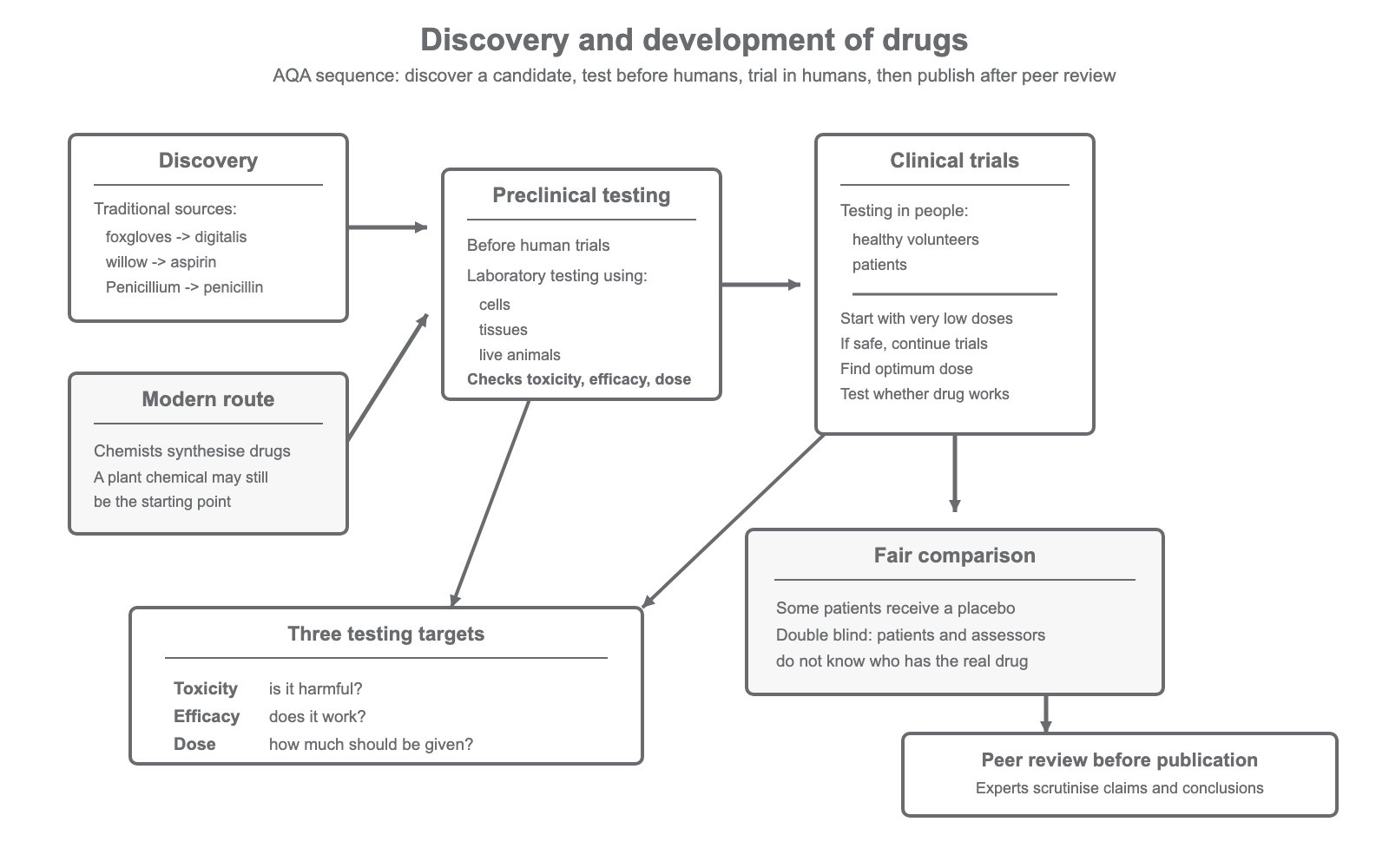
Preclinical results help scientists decide whether it is reasonable to move to human trials. A drug that looks promising in the laboratory still has to be trialled in people, because cells, tissues and animals cannot prove exactly how the drug will behave in humans.
Clinical trials
Clinical trials are drug trials in humans. AQA states that clinical trials use healthy volunteers and patients.
Clinical trial
A test of a potential medical drug in people, using healthy volunteers and patients.
Clinical trials begin cautiously. Very low doses of the drug are given at the start of the clinical trial. This reduces the risk to volunteers and patients while scientists look for evidence about safety.
Continue this lesson.
You’re previewing NovaLearn without an account. Create a free account to read the rest.
Create free account