4.7.2.3b - Investigating Decay Using Milk pH
In this Biology-only required practical, you investigate how temperature affects the rate of decay of fresh milk. The evidence is a change in pH: as milk is broken down, acidic products form, so the pH falls. AQA's classroom method usually uses lipase to make the change fast enough to measure in a lesson, but the practical is still assessed as decay of milk by pH change.
What pH Shows
Decay is the breakdown of biological material. In fresh milk, the useful signal is pH because breakdown products can make the mixture more acidic. In the classroom method, milk is made alkaline using sodium carbonate and a suitable pH indicator is added. Lipase is then used as a rapid model for decay: it breaks down fat in the milk into fatty acids and glycerol, so the pH falls.
Rate of Decay
The rate of decay is how quickly biological material is broken down. In this practical it can be estimated from how quickly pH falls.
If a pH probe is used, the dependent variable can be the change in pH over a set time. If an indicator endpoint is used, the dependent measurement is usually the time taken for the indicator to show that the pH has fallen to a chosen endpoint. A shorter time means a faster rate.
[DIAGRAM: asset_name: milk-ph-decay-model - diagram 1; asset_slug: 103_4_7_2_3b_required_practical_10_decay_and_milk_ph_diagram1; file: diagram_assets/imagegen_regen_all/103_4_7_2_3b_required_practical_10_decay_and_milk_ph_diagram1_imagegen.png; recommended_method: codex_image_gen; description: Monochrome apparatus diagram for AQA required practical 10 showing two boiling tubes in a water bath: one with lipase and one with milk, sodium carbonate and pH indicator. The diagram labels thermometer, water bath, stop clock, pipette transfer of lipase, temperature as the independent variable, pH change/time to endpoint as the dependent measurement, and fatty acids lowering pH.]
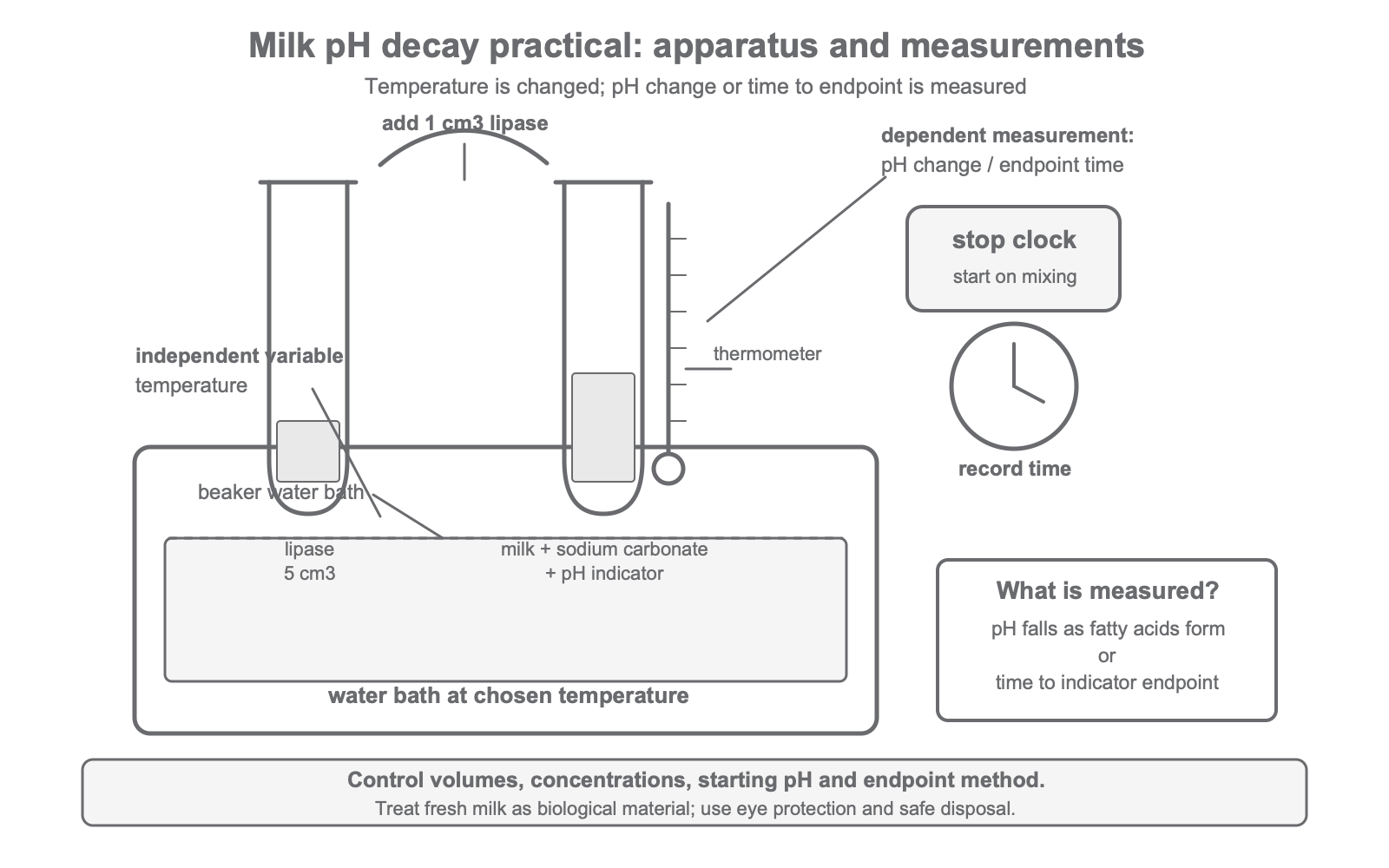
The important exam distinction is this: the practical changes temperature, not pH. pH is measured because it gives evidence about how fast decay is happening.
Variables and Apparatus
The independent variable is the temperature of the milk and lipase mixture. The usual way to control this is to place the tubes in a water bath and use a thermometer to check the actual temperature of the liquids before mixing.
The main apparatus links directly to the AQA apparatus and techniques:
- thermometer or temperature probe to record temperature
- pH indicator, pH meter or pH probe to record pH change
- boiling tubes or test tubes for the milk mixture and lipase
- water bath or beaker of water to control temperature
- pipettes or syringes to measure volumes
- stop clock to measure time
The official apparatus tag includes appropriate apparatus for measuring anaerobic decay. In this required practical, the examinable measurement is still pH change in the milk mixture, not a separate gas-volume measurement.
Control variables make the comparison valid. Use the same volume and type of milk, the same volume and concentration of lipase, the same volume of sodium carbonate, the same number of drops of indicator, the same starting pH, and the same endpoint or recording time. If the class uses fresh milk or cream, it must not be tasted and must be handled as a biological material because microorganisms may be present.
To compare temperatures fairly, only temperature should change; the mixture, volumes, concentrations, starting pH and endpoint method should stay the same.
Practical questions often reward exact apparatus wording. "Keep it fair" is too vague. A stronger answer names a control variable and says how to keep it constant, such as measuring 5 cm3 of milk each time with the same syringe.
Method and Risk
A suitable method is:
- Choose a range of temperatures, for example cold, room temperature and warm water baths, as instructed by the teacher.
- Label one tube "lipase" and one tube "milk" for each temperature.
- Add a measured volume of lipase to the lipase tube, for example 5 cm3.
- Add measured milk, sodium carbonate and a suitable pH indicator to the milk tube. A common AQA handbook method uses 5 cm3 milk and 7 cm3 sodium carbonate. The mixture starts alkaline.
- Place both tubes in the water bath until their contents reach the chosen temperature.
- Transfer a measured volume of lipase into the milk tube, for example 1 cm3, and start the stop clock immediately.
- Record pH at regular intervals, or record the time taken for the indicator endpoint.
- Repeat at each temperature, calculate means and identify anomalies.
Some schools use cresol red, where the colour endpoint may be purple to yellow. Others use phenolphthalein, where alkaline pink becomes colourless as pH falls. A pH probe gives a more objective result because it records numerical pH instead of relying on a judgement of colour change.
Risk reduction matters because this practical can involve hot water, alkaline sodium carbonate, indicator solvent and fresh biological material. Wear eye protection, avoid skin contact with indicator or sodium carbonate, keep flammable indicator away from flames, use water baths carefully, do not eat or taste the milk, wash hands, disinfect spills and dispose of mixtures as instructed. The AQA apparatus tag also includes safe use of microorganisms, so fresh milk must be treated as a possible source of microorganisms even when the fast lipase model is used.
Continue this lesson.
You’re previewing NovaLearn without an account. Create a free account to read the rest.
Create free account