4.5.3.3b - Kidney Failure, Dialysis and Transplants
Kidneys help keep the internal conditions of the blood within a safe range. If the kidneys fail, waste substances and excess water or ions can build up, so treatment is needed. This lesson focuses only on the two GCSE treatment routes: kidney dialysis and kidney transplant, plus how to evaluate their advantages and disadvantages.
Kidney failure and treatment choices
Kidney failure means the kidneys are not working well enough to maintain the composition of the blood. The important GCSE consequence is that substances the kidneys would normally remove, such as urea and excess ions or water, may remain in the blood.
This lesson does not require detailed kidney structure, named parts of the urinary system or detailed normal kidney-control mechanisms. The treatment idea is enough: if kidney function is lost, a patient may need a method that replaces some kidney function.
Kidney failure
A condition in which the kidneys do not work well enough to remove waste substances and maintain safe water and ion levels in the blood.
The AQA treatment choices are:
| Treatment | Basic idea |
|---|---|
| Dialysis | A mechanical device filters the blood using dialysis fluid and a partially permeable membrane. |
| Kidney transplant | A healthy donor kidney is placed into the patient in an operation. |
Dialysis is a repeated treatment. A transplant can work for a long time, but it depends on a suitable donor, surgery and preventing rejection of the kidney.
How dialysis works
Dialysis is used when the patient's kidneys cannot clean the blood effectively. In the GCSE model, blood is taken from the patient and flows through a dialysis machine. The blood is separated from dialysis fluid by a partially permeable membrane.
Partially permeable membrane
A membrane that allows some small substances to pass through but prevents larger substances, such as blood cells and large proteins, from crossing.
[DIAGRAM: asset_name: dialysis-principle - diagram 1; asset_slug: 062_4_5_3_3b_kidney_failure_dialysis_and_transplants_diagram1; file: diagram_assets/imagegen_regen_all/062_4_5_3_3b_kidney_failure_dialysis_and_transplants_diagram1_imagegen.png; recommended_method: codex_image_gen; description: Monochrome dialysis machine schematic. Blood from a patient flows beside dialysis fluid, separated by a partially permeable membrane. Arrows show urea and excess ions diffusing from blood into dialysis fluid, while blood cells and large proteins remain in the blood. Dialysis fluid is labelled as containing suitable glucose and ion concentrations.]
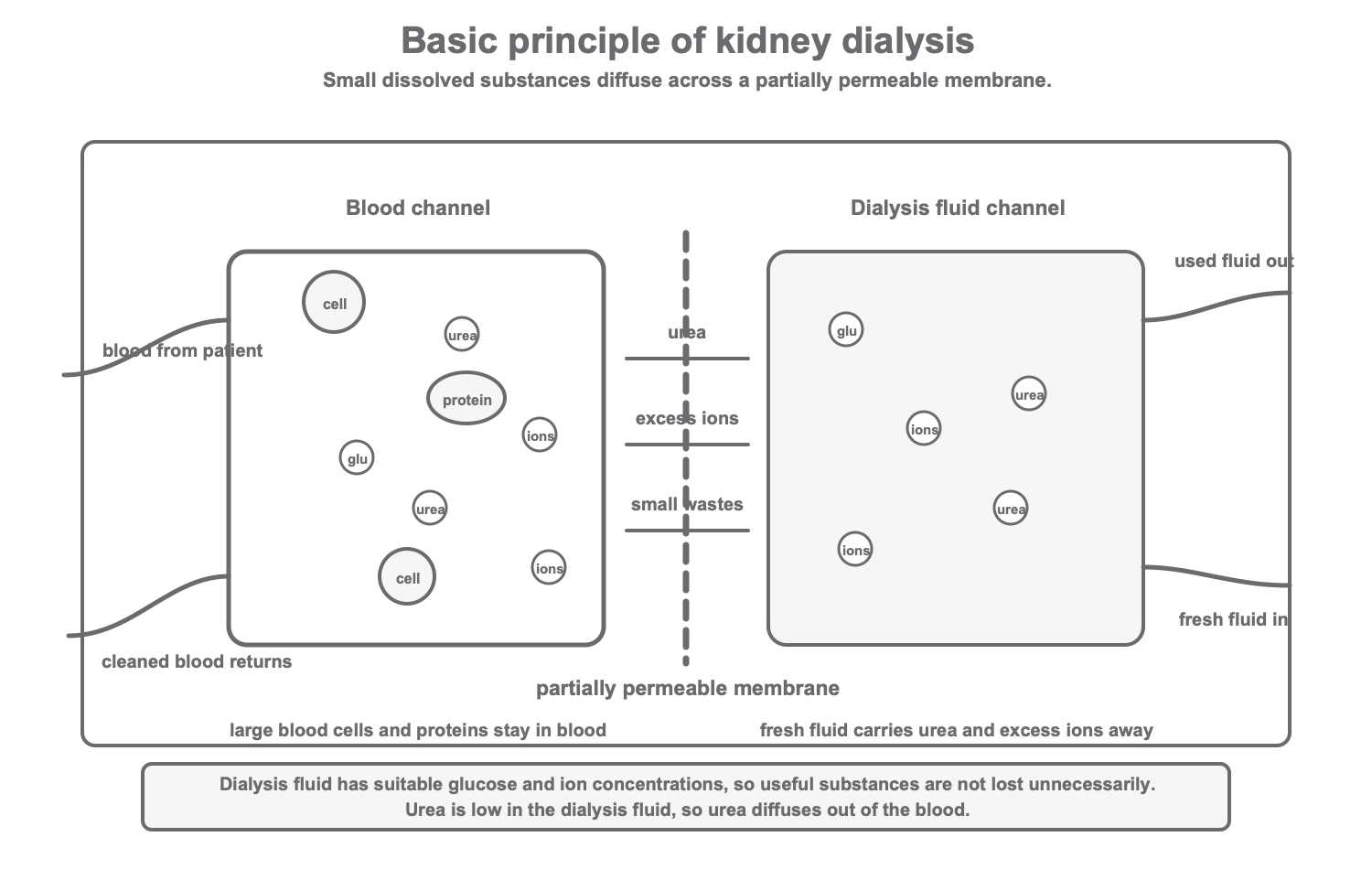
Small dissolved substances can move through the membrane by diffusion. Urea is at a higher concentration in the blood than in the fresh dialysis fluid, so urea diffuses out of the blood and into the dialysis fluid. If some ions are in excess in the blood, they can also diffuse into the dialysis fluid.
Blood cells and large proteins are too large to pass through the membrane, so they stay in the blood. The cleaned blood is returned to the patient.
Dialysis fluid
Dialysis fluid is not just water. Its composition is chosen carefully so that useful substances are not removed from the blood unnecessarily.
The dialysis fluid contains glucose at a suitable concentration. This means there is no large concentration gradient causing glucose to diffuse out of the blood. The dialysis fluid also contains needed ions at suitable concentrations. If the blood contains too much of a particular ion, that ion can diffuse out; if the ion concentration is already suitable, there is little net diffusion.
The dialysis fluid has no urea, or a much lower urea concentration than the blood. This creates the concentration gradient needed for urea to diffuse from the blood into the dialysis fluid.
| Substance or component | What happens during dialysis | Why |
|---|---|---|
| Urea | Diffuses from blood into dialysis fluid | Dialysis fluid has a very low urea concentration |
| Excess ions | Can diffuse from blood into dialysis fluid | Concentration gradient removes excess ions |
| Glucose | Mostly stays in the blood | Dialysis fluid has a suitable glucose concentration |
| Blood cells and large proteins | Stay in the blood | They are too large to cross the membrane |
Continue this lesson.
You’re previewing NovaLearn without an account. Create a free account to read the rest.
Create free account