4.6.2.3 - Selective breeding
Selective breeding is a way humans change the inherited characteristics of plants and animals over many generations. It is also called artificial selection because people, not the environment, choose which organisms reproduce. In this lesson, the main job is to explain the process clearly and weigh its useful impacts against risks such as inbreeding.
What selective breeding means
Selective breeding means humans choose plants or animals with particular genetic characteristics and breed them together. The word genetic matters because the characteristic must be inherited by offspring, not just caused by training, feeding or one organism's environment.
Selective breeding
Selective breeding, or artificial selection, is the process by which humans breed plants and animals for particular genetic characteristics.
Selective breeding has been used for thousands of years. Early farmers kept seeds from useful food crops and bred domesticated animals that had helpful features. Over many generations, this changed crops and animals from their wild ancestors.
The key comparison with natural selection is the selecting agent. In natural selection, the environment affects which variants are more likely to survive and reproduce. In selective breeding, humans decide which parents are used for breeding because they show a desired characteristic.
Process over generations
Selective breeding starts with a mixed population. This means the individuals are not all the same; some show the desired characteristic more strongly than others. A breeder chooses parents that show the desired characteristic and breeds them together.
The offspring are then checked. Not every offspring will show the desired characteristic strongly, so the breeder selects offspring that do show it and breeds those together. This cycle is repeated for many generations until all the offspring show the desired characteristic.
[DIAGRAM: asset_name: selective-breeding-process - diagram 1; asset_slug: 082_4_6_2_3_selective_breeding_diagram1; file: diagram_assets/imagegen_regen_all/082_4_6_2_3_selective_breeding_diagram1_imagegen.png; recommended_method: codex_image_gen; description: Monochrome flow diagram showing selective breeding from a mixed population: choose parents with the desired inherited characteristic, breed them, select offspring with the characteristic, repeat over many generations, and end with offspring that all show the desired characteristic. Include a note that humans are the selecting agent. Do not include Punnett squares, genetic engineering, cloning, or allele calculations.]
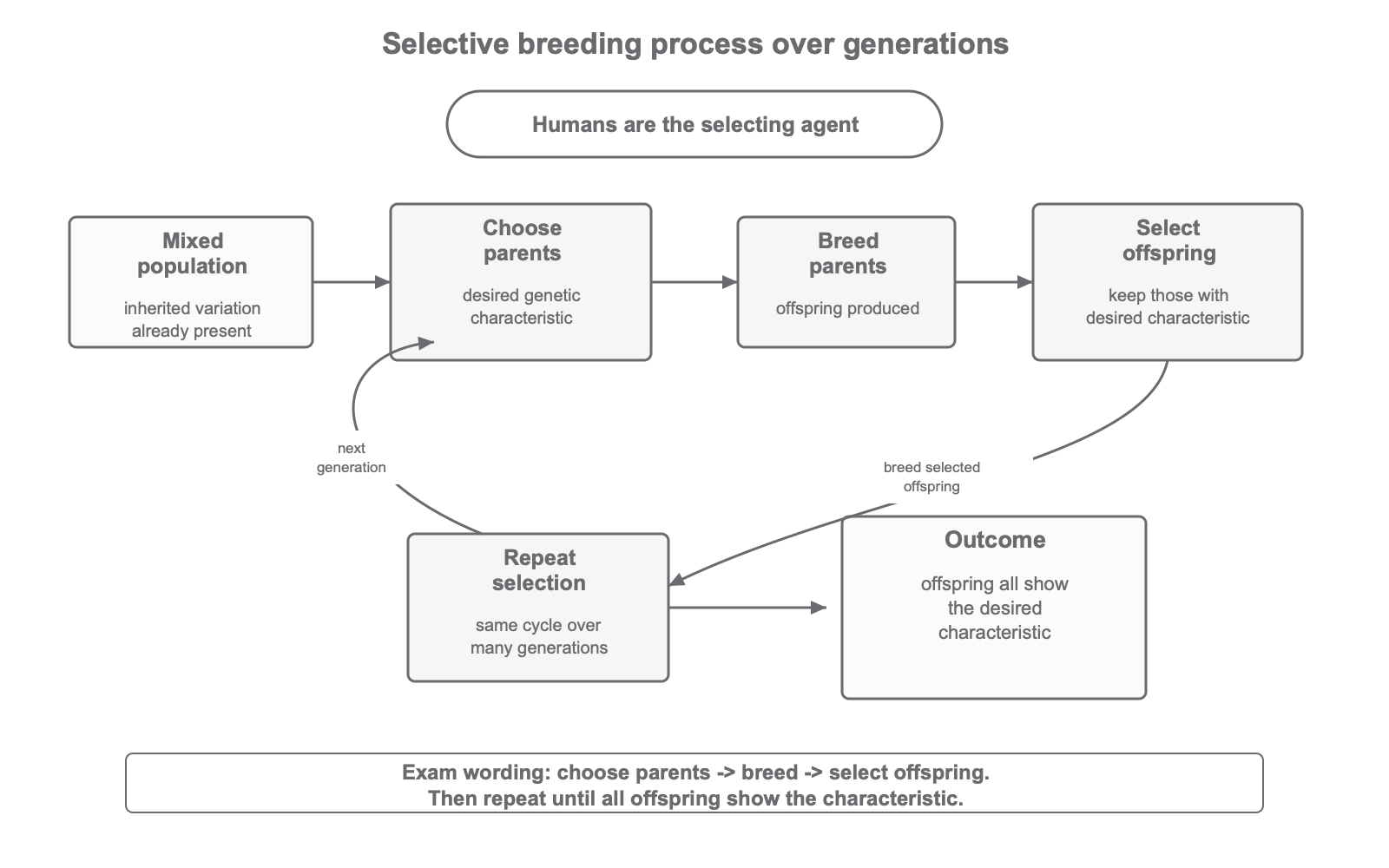
The repeated selection is essential. If two useful parents are bred once, the result is only one generation of offspring. Selective breeding is a programme over many generations, where humans keep choosing the individuals that best show the characteristic.
Chosen characteristics
The chosen characteristic can be useful or chosen for appearance. AQA names both food plants and domesticated animals, so strong answers should be able to use examples from each group.
| Example from the specification | Why humans might select it |
|---|---|
| Disease resistance in food crops | More crop plants may survive disease, so yield may be higher |
| Animals that produce more meat or milk | Farms may produce more food from the animals |
| Domestic dogs with a gentle nature | Dogs may be easier and safer to keep around people |
| Large or unusual flowers | Plants may be more attractive to gardeners or buyers |
Impact means the effect selective breeding has. A benefit is a positive impact, such as more food production or plants with a useful characteristic. An impact can also be negative, especially if the selected characteristic causes welfare or health problems.
Do not write that selective breeding creates a characteristic from nothing. The breeder selects from existing inherited variation in the population, then increases the frequency of the desired characteristic by controlling which organisms reproduce.
Continue this lesson.
You’re previewing NovaLearn without an account. Create a free account to read the rest.
Create free account