4.3.3.2 - Plant Defence Responses
Plants cannot run away from pathogens or herbivores, so they rely on built-in defences. In this biology-only AQA GCSE Biology lesson, the important skill is to describe examples of physical and chemical plant defence responses, and to recognise the mechanical adaptations AQA lists alongside them. Exam questions often test whether you can classify a defence and explain what it prevents.
Three Defence Categories
A plant defence response is a feature or response that helps a plant resist damage or infection. In this topic, the threats are mainly microorganisms, such as plant pathogens, and herbivores, which are animals that eat plants.
Herbivore
An animal that feeds on plants.
AQA groups the examples into three useful categories:
| Category | Main job in this lesson | AQA examples |
|---|---|---|
| Physical defence responses | Resist invasion by microorganisms | cellulose cell walls, tough waxy cuticle, layers of dead cells around stems |
| Chemical plant defence responses | Kill microorganisms or deter herbivores | antibacterial chemicals, poisons |
| Mechanical adaptations | Deter animals or trick animals | thorns and hairs, leaves that droop or curl when touched, mimicry |
[DIAGRAM: asset_name: plant_defence_categories - diagram 1; asset_slug: 042_4_3_3_2_plant_defence_responses_diagram1; file: diagram_assets/imagegen_regen_all/042_4_3_3_2_plant_defence_responses_diagram1_imagegen.png; recommended_method: codex_image_gen; description: Monochrome concept diagram of a plant with three labelled defence categories: physical barriers against microorganisms, chemical responses, and mechanical adaptations against animals, using only AQA-listed examples.]
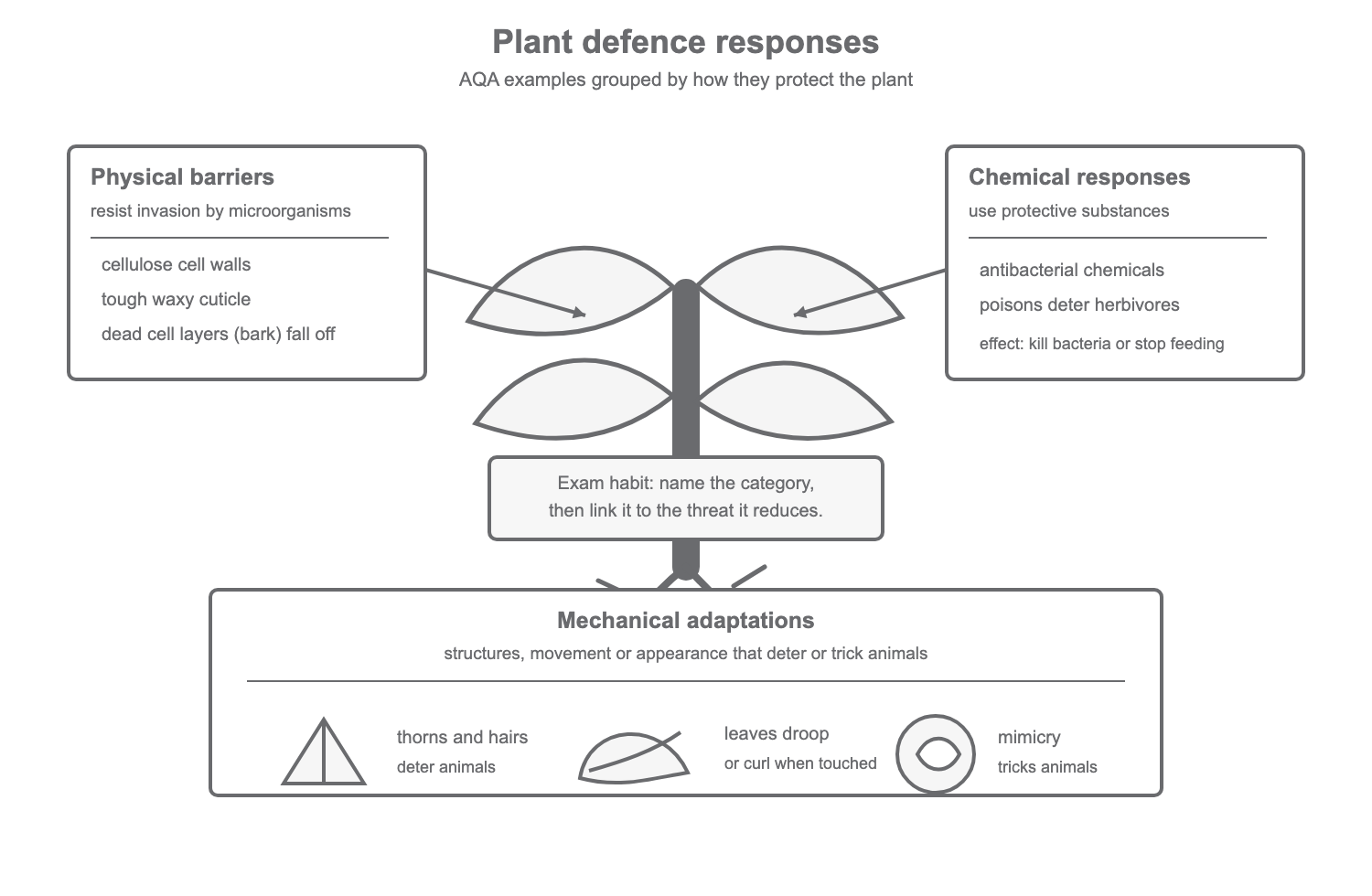
The category matters because it tells you what kind of answer to write. A waxy cuticle is not a poison, so it is not chemical. A poisonous berry is not a barrier layer, so it is not a physical response. A leaf curling when touched is a movement-based mechanical adaptation.
Physical Barriers
Physical plant defence responses are structures that form barriers. In this specification point, they resist the invasion of microorganisms. They make it harder for pathogens to get into living plant tissues.
Plant cells have cellulose cell walls. Cellulose makes the wall strong, so the wall forms a protective layer around each plant cell. A microorganism has to get past this barrier before it can infect the cell.
Leaves have a tough waxy cuticle on the surface. The cuticle helps form a barrier over the leaf, reducing the chance that microorganisms enter through the leaf surface. Do not describe the cuticle mainly as a chemical poison; in this lesson it is a physical barrier.
Stems of trees can have layers of dead cells around them. This is bark. Bark protects the living tissues underneath, and some outer bark can fall off. If microorganisms are on the outer dead layer, shedding that layer can help remove them from the plant surface.
Chemical Defences
Chemical plant defence responses involve substances produced by the plant. AQA names two: antibacterial chemicals and poisons to deter herbivores.
Antibacterial chemicals act against bacteria. A GCSE answer does not need the names of specific plant chemicals. The key idea is that the plant produces chemicals that can kill bacteria or reduce bacterial growth, so bacterial pathogens are less likely to infect or spread through the plant.
Poisons deter herbivores. A poison may make plant tissue harmful, unpleasant or painful to eat. This reduces the chance that animals keep eating the plant, so less of the plant is removed or damaged.
Be careful with the word toxin. It can be used for a poison, but do not drift into bacterial toxins from human disease. Here the poison is a plant defence against herbivores.
Continue this lesson.
You’re previewing NovaLearn without an account. Create a free account to read the rest.
Create free account