4.5.4.1b - Required Practical - Plant Responses
In this biology-only required practical, you investigate how light or gravity affects the growth of newly germinated seedlings. The practical is assessed through method, variables, control setups, length measurements, accurate labelled biological drawings and conclusions from data. The plant-hormone theory is only used here to explain what the evidence shows.
Aim and response types
The required practical is to investigate the effect of light or gravity on the growth of newly germinated seedlings. A newly germinated seedling has started to grow from a seed, so its root and shoot can be measured and observed.
Phototropism
A growth response by part of a plant to light.
The light version of RP8 uses this idea when seedlings grow differently in full light, one-sided light or darkness.
Gravitropism
A growth response by part of a plant to gravity. It may also be called geotropism.
In a light investigation, the independent variable is the light condition, such as full light, darkness or light from one direction. The dependent variable is usually seedling growth, measured as shoot height or increase in shoot length in mm. The appearance of the seedling, especially bending towards light, is also recorded in labelled biological drawings.
In a gravity investigation, the independent variable is the gravity condition experienced by the seedling, such as a stationary vertical dish compared with a rotating clinostat control. The dependent variable is the growth of the root or shoot, measured as length and shown in labelled drawings.
The same practical skill sits underneath both versions: change one environmental stimulus, keep other variables controlled, and record growth using both measurements and careful observations.
Light response method
[DIAGRAM: asset_name: plant-response-light-apparatus - diagram 1; asset_slug: 068_4_5_4_1b_required_practical_8_plant_responses_diagram1; file: diagram_assets/imagegen_regen_all/068_4_5_4_1b_required_practical_8_plant_responses_diagram1_imagegen.png; recommended_method: codex_image_gen; description: Monochrome labelled apparatus layout for RP8 light response showing three seedling dishes or pots: one in full light, one in a box with a side slit for one-sided light, and one in darkness; labels for damp cotton wool or soil, equal water, same seed type and age, same temperature, same time left, ruler/thread measurement in mm, repeated daily measurements and labelled biological drawings of appearance.]
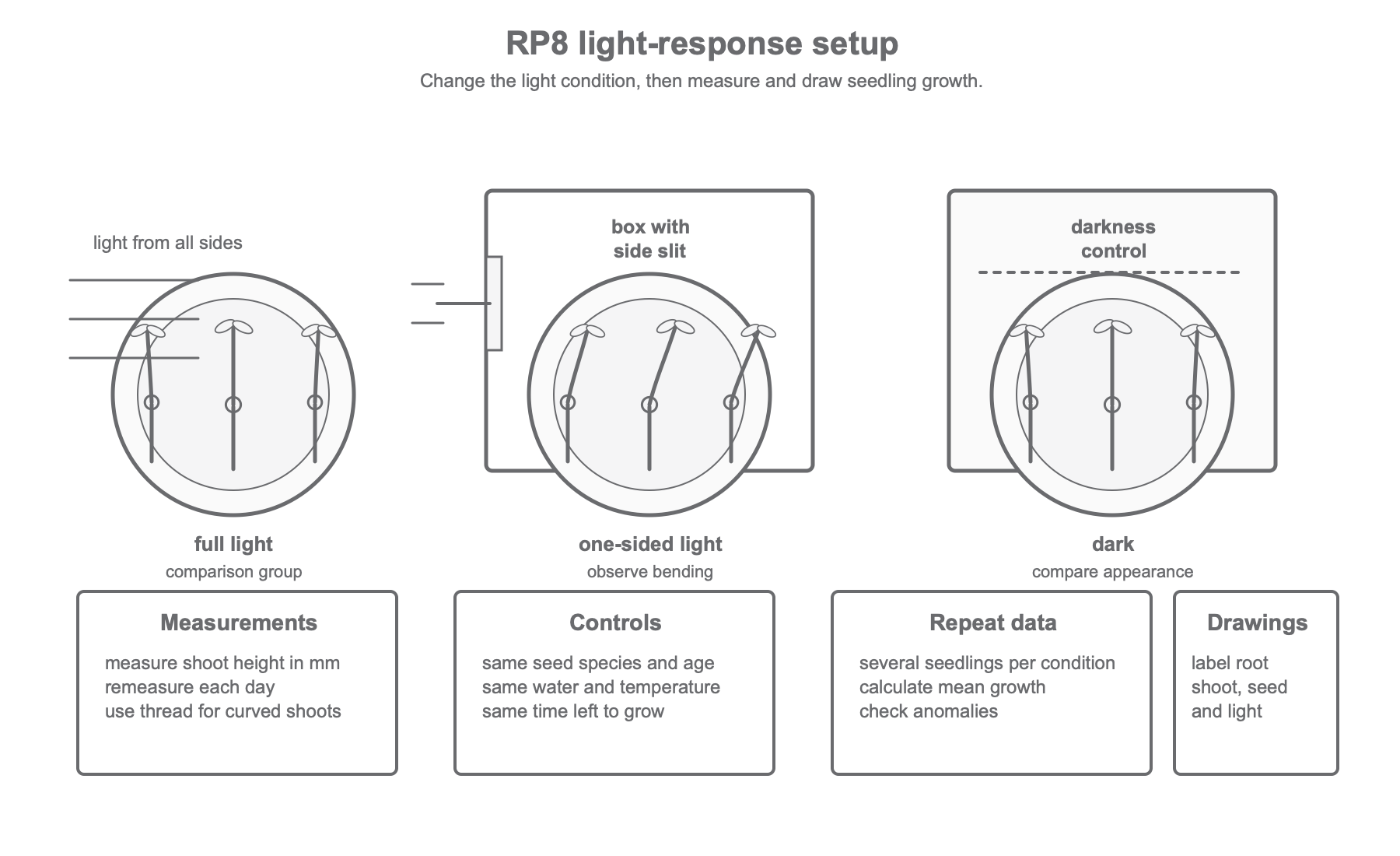
A common light-response method uses white mustard or cress seedlings because they germinate quickly. AQA's practical handbook uses Petri dishes with mustard seeds on damp cotton wool and compares light conditions such as full sunlight, partial light and darkness. Exam questions may also describe light from one direction using a box with a slit.
A valid light-response method is:
- Place damp cotton wool or the same soil in each Petri dish or pot.
- Add the same number of seeds to each dish, using the same species and similar seed age.
- Keep the dishes warm and undisturbed while the seeds germinate.
- Add equal amounts of water to each dish so water availability is controlled.
- When the seeds have germinated, make the number of seedlings in each dish the same by removing extras if needed.
- Put one group in full light, one group in darkness, and one group in one-sided or partial light.
- Leave all groups for the same length of time at the same temperature.
- Measure the shoot height or length of each seedling in
mm, repeating this every day for at least five days if the method is tracking growth over time. - Record the appearance of seedlings using accurate labelled biological drawings, such as whether shoots are straight or bending towards the light.
- Calculate the mean height or mean height increase for each group and compare the groups.
If shoots are curved, do not guess their length from a straight ruler placed beside the pot. Carefully straighten the shoot without damaging it, or use thread along the curve and then measure the thread with a ruler.
The light condition is the planned change. The measurement is seedling growth, and the drawing records visible features such as bending.
Good control variables include seed species, seedling age, number of seedlings, water volume, cotton wool or soil type, temperature, time left to grow and the way the height is measured.
Gravity response method
[DIAGRAM: asset_name: plant-response-gravity-apparatus - diagram 2; asset_slug: 068_4_5_4_1b_required_practical_8_plant_responses_diagram2; file: diagram_assets/imagegen_regen_all/068_4_5_4_1b_required_practical_8_plant_responses_diagram2_imagegen.png; recommended_method: codex_image_gen; description: Monochrome labelled gravity-response apparatus for RP8 showing a stationary vertical Petri dish with damp blotting paper in a dark box and a clinostat control that rotates; labels explain that darkness prevents phototropism, damp paper provides water without directing root growth, the stationary root bends downwards and grows longer, the clinostat control grows straight because the one-sided effect of gravity is averaged, and ink marks spread in the growing/bending region.]
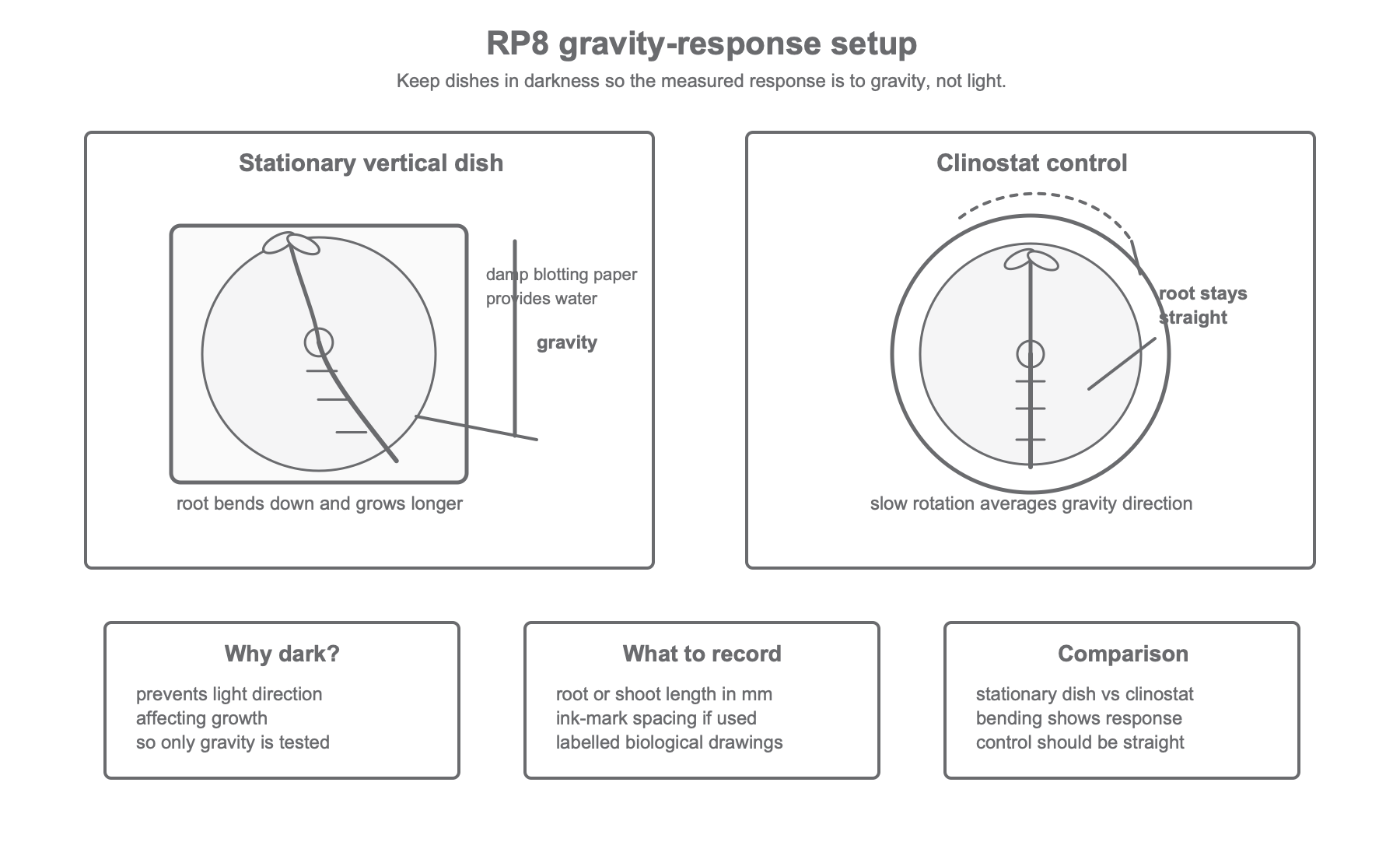
The gravity version investigates how roots or shoots grow when gravity is the stimulus. Seedlings are usually placed against damp blotting paper or cotton wool in a Petri dish, then the dish is placed vertically so the root is not already pointing straight down.
A valid gravity-response method is:
- Germinate seedlings until the roots and shoots are visible.
- Place similar seedlings on damp blotting paper or cotton wool in Petri dishes.
- Put small ink marks on the root if the investigation is measuring where growth occurs.
- Fix one Petri dish vertically and leave it stationary.
- Put a second Petri dish on a clinostat so it rotates slowly as a control.
- Keep both dishes in darkness for the same time, such as
24 hours, so light direction does not affect the result. - Record root or shoot length measurements and make labelled biological drawings before and after the time period.
- Compare the stationary seedlings with the clinostat control.
Continue this lesson.
You’re previewing NovaLearn without an account. Create a free account to read the rest.
Create free account