4.6.1.6a - Genetic Inheritance Terms and Gametes
Genetic inheritance uses a small set of precise words. They link the DNA carried on chromosomes to the alleles in gametes, the genotype an organism inherits, and the phenotype that may be expressed. This lesson builds that language and stops just before the full genetic-cross method, which is taught in the next split.
Chromosomes, genes and alleles
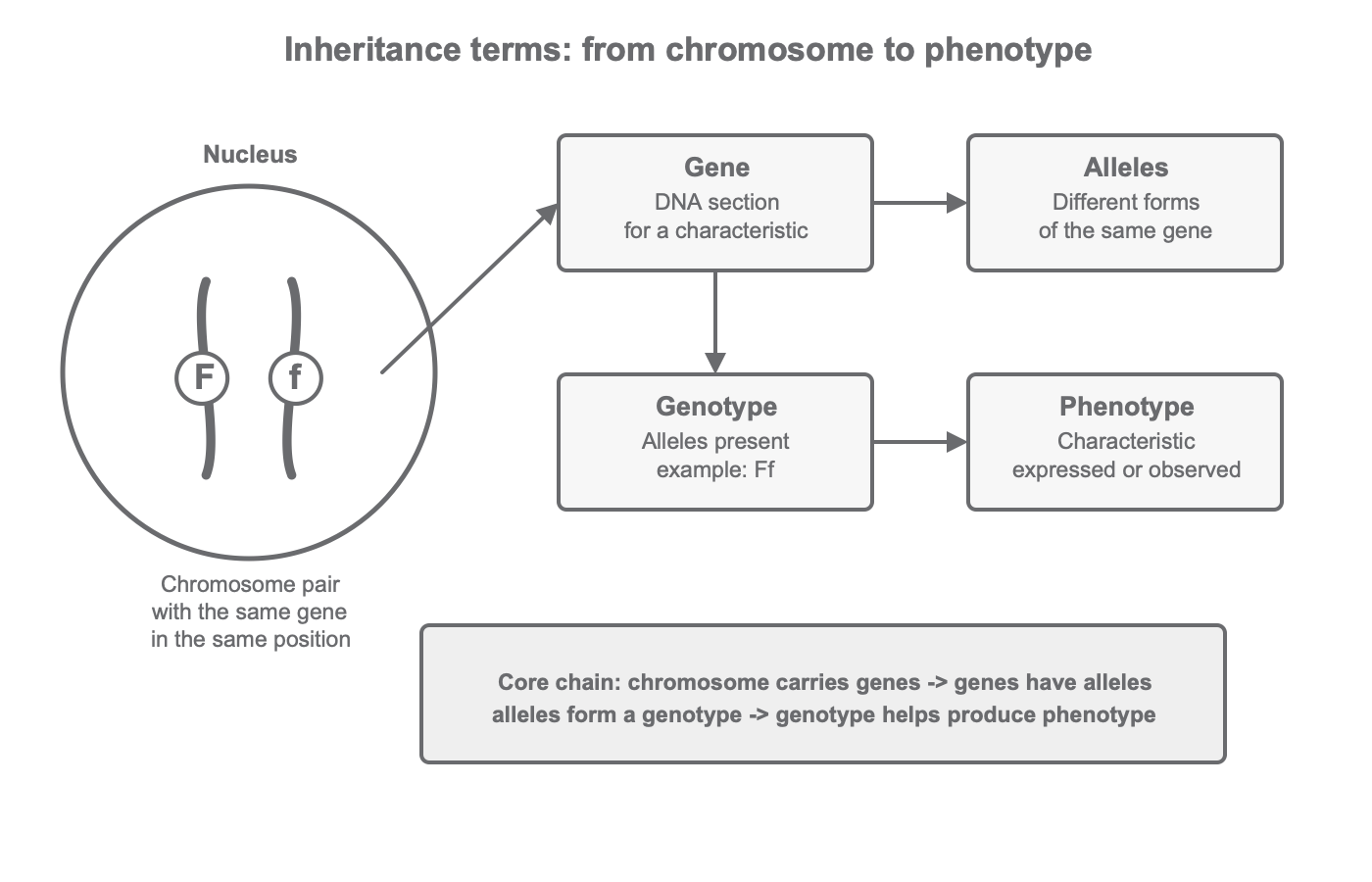
A chromosome is a long structure made of DNA. In plant and animal cells, chromosomes are found in the nucleus. Chromosomes carry many genes.
Chromosome
A structure made of DNA that carries genetic information in a cell.
A gene is a small section of DNA on a chromosome. At GCSE level, a gene can be described as a section of DNA that controls a characteristic by coding for a particular protein or part of a protein.
Gene
A small section of DNA on a chromosome that controls a characteristic by coding for a particular protein.
Different forms of the same gene are called alleles. For example, a gene involved in fur colour could have one allele that gives black fur and another allele that gives brown fur. The important idea is that the alleles are versions of the same gene, not different genes in different places.
Allele
A different form of the same gene.
[DIAGRAM: asset_name: inheritance-terms-map - diagram 1; asset_slug: 075_4_6_1_6a_genetic_inheritance_terms_and_gametes_diagram1; file: diagram_assets/imagegen_regen_all/075_4_6_1_6a_genetic_inheritance_terms_and_gametes_diagram1_imagegen.png; recommended_method: codex_image_gen; description: Monochrome map linking chromosome, gene, allele, genotype and phenotype. Show a nucleus containing a chromosome pair with a highlighted gene position, two allele versions labelled F and f, and a simple flow from gene versions to genotype to phenotype.]
Genotype and phenotype
The genotype is the combination of alleles an organism has for a gene. In simple GCSE inheritance examples, letters are often used to represent alleles. A capital letter can represent a dominant allele, such as F, and a lower-case version of the same letter can represent a recessive allele, such as f.
Genotype
The alleles present in an organism for a particular gene.
The phenotype is the characteristic that is expressed or observed. The genotype works at a molecular level to help develop the phenotype. For a simple single-gene example, FF and Ff might both give the same visible fur colour if F is dominant, while ff gives the recessive fur colour.
Phenotype
The characteristic that is expressed or observed in an organism.
Keep the two words separate: genotype is the allele combination, while phenotype is the characteristic. A genotype is written with allele symbols such as Ff; a phenotype is written in words such as black fur or brown fur.
| Term | GCSE meaning | Example for one gene |
|---|---|---|
| Genotype | Alleles present | FF, Ff or ff |
| Phenotype | Characteristic expressed | Fur colour |
Dominant, recessive and allele pairs
A dominant allele is always expressed if it is present. In allele notation, the dominant allele is usually shown with a capital letter. If F is dominant, an organism with genotype FF or Ff will show the dominant phenotype.
Dominant allele
An allele that is expressed even if only one copy is present.
A recessive allele is expressed only when two copies are present, so there is no dominant allele present. In allele notation, the recessive allele is usually shown with a lower-case letter. If f is recessive, the recessive phenotype is shown only by genotype ff.
Recessive allele
An allele that is expressed only if two copies are present.
The words homozygous and heterozygous describe whether the two alleles are the same or different.
| Genotype | Alleles present | Term | Phenotype if F is dominant |
|---|---|---|---|
FF | Two dominant alleles | Homozygous dominant | Dominant phenotype |
Ff | One dominant and one recessive allele | Heterozygous | Dominant phenotype |
ff | Two recessive alleles | Homozygous recessive | Recessive phenotype |
Homo- means same, which helps with homozygous: the alleles match. Hetero- means different, which helps with heterozygous: the alleles do not match.
Continue this lesson.
You’re previewing NovaLearn without an account. Create a free account to read the rest.
Create free account