4.7.5.2 - Farming Techniques
Modern farming can increase the efficiency of food production by changing how food animals use energy and nutrients. The AQA biology-only boundary is specific: limiting movement, controlling temperature, and using high-protein foods can increase growth, but some people have ethical objections to intensive farming methods. This lesson teaches the biology first, then shows how to evaluate the advantages and disadvantages without drifting into fisheries, biotechnology or crop farming.
Food-production efficiency
Food-production efficiency means how much useful food is produced compared with the resources put in. For food animals, the useful output might be animal biomass used as food. The main biological idea is that not all food eaten by an animal becomes growth.
Some food is used in respiration. Respiration transfers energy for life processes such as movement, digestion, keeping body temperature stable and building new molecules. Energy transferred for movement or temperature control is not available to become new biomass.
Food-production efficiency
Food-production efficiency is how effectively resources such as animal feed are converted into useful food for humans.
Use the phrase energy transfer to the environment carefully. The animal does not "waste" all of this energy on purpose. Heat is transferred to the surroundings during respiration and body-temperature control, and movement transfers energy away from growth.
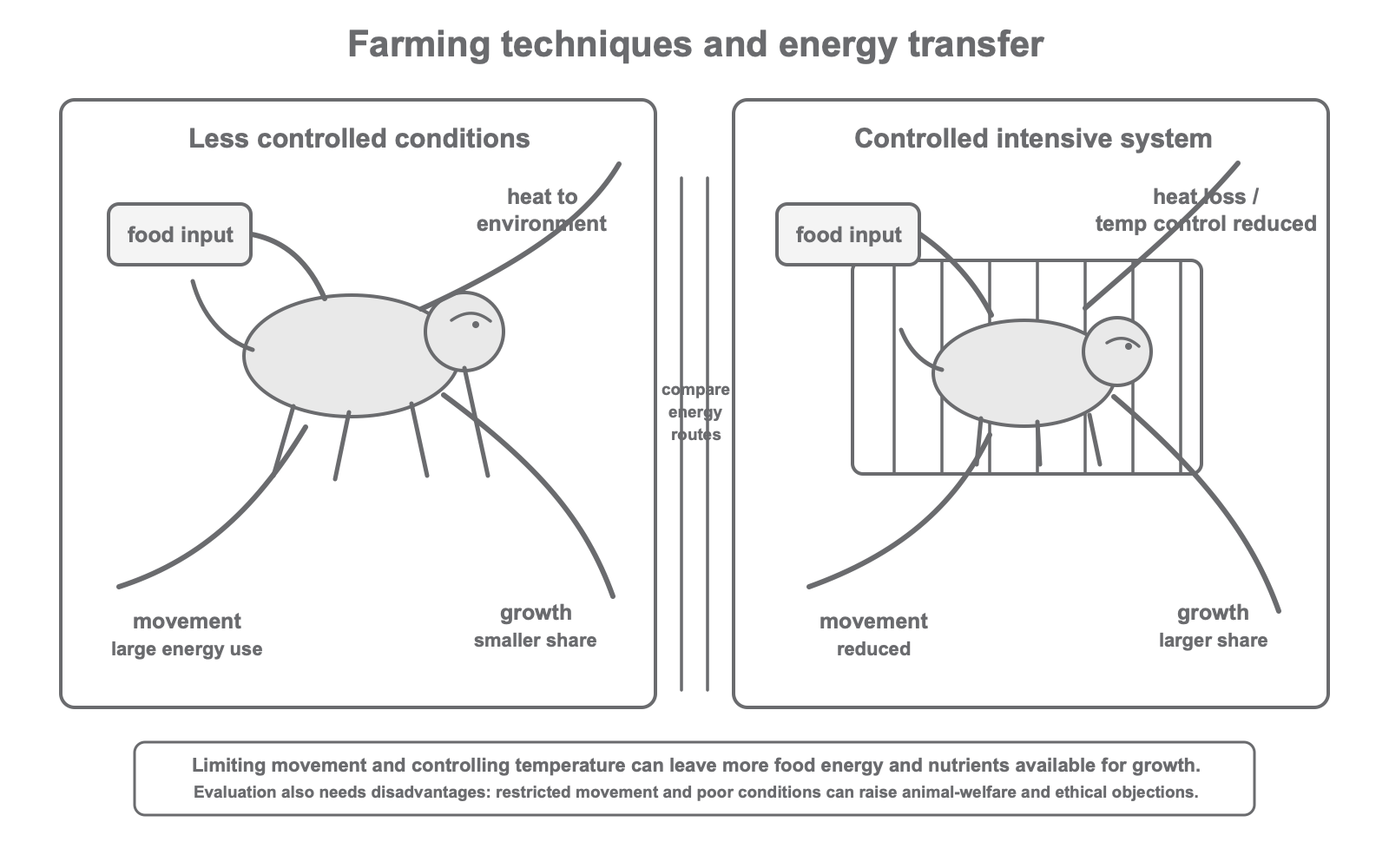
[DIAGRAM: asset_name: animal-energy-transfer-and-growth - diagram 1; asset_slug: 115_4_7_5_2_farming_techniques_diagram1; file: diagram_assets/imagegen_regen_all/115_4_7_5_2_farming_techniques_diagram1_imagegen.png; recommended_method: codex_image_gen; description: Monochrome comparison of a food animal in less controlled conditions and in an intensive controlled system. Food input arrows split into energy used for movement, energy transferred to the environment as heat/temperature control, and energy/nutrients available for growth. The controlled-system side shows smaller movement and heat-loss arrows and a larger growth arrow, with a note that welfare must be evaluated.]
Limiting movement
One modern farming technique is to limit the movement of food animals. If an animal moves less, its muscles contract less often. Muscle contraction needs energy transferred by respiration.
Limiting movement can therefore reduce the amount of food energy used for movement. More of the food energy and nutrients can be used for growth, so the animal may gain biomass faster. In an exam answer, make the link explicit:
less movement -> less energy used in respiration for muscle contraction -> more energy available for growth -> more food produced from the feed
This is not automatically a perfect method. The same restriction that increases efficiency can reduce welfare if animals cannot move normally or show natural behaviours. That tension is why AQA asks you to evaluate modern farming techniques, not just list them.
Controlling temperature
Food animals also use energy to control their body temperature. If surroundings are too cold, animals may use more energy in respiration to keep warm. If surroundings are too hot, energy and water may be used in cooling responses, and stress can reduce normal growth.
Farmers can control the temperature of the animals' surroundings, for example by using indoor housing, ventilation, heating or cooling. The GCSE point is not the engineering detail. The point is that keeping the surroundings closer to a suitable temperature reduces the energy transferred to the environment for temperature control.
When less food energy is needed for temperature regulation, more can be available for growth. This can improve the efficiency of food production because a greater proportion of the feed contributes to useful animal biomass.
Limiting movement and controlling temperature both improve efficiency by reducing energy transfer away from growth.
That does not remove the need for welfare judgement. A temperature-controlled system can be beneficial if it keeps animals comfortable, but it can be harmful if animals are crowded or unable to behave normally.
Continue this lesson.
You’re previewing NovaLearn without an account. Create a free account to read the rest.
Create free account