4.5.2.1b - Required Practical - Reaction Time
In this required practical, you investigate how a chosen factor affects human reaction time. The core skill is not just catching a ruler: it is planning a valid test, controlling variables, repeating measurements, calculating means and interpreting reaction-time data. AQA can assess the ruler-drop method, a computer-program method, and how to translate data between tables, calculations and graphs.
Aim and Reaction Time
Reaction time is the time taken to respond to a stimulus. In this practical, the stimulus might be seeing a ruler begin to fall, or seeing a computer screen change colour. The response is the action made by the participant, such as catching the ruler or pressing a key.
Reaction Time
The time taken for a person to respond to a stimulus.
The required practical is to investigate the effect of a factor on human reaction time. The factor might be practice, distraction, tiredness, age, caffeine, or another teacher-approved factor. The key point is that the factor must be changed in a planned way while the reaction-time test is kept as consistent as possible.
Do not turn this lesson into the full reflex-arc topic. You only need enough biology vocabulary to describe the stimulus, the response, and the time between them.
Ruler-Drop Method
[DIAGRAM: asset_name: reaction-time-ruler-drop-apparatus - diagram 1; asset_slug: 053_4_5_2_1b_required_practical_7_reaction_time_diagram1; file: diagram_assets/imagegen_regen_all/053_4_5_2_1b_required_practical_7_reaction_time_diagram1_imagegen.png; recommended_method: codex_image_gen; description: Monochrome apparatus layout showing a seated participant with forearm on a table and hand over the edge, a second person holding a metre ruler vertically with the zero mark level with the top of the thumb, labels for no warning/no push, same dominant hand, same starting position, repeated trials, and conversion from distance caught to reaction time.]
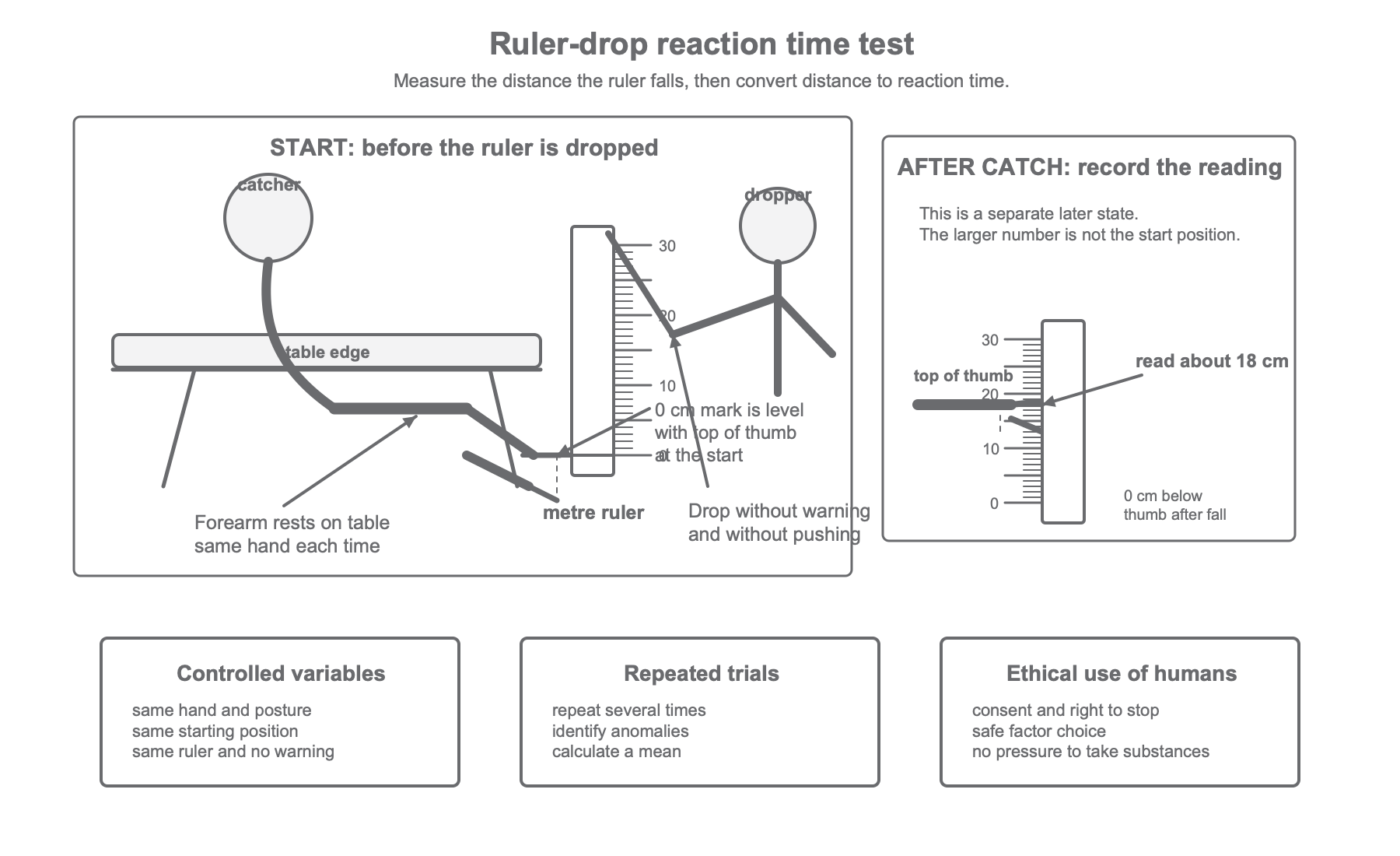
The standard school method uses a metre ruler, a table and a chair. It measures how far the ruler falls before the participant catches it. A shorter distance means the participant caught the ruler sooner, so the reaction time is shorter.
A valid ruler-drop method is:
- Ask the participant for consent and check they understand the task.
- The participant sits with good posture and places the forearm of their dominant hand across the table, with the hand overhanging the edge.
- The partner holds the ruler vertically between the participant's thumb and finger, without touching them.
- The zero mark of the ruler is level with the top of the participant's thumb.
- The partner drops the ruler without warning and without pushing it down.
- The participant catches the ruler as quickly as possible.
- Record the distance on the ruler level with the top of the thumb.
- Repeat several times, then convert the ruler distances into reaction times using the provided conversion table, scale or equation.
If the investigation is about a factor, collect data before and after changing the factor, or compare two controlled conditions. For example, a student could measure reaction time in quiet conditions and then repeat the same test with distracting music.
Variables, Validity and Ethics
The independent variable is the factor being changed, such as practice, distraction, caffeine condition or amount of sleep. The dependent variable is the reaction time, measured in seconds or milliseconds. In a ruler-drop test, the raw measurement is distance fallen, which is then converted to reaction time.
Validity means the investigation is really testing the chosen factor. For a ruler-drop test, useful control variables include:
- same participant, or similar participants if groups are compared
- same hand each time, usually the dominant hand
- same ruler, held with the same end at the top
- same starting position, with the zero mark level with the thumb
- same posture and forearm position
- no warning before the ruler is dropped
- same environment, such as light, noise and distractions
- same rest time between trials
- same time interval after the factor is applied, such as the same time after drinking coffee if caffeine is being investigated
Ethics matter because humans are the test subjects. Participants should give consent, be allowed to stop, and not be pressured to consume caffeine or any other substance. If caffeine is used, it must be teacher-approved and safe for the participant; a safer design might compare normal intake with no additional caffeine, or use a non-drug factor such as practice or distraction.
If a question asks how to improve validity, name the exact control. "Make it fair" is too vague. "Use the same hand each time" or "drop the ruler from the same starting position" can earn credit because each one explains what is actually controlled.
Continue this lesson.
You’re previewing NovaLearn without an account. Create a free account to read the rest.
Create free account