4.6.1.8 - Sex Determination
Human sex determination in this AQA GCSE Biology section is about one chromosome pair. Ordinary human body cells contain 23 pairs of chromosomes: 22 pairs control characteristics only, and one pair carries genes that determine sex. The key skill is to use a simple genetic cross to show why the expected sex-chromosome outcomes are in a 1:1 ratio.
Chromosome pairs in body cells
An ordinary human body cell contains 23 pairs of chromosomes. Most of these chromosome pairs are not the sex chromosomes: 22 pairs control characteristics only. The remaining pair carries genes that determine sex.
Sex chromosomes
Sex chromosomes are the chromosome pair that carries genes that determine sex.
[DIAGRAM: asset_name: human-sex-chromosome-pairs: Human body-cell chromosome pairs and sex chromosomes - diagram 1; asset_slug: 079_4_6_1_8_sex_determination_diagram1; file: diagram_assets/imagegen_regen_all/079_4_6_1_8_sex_determination_diagram1_imagegen.png; recommended_method: codex_image_gen; description: Monochrome deterministic diagram showing an ordinary human body cell with 23 chromosome pairs, 22 pairs that control characteristics only, and the one sex chromosome pair represented as XX in females or XY in males.]
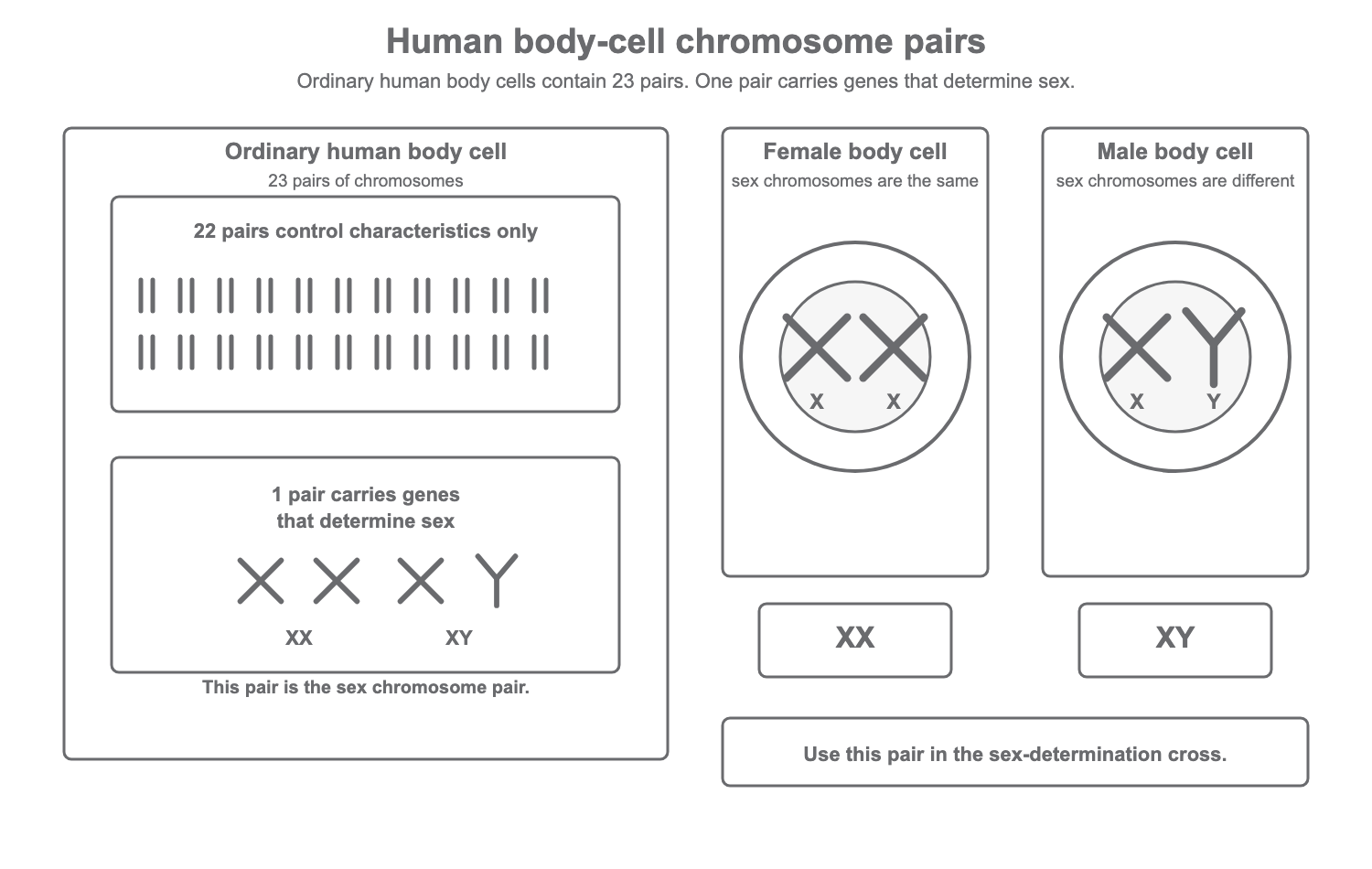
The exam wording is exact. It is not enough to say that "chromosomes determine sex"; only one chromosome pair is the sex chromosome pair. The other 22 pairs are still chromosomes, but in this specification row they are described as controlling characteristics only.
XX and XY sex chromosomes
In females, the sex chromosomes are the same: XX. In males, the sex chromosomes are different: XY. These letters describe the sex chromosome pair in ordinary body cells.
You should use the letters exactly. XX means two X chromosomes. XY means one X chromosome and one Y chromosome. This AQA row is about the inheritance of whole sex chromosomes, so the cross uses X and Y rather than different forms of a gene.
For this GCSE model, females are XX and males are XY.
Use this contrast when identifying the sex-chromosome pair in each parent.
Gametes for the cross
To carry out the genetic cross, use the sex chromosomes that can be passed on in gametes. A gamete is a sex cell; in this cross, the gametes are egg cells and sperm cells.
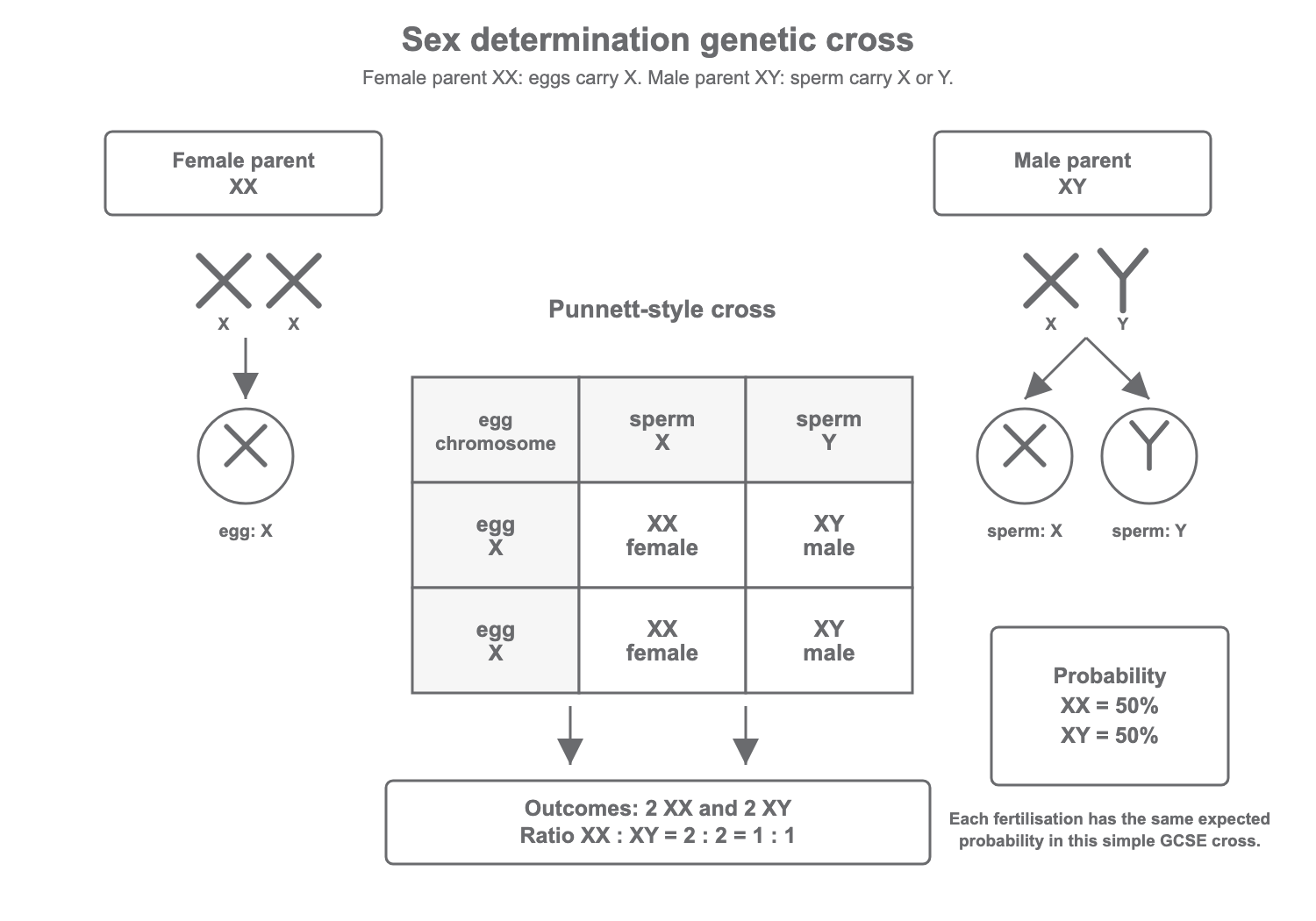
The female parent is XX, so each egg cell carries an X chromosome. The male parent is XY, so sperm cells can carry either an X chromosome or a Y chromosome. When an egg and sperm join, the offspring receives one sex chromosome from each parent.
This is why the sperm chromosome changes the outcome in the simple cross. An X-carrying sperm gives XX. A Y-carrying sperm gives XY.
Sex inheritance cross
A genetic cross combines the possible chromosomes from each parent's gametes. In this cross, every egg cell contributes X. Half of the sperm possibilities are X and half are Y, so the possible offspring sex chromosomes are XX and XY.
[DIAGRAM: asset_name: sex-inheritance-punnett-cross: Punnett-style sex determination cross - diagram 2; asset_slug: 079_4_6_1_8_sex_determination_diagram2; file: diagram_assets/079_4_6_1_8_sex_determination_diagram2.png; recommended_method: deterministic_drawn; description: Monochrome deterministic Punnett-style sex determination cross with female parent XX producing X eggs, male parent XY producing X or Y sperm, offspring combinations XX, XY, XX and XY, and the simplified 1:1 ratio.]
Continue this lesson.
You’re previewing NovaLearn without an account. Create a free account to read the rest.
Create free account