4.3.1.6 - Human Defence Systems
Pathogens can cause communicable disease only if they reach a place in the body where they can survive and reproduce. The human body therefore has two broad layers of defence: non-specific systems that reduce pathogen entry, and the immune system, which responds if pathogens get inside. This lesson stays inside the AQA boundary: skin, nose, trachea and bronchi, stomach, and three white blood cell defences.
Barriers and the immune system
A pathogen is a microorganism that causes infectious disease. Human defence systems reduce the chance that pathogens cause disease.
Non-specific defence
A defence that acts against many different pathogens in the same general way, rather than targeting one named pathogen.
The skin, nose, trachea and bronchi, and stomach are non-specific defences. They help stop pathogens from entering the body or help destroy pathogens before they reach body tissues.
The immune system is the body's internal defence against disease. If a pathogen enters the body, the immune system tries to destroy it. White blood cells are important immune-system cells because they can engulf pathogens, produce antibodies and produce antitoxins.
[DIAGRAM: asset_name: human-defence-systems-overview - diagram 1; asset_slug: 035_4_3_1_6_human_defence_systems_diagram1; file: diagram_assets/imagegen_regen_all/035_4_3_1_6_human_defence_systems_diagram1_imagegen.png; recommended_method: codex_image_gen; description: Monochrome two-stage overview showing non-specific barriers at body entry points: skin barrier, nose hairs and mucus, trachea/bronchi mucus and cilia, and stomach acid; then an internal immune-response panel showing white blood cells carrying out phagocytosis, antibody production and antitoxin production.]
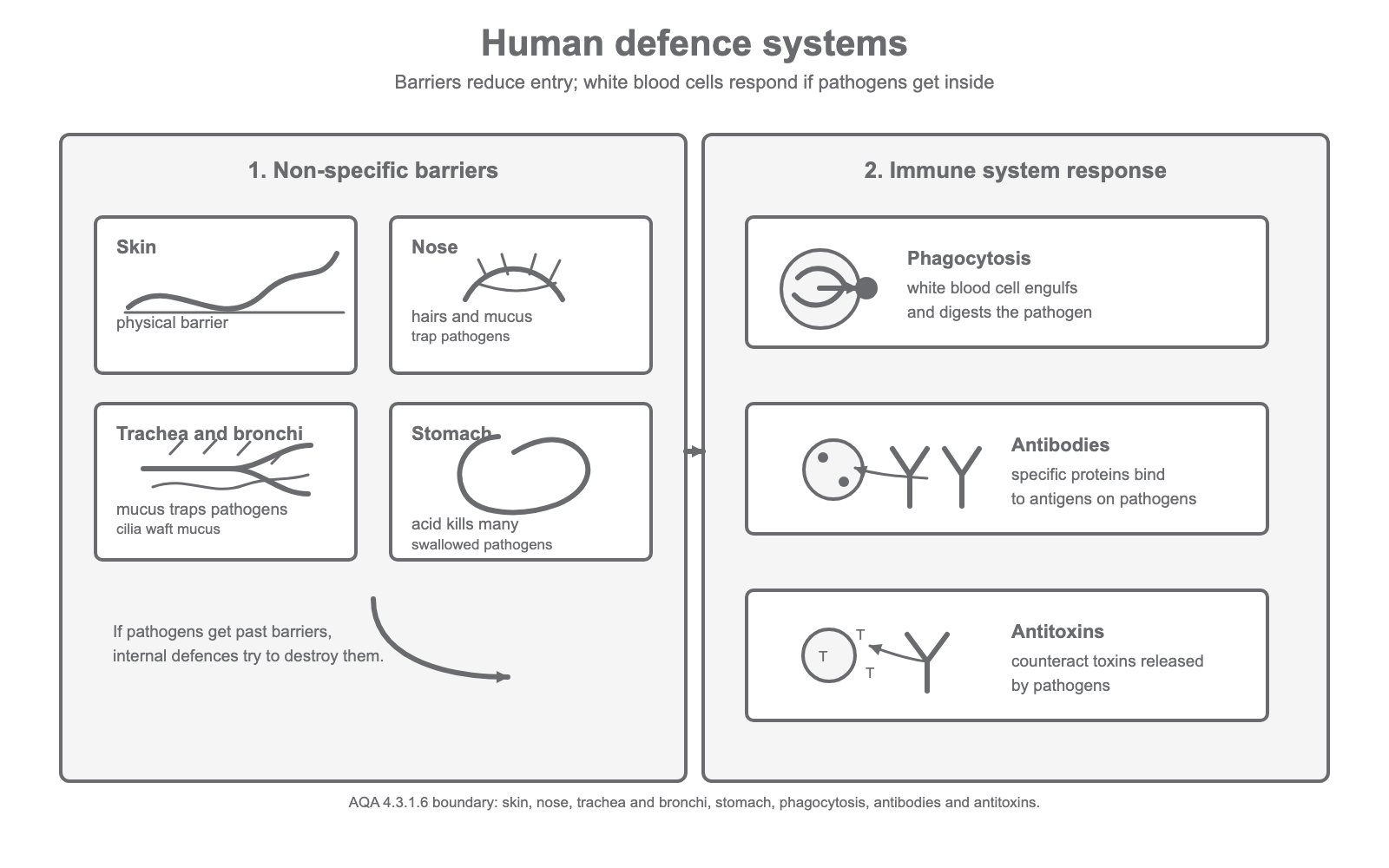
Do not treat these two layers as the same thing. Barriers mainly reduce entry. The immune system acts if pathogens get past those barriers and enter body tissues or blood.
Skin and nose
The skin is a physical barrier. It covers the outside of the body and makes it harder for pathogens to enter body tissues. If the skin is cut, a clot can form and dry into a scab. This helps close the gap, reducing blood loss and reducing the chance of pathogens entering through the wound.
The nose protects the airways. Nose hairs and sticky mucus trap particles and microorganisms from inhaled air. Trapping pathogens is useful because it keeps many of them away from the deeper parts of the breathing system.
Mucus
A sticky secretion that can trap pathogens and particles.
In an exam, the strongest answer links the structure to the defence. For example, "mucus traps pathogens" is better than just "the nose has mucus".
Airways and stomach
The trachea and bronchi are airways that lead towards the lungs. Their lining produces mucus, which traps pathogens and dust. The lining also has tiny hair-like structures called cilia.
Cilia
Tiny hair-like structures on some cells that can move mucus along a surface.
In the trachea and bronchi, cilia waft mucus upwards towards the throat. The mucus can then be swallowed. This matters because swallowed pathogens are carried to the stomach.
The stomach contains acid. The acid kills many pathogens that are swallowed in food, water or mucus. This is a chemical defence, but it is still non-specific because it does not target one particular pathogen.
Mucus traps pathogens, cilia move the mucus, and stomach acid kills many swallowed pathogens.
Now keep the sequence clear: trap, move, swallow, kill.
Continue this lesson.
You’re previewing NovaLearn without an account. Create a free account to read the rest.
Create free account