4.5.3.6 - Hormones to Treat Infertility
This Higher Tier lesson is about using hormones in modern reproductive technologies to treat infertility. The key idea is that FSH and LH can be given to stimulate egg maturation, either so pregnancy may happen in the normal way or as part of IVF. Keep the boundary tight: this is not a full lesson on every reproductive technology.
Infertility and hormones
Infertility means difficulty becoming pregnant. AQA focuses on one way infertility can be treated: giving reproductive hormones to a woman so that eggs mature and can be fertilised.
The hormones named in this specification point are FSH and LH. In the menstrual-cycle lesson, FSH is linked with egg maturation and LH is linked with release of an egg. In this lesson, the important treatment idea is simpler: FSH and LH can be given as part of fertility treatment to stimulate egg maturation.
Fertility drug
A treatment containing hormones such as FSH and LH, used to stimulate egg maturation in the ovary.
This whole specification point is Higher Tier only. A good HT answer explains how the hormones are used and then evaluates the method, instead of only naming FSH and LH.
Fertility drugs
One fertility-treatment route is to give FSH and LH in a fertility drug. These hormones stimulate egg maturation in the ovary. If an egg is released and sperm reaches it inside the woman's reproductive system, fertilisation may happen inside the body and she may become pregnant in the normal way.
This wording matters. The fertility drug does not fertilise the egg itself. The drug stimulates egg maturation; fertilisation and pregnancy may then happen through the usual route inside the body.
Keep the answer focused:
| Step | What happens |
|---|---|
| 1 | FSH and LH are given in a fertility drug. |
| 2 | The hormones stimulate egg maturation in the ovary. |
| 3 | An egg may be released. |
| 4 | Fertilisation may happen inside the body, so pregnancy may occur in the normal way. |
Do not use this section to revise the separate sibling topic about preventing pregnancy; here the aim is increasing the chance of pregnancy.
IVF sequence
IVF stands for in vitro fertilisation. In vitro means outside the body, so IVF involves fertilising eggs with sperm in a laboratory.
IVF
In vitro fertilisation: a fertility treatment in which eggs are fertilised by sperm outside the body in a laboratory, and an embryo is then inserted into the uterus.
In IVF, the hormones are used at the start. FSH and LH are given to stimulate the maturation of several eggs. Several eggs are stimulated because not every collected egg will necessarily fertilise and develop into an embryo suitable for transfer.
[DIAGRAM: asset_name: hormone-assisted-fertility-routes - diagram 1; asset_slug: 065_4_5_3_6_hormones_to_treat_infertility_diagram1; file: diagram_assets/imagegen_regen_all/065_4_5_3_6_hormones_to_treat_infertility_diagram1_imagegen.png; recommended_method: codex_image_gen; description: Monochrome flow diagram comparing the two AQA-required hormone-assisted fertility routes. The first route shows FSH and LH fertility drugs stimulating egg maturation so fertilisation may happen inside the body and pregnancy may occur in the normal way. The second route shows IVF: FSH and LH stimulate several eggs, eggs are collected, fertilised by sperm in the laboratory, embryos develop into tiny balls of cells, and one or two embryos are inserted into the uterus.]
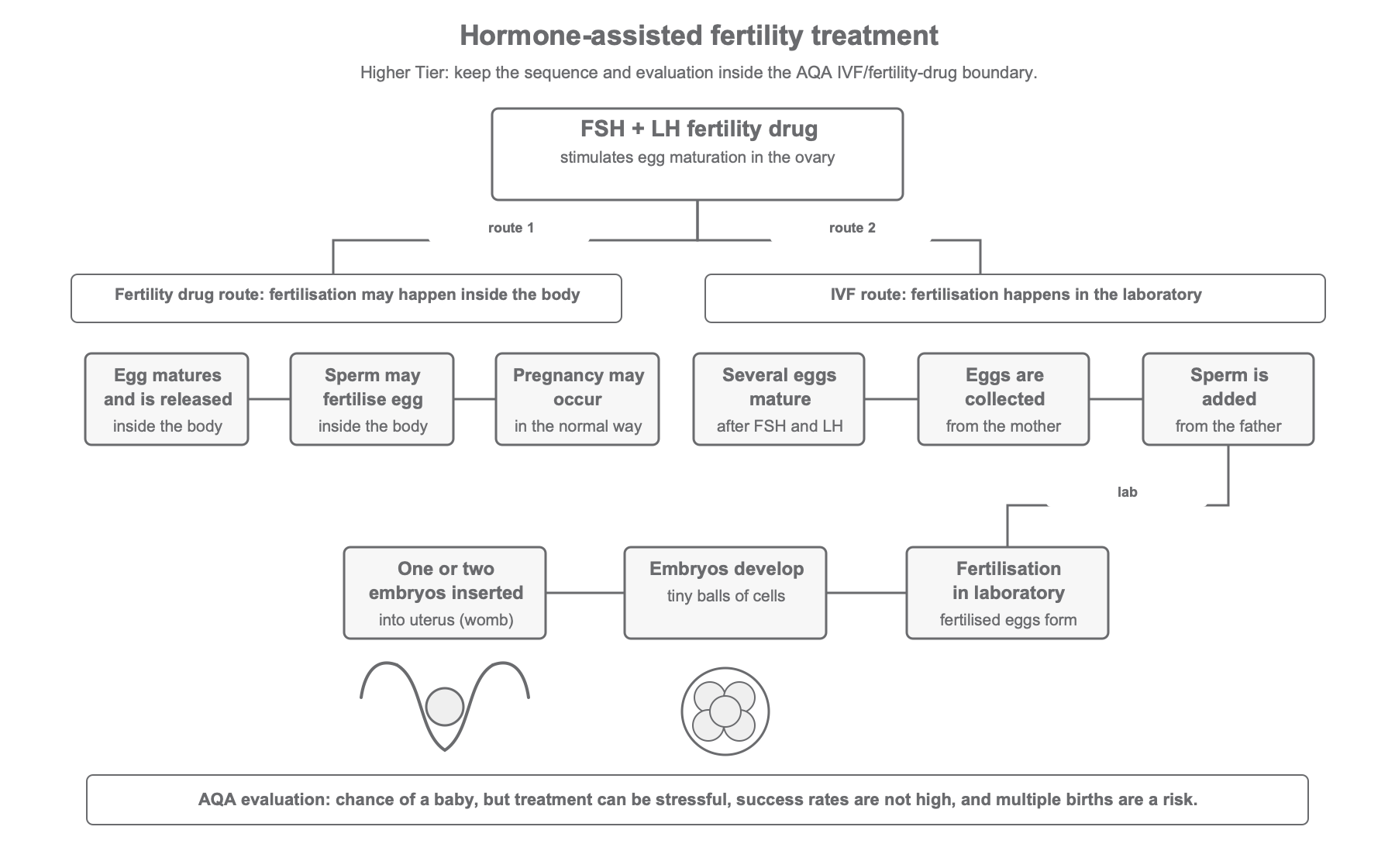
The required IVF sequence is:
- FSH and LH are given to stimulate the maturation of several eggs.
- The eggs are collected from the mother.
- The eggs are fertilised by sperm from the father in the laboratory.
- The fertilised eggs develop into embryos.
- When the embryos are tiny balls of cells, one or two embryos are inserted into the mother's uterus, or womb.
The official GCSE wording uses mother and father for the eggs and sperm in this sequence. Do not add extra reproductive-technology details unless a question explicitly gives that information; they are outside this specification point.
Continue this lesson.
You’re previewing NovaLearn without an account. Create a free account to read the rest.
Create free account