4.6.3.5 - Fossils
Fossils are evidence from organisms that lived millions of years ago, usually found in rocks. They do not give a perfect record of every organism that has ever lived, but they can show how much or how little organisms have changed as life developed on Earth. In this lesson, the key skills are to describe how fossils form, explain why the fossil record is incomplete, and interpret fossil information in tables, graphs and evolutionary trees.
What fossils are
A fossil is the remains of an organism from millions of years ago, found in rocks. In GCSE Biology, "remains" is used broadly: a fossil might be part of an organism, such as a shell or bone, or it might be a preserved trace of activity, such as a footprint or burrow.
Fossil
A fossil is the remains or preserved trace of an organism from millions of years ago, found in rocks.
This matters because fossils are not only dinosaur bones. A footprint can be a fossil because it is evidence that an organism was once there. A burrow can be a fossil because it records an organism's activity even if the body itself has not been preserved.
For exam answers, use exact wording. If a question asks for what a fossil is, include the idea of organisms from millions of years ago and rocks. If it asks for examples, give both body remains and traces only if the question allows more than one answer.
How fossils form
AQA expects three ways fossils may form. First, parts of organisms may not decay because one or more of the conditions needed for decay are absent. Decay usually needs decomposers and suitable conditions for them to work, so if conditions are unsuitable, parts of the organism may be preserved.
Second, parts of the organism may be replaced by minerals as they decay. This is common for hard parts such as bones, teeth, shells and wood. The original material breaks down, but minerals are deposited in its place, preserving the shape of the part.
Third, fossils may be preserved traces of organisms. These include footprints, burrows and rootlet traces. Trace fossils are evidence of behaviour or growth, not preserved body parts.
[DIAGRAM: asset_name: fossil-formation-routes: Three ways fossils may form - diagram 1; asset_slug: 091_4_6_3_5_fossils_diagram1; file: diagram_assets/imagegen_regen_all/091_4_6_3_5_fossils_diagram1_imagegen.png; recommended_method: codex_image_gen; description: Monochrome three-panel diagram showing fossils forming when decay conditions are absent, when body parts are replaced by minerals as they decay, and when traces such as footprints, burrows and rootlet traces are preserved.]
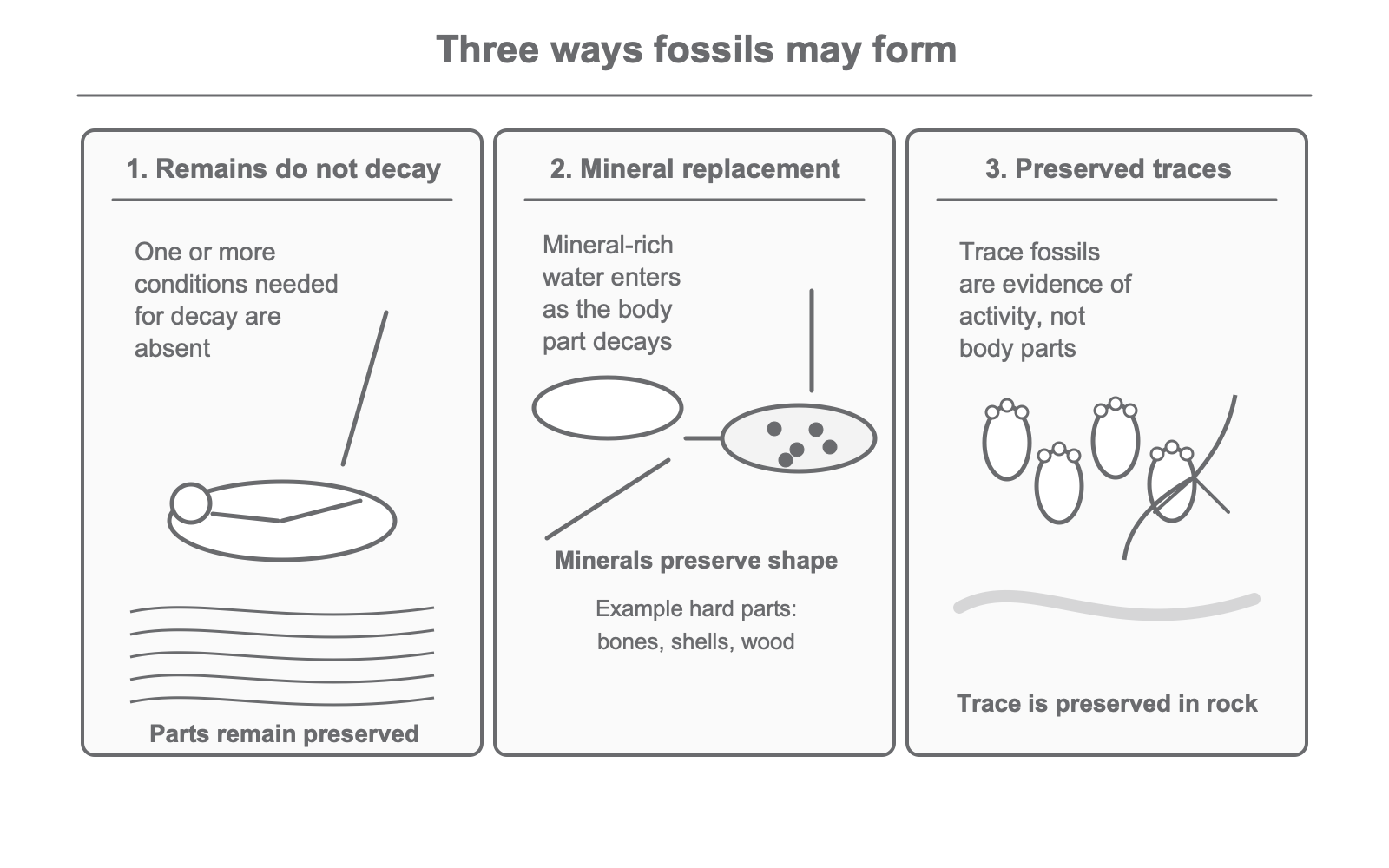
The safest way to revise this is as a three-route list:
- Parts do not decay because conditions for decay are absent.
- Parts are replaced by minerals as they decay.
- Traces such as footprints, burrows or rootlet traces are preserved.
The incomplete fossil record
The fossil record means all the fossils that scientists have found and described. It is useful evidence, but it is incomplete. Many organisms never become fossils at all, and many fossils that did form have not survived or have not been found.
Fossil record
The fossil record is the collection of fossils known from rocks.
There are two main reasons from the specification. Many early forms of life were soft-bodied, so they left few traces behind. Soft parts usually decay more easily than hard parts, so organisms without shells, bones or other hard structures are less likely to be preserved.
The second reason is geological activity. Rocks can be changed, buried deeply, heated, folded, uplifted, weathered or eroded over millions of years. This can destroy traces that were once present. The older the rocks and fossils are, the more time there has been for these changes to happen.
Because early life was often soft-bodied and traces have often been destroyed, scientists cannot be certain about how life began on Earth. That does not mean scientists know nothing. It means the available fossil evidence has gaps, so explanations must be based on incomplete evidence and can be revised if new evidence is found.
After your explanation, check the wording. A strong GCSE answer says "incomplete", "few traces" and "destroyed by geological activity", rather than making a vague claim that fossils are just "hard to find".
Continue this lesson.
You’re previewing NovaLearn without an account. Create a free account to read the rest.
Create free account