4.3.3.1 - Detection And Identification Of Plant Diseases
Plant disease diagnosis starts with careful observation: what has changed in the plant, and where? This AQA Biology-only lesson covers the signs that can help detect plant disease, the methods used to identify the cause, and the limited plant disease and ion-deficiency examples required by the specification. The symptom and identification method lists are Higher-tier only, so they are flagged clearly.
Scope And Key Idea
This section of the specification is biology only. Within it, the signs used to detect plant diseases and the methods used to identify them are marked HT only. The named plant problems and ion deficiencies must still stay inside the AQA boundary.
Plants can be infected by viral, bacterial and fungal pathogens. They can also be affected by insects and by ion deficiency conditions. The exam skill is to move carefully from evidence to conclusion: a symptom may show that a plant is unhealthy, but it may not prove the exact cause.
Plant disease
A condition that damages a plant or stops it working normally, often because of a pathogen, pest or ion deficiency.
For this lesson, AQA restricts named plant disease knowledge to:
| Problem type | AQA example |
|---|---|
| Viral disease | Tobacco mosaic virus |
| Fungal disease | Black spot |
| Insect problem | Aphids |
| Ion deficiency | Nitrate deficiency or magnesium deficiency |
Detecting Plant Disease
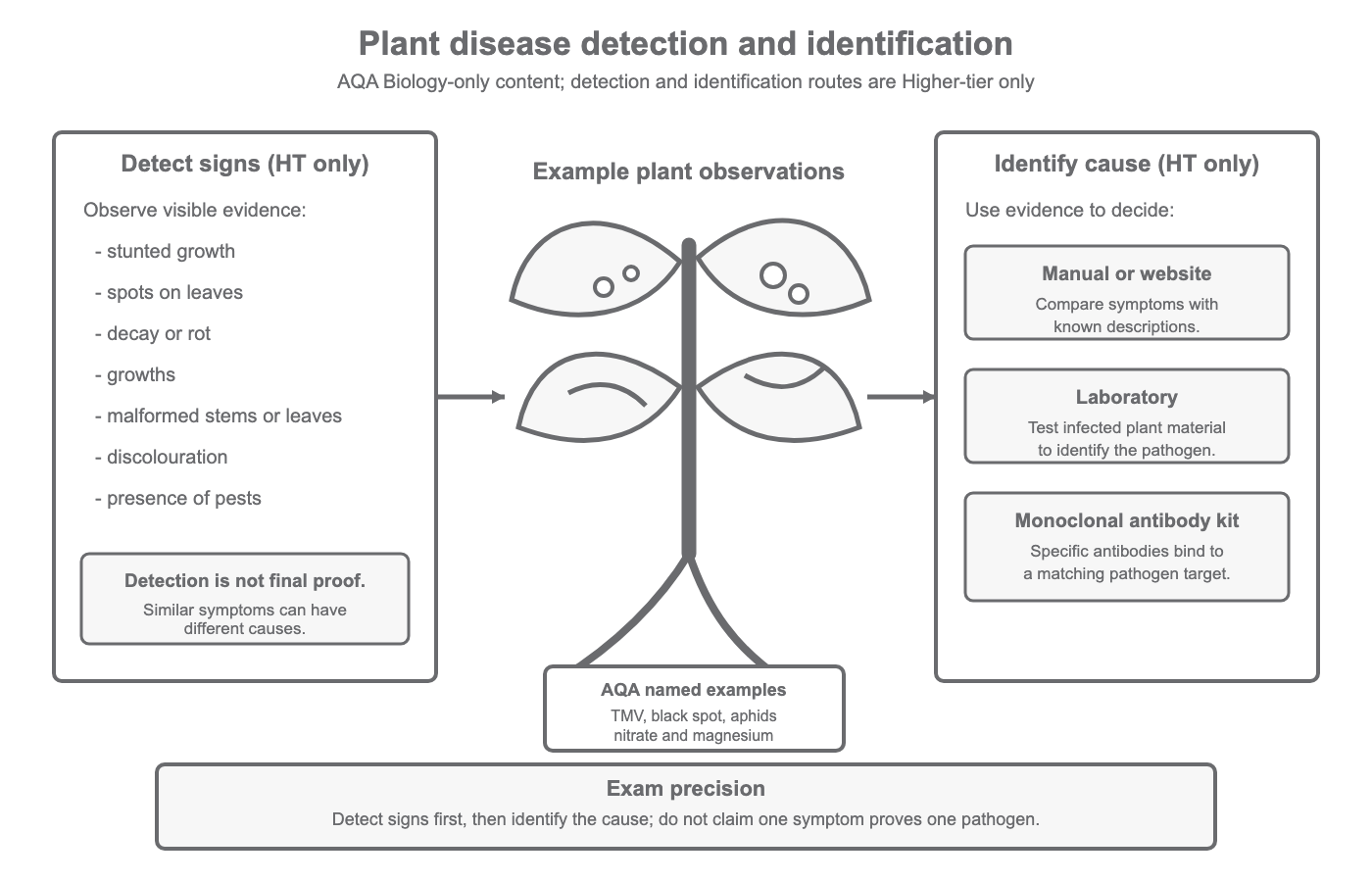
HT only: Plant diseases can be detected by observing visible signs. Detecting a disease means noticing evidence that the plant is unhealthy; it is not always the same as identifying the exact pathogen or cause.
AQA's detection signs are:
- stunted growth
- spots on leaves
- areas of decay, also called rot
- growths
- malformed stems or leaves
- discolouration
- the presence of pests
These signs are deliberately broad. For example, yellow leaves could be linked to an ion deficiency, a pathogen, old age or poor growing conditions. Spots on leaves may suggest infection, but the pattern and plant species matter. That is why a careful answer should say that symptoms help detect or suggest plant disease, rather than claiming that one sign always proves one disease.
[DIAGRAM: asset_name: plant-disease-diagnosis-map - diagram 1; asset_slug: 041_4_3_3_1_detection_and_identification_of_plant_diseases_diagram1; file: diagram_assets/imagegen_regen_all/041_4_3_3_1_detection_and_identification_of_plant_diseases_diagram1_imagegen.png; recommended_method: codex_image_gen; description: Monochrome AQA-depth map showing observable plant disease signs, a central plant with labelled symptom examples, three identification methods, and a reminder that symptoms suggest a problem but further information or testing identifies the cause.]
Identifying The Cause
HT only: Identification means deciding what is causing the plant problem. AQA requires three identification routes.
| Identification route | What it does at GCSE depth |
|---|---|
| Reference to a gardening manual or website | Compares the plant's symptoms with known disease or deficiency descriptions. |
| Taking infected plants to a laboratory | Allows specialists to identify the pathogen from the infected plant material. |
| Using testing kits that contain monoclonal antibodies | Tests for a specific pathogen because monoclonal antibodies bind to a matching target from that pathogen. |
Do not overcomplicate monoclonal antibody test kits in this lesson. You do not need to describe how monoclonal antibodies are made or give a full laboratory protocol here. The AQA-depth idea is specificity: a monoclonal antibody is chosen because it binds to one particular target, so the kit can help identify whether that pathogen is present.
Continue this lesson.
You’re previewing NovaLearn without an account. Create a free account to read the rest.
Create free account