4.5.2.1a - The Nervous System and Reflex Arcs
The nervous system lets humans react to changes around them and coordinate behaviour. For AQA, the key idea is a fast pathway: receptors detect a stimulus, neurones carry electrical impulses to the central nervous system, and effectors bring about a response. Reflex arcs are a special case because they produce rapid, automatic responses that help protect the body.
From stimulus to response
A stimulus is a change in the environment. It could be a change outside the body, such as sudden bright light, or a change inside the body. AQA describes a basic control sequence like this:
stimulus -> receptor -> coordination centre -> effector -> response
In some exam questions, AQA shortens coordination centre to coordinator. Use either term carefully: it is the part that receives and processes information from receptors.
Receptor
A cell or group of cells that detects a stimulus.
The receptor is the first biological structure in the pathway. It turns the detected change into information that can be carried through the nervous system.
Coordination centre
A structure, such as the brain or spinal cord, that receives and processes information from receptors.
In this lesson, the most important coordination centre is the CNS. It links the information coming in to the response going out.
Effector
A muscle or gland that brings about a response.
[DIAGRAM: asset_name: stimulus-to-response-control-sequence - diagram 1; asset_slug: 052_4_5_2_1a_the_nervous_system_and_reflex_arcs_diagram1; file: diagram_assets/imagegen_regen_all/052_4_5_2_1a_the_nervous_system_and_reflex_arcs_diagram1_imagegen.png; recommended_method: codex_image_gen; description: Monochrome flow diagram showing stimulus, receptor, coordination centre, effector and response, with the CNS identified as brain and spinal cord and effectors shown as muscle contraction or gland hormone secretion.]
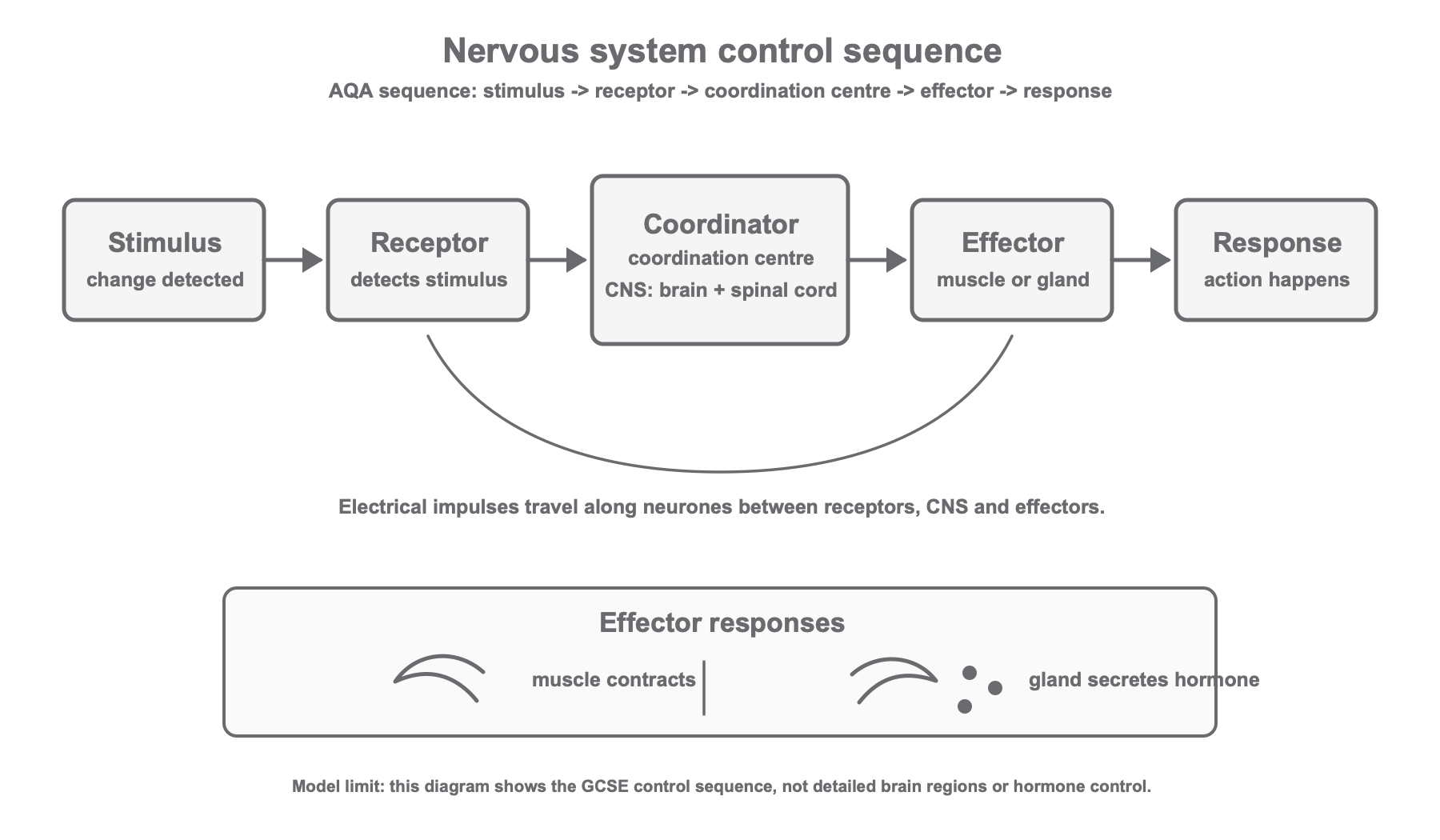
An effector does not decide the response. It carries it out. A muscle may contract, such as when a limb moves. A gland may secrete a hormone. The coordination centre is where information is processed so the response fits the stimulus.
Neurones and the CNS
Information in the nervous system travels along specialised cells called neurones. For this lesson, the important point is that information passes along neurones as electrical impulses.
Central nervous system
The central nervous system, or CNS, is the brain and spinal cord.
Receptors send information along neurones to the CNS. The CNS coordinates the response of effectors. This structure is adapted for fast communication because impulses travel along neurones to link the receptor, CNS and effector in a pathway.
Keep the direction clear:
| Stage | What happens |
|---|---|
| Receptor | Detects the stimulus |
| Neurone pathway to CNS | Carries electrical impulses to the CNS |
| CNS | Coordinates the response |
| Neurone pathway from CNS | Carries impulses towards the effector |
| Effector | Carries out the response |
The detailed regions of the brain are not part of this lesson. Here, the brain matters only because it is part of the CNS, along with the spinal cord.
What reflex actions are
A reflex action is a rapid, automatic response to a stimulus. Reflex actions are important because they can protect the body from harm before there is time for conscious thought.
Reflex action
A rapid, automatic response to a stimulus that does not involve the conscious part of the brain.
Do not write only an example if the question asks what a reflex action is. Pulling your hand away from a hot object is an example. The definition needs the ideas of automatic or involuntary, rapid, and not involving the conscious part of the brain.
The phrase does not involve the conscious part of the brain is precise. It does not mean the nervous system is absent. A reflex still uses neurones and a coordination centre, often the spinal cord.
Examples that fit this level include blinking in sudden bright light and withdrawing a hand from a hot object. Actions such as deciding to kick a ball, writing a message, or choosing to catch something are not reflex actions because they involve conscious control.
The reflex arc sequence
A reflex arc is the pathway followed by impulses during a reflex action. AQA expects you to know how each named structure relates to its function.
The main sequence is:
stimulus -> receptor -> sensory neurone -> relay neurone -> motor neurone -> effector -> response
There are synapses between neurones. A synapse is the small junction between one neurone and the next. In a reflex arc, synapses help pass the impulse from sensory neurone to relay neurone, and from relay neurone to motor neurone.
Continue this lesson.
You’re previewing NovaLearn without an account. Create a free account to read the rest.
Create free account