HP9 - Conditional probability
Use given information to restrict the group from which a random choice is made. HP9 develops conditional probabilities through two-way tables, Venn diagrams and expected-frequency trees, including questions that reverse the direction of the information.
Restricting the sample
Suppose one fifth of bus users arrive late. Does that mean one fifth of late arrivals use the bus? These statements start with different groups, so they need different denominators.
Conditional probability
, read “the probability of given ”, is the chance of among cases where occurs. For a uniformly chosen member of a finite group:
The conditioning group must be non-empty.
The numerator counts cases satisfying both the condition and the event. The denominator counts every case satisfying the condition, rather than the whole original sample.
Consider these pupils:
| Travel method | Late | On time | Total |
|---|---|---|---|
| Bus | |||
| Train | |||
| Total |
Worked example 1: a row restriction
Question. One pupil is chosen uniformly at random from the table. Given that the pupil uses the bus, find the probability that they are late.
Plan. Restrict the denominator to the bus users.
Answer. .
Check. Among bus users, are late and are on time. These conditional probabilities sum to .
Reverse only the direction of the given information. The numerator stays the same, but the reference group changes.
Worked example 2: reversing the condition
Question. Given that the chosen pupil is late, find the probability that they use the bus.
Plan. Restrict the denominator to all late pupils.
Answer. .
Check. The other late pupils use the train, so . The denominator is no longer .
The count rule also works with probabilities. For example, : the common whole-sample denominator cancels.
Conditional multiplication rule
Rearranging gives
The conditional probability is not defined by this quotient when .
The multiplication form is in the supplied Higher additional formulae sheet.
Conditioning describes information about the chosen case; it does not by itself establish what causes an outcome.
Watch out
and need not agree. The opening example gives for late given bus, but for bus given late.
Choose the denominator from the wording after “given”.
Venn conditioning
In a Venn diagram, the condition selects a region or a combination of regions. Count the entire selected group, including overlaps, before choosing the favourable members within it.
Let be art, music and chess for pupils. Their disjoint Venn regions are:
| Region | Count |
|---|---|
| only | |
| only | |
| only | |
| and only | |
| and only | |
| and only | |
| All three | |
| None |
[DIAGRAM: asset_name: Conditioning in three sets; asset_slug: three-set-conditioning; caption: A condition includes all overlaps inside its selected group.; description: Three circles A, B and C in a universal set of fifty have A-only eight, B-only ten, C-only seven, AB-only six, AC-only four, BC-only five, all three three and outside seven. C contains nineteen pupils, including seven who are also in A.]
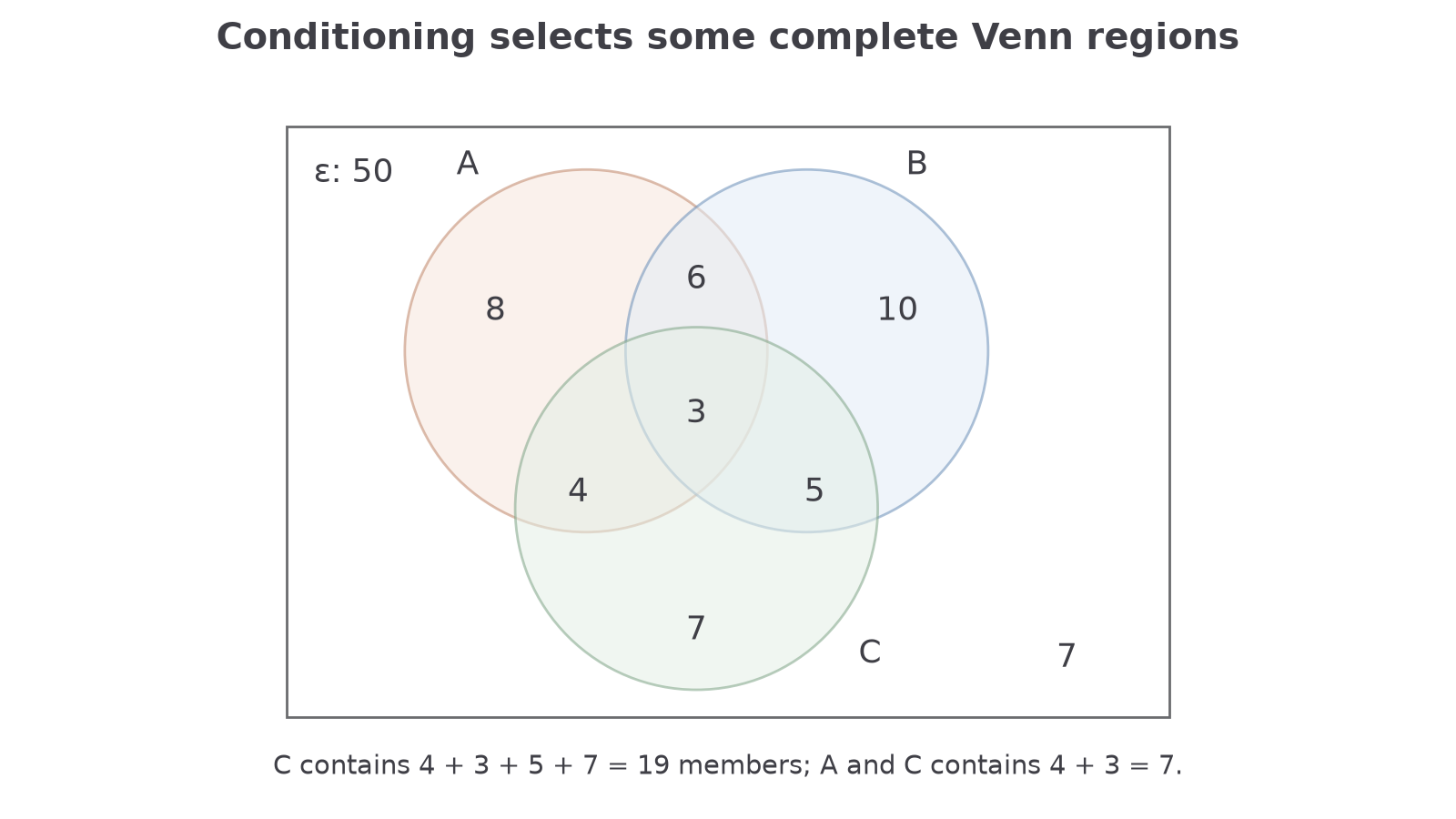
With three sets, “in and ” includes the central all-three region. Here . If filling a diagram from membership totals, start with the all-three count, then subtract it from pairwise intersections before finding “only” regions.
Worked example 3: conditioning on a set
Question. A pupil from this group is chosen uniformly at random. Given that the pupil attends chess, find the probability that they also attend art.
Plan. Use all members of as the denominator and as the numerator.
Answer. .
Check. The other chess members number , so the conditional probabilities and total .
Change only the condition to “not chess”. The selected group now lies outside circle , but still inside the universal set.
Worked example 4: conditioning on a complement
Question. Given that the randomly chosen pupil does not attend chess, find the probability that they attend art.
Plan. Count all members, then the art members within .
Answer. .
Check. Outside chess there are pupils. Exactly attend art; the other do not.
Continue this lesson.
You’re previewing NovaLearn without an account. Create a free account to read the rest.
Create free account