FP2–FP4, HP2–HP4 - Probability and expected outcomes
Describe chance numerically, calculate probabilities when outcomes are equally likely, and find missing probabilities. FP2 and HP2 introduce fairness assumptions; FP3 and HP3 give the probability scale; FP4 and HP4 explain why complete, non-overlapping possibilities have probabilities totalling one.
Probability scale
A bag contains three colours of counter. Must the chance of each colour be ? Counting the colour names is not enough: we need to know how many counters carry each colour.
Probability
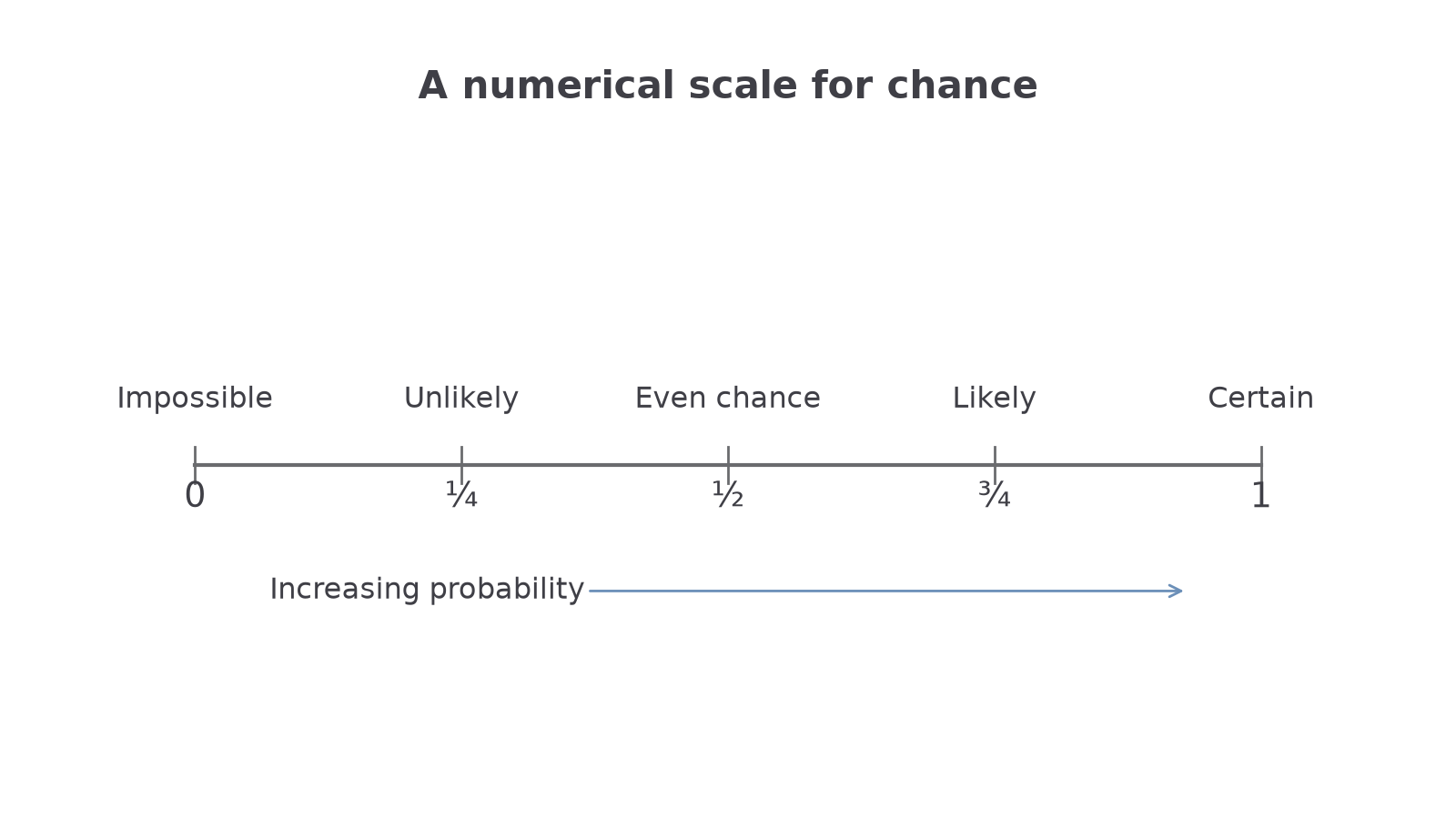
The probability of an event is a number describing its chance of happening. In the finite experiments here, means impossible and means certain. Every probability lies between and , inclusive.
An outcome is one possible result of an experiment. An event is a collection of outcomes of interest, such as getting an even number on a die.
Probability can be written as a fraction, decimal or percentage: . An even chance is exactly . A probability between and is unlikely; one between and is likely. “Likely” still allows the event not to happen.
[DIAGRAM: asset_name: The probability scale; asset_slug: probability-scale; caption: Probability runs from impossible at zero to certain at one.; description: An exact number line from zero to one marks one quarter, one half and three quarters, with impossible, unlikely, even chance, likely and certain positioned appropriately.]
Worked example 1: below an even chance
Question. An event has probability . Is it impossible, unlikely, an even chance, likely or certain?
Plan. Compare with the scale's boundary values.
Answer. Unlikely.
Check. It is , below but above , so neither an even chance nor impossible.
Change only the probability. It now lies on the other side of an even chance.
Worked example 2: above an even chance
Question. An event has probability . Describe its likelihood.
Plan. Locate between and .
Answer. Likely, but not certain.
Check. The event can still fail: its probability is less than .
Words describing chance must agree with these numerical limits.
Watch out
A probability of , or , is invalid. A probability of is valid because it means , not .
Choose a description using the numerical scale.
Equally likely outcomes
If every individual outcome has the same chance, count the favourable outcomes and divide by the total. First check that the equal-chance assumption is justified.
Equally likely outcomes
This counting rule requires the counted outcomes to be equally likely.
Not in the formula booklet: learn it.
A fair six-sided die has each face probability . Choosing one counter uniformly at random means every individual counter has the same chance. Different colours need not have the same chance, because a colour can occur on several counters.
Worked example 3: two colours
Question. A bag contains red and blue counters. One counter is chosen uniformly at random. Find the probability that it is red.
Plan. Count individual red counters and all individual counters.
Answer. .
Check. Four of the ten equally likely counters are red, giving . Having two colour names does not make the chance .
Split the blue group into two colours without changing the red counters or total.
Worked example 4: three colours
Question. A bag contains red, blue and green counters. One counter is chosen uniformly at random. Find the probability that it is red.
Plan. Use the same individual-counter model, despite the extra colour name.
Answer. .
Check. There are still four red counters among ten; changing non-red labels cannot change the red probability.
Continue this lesson.
You’re previewing NovaLearn without an account. Create a free account to read the rest.
Create free account