FA9–FA10, HA9–HA10 - Gradient and intercept
Can two lines cross the vertical axis at different heights yet stay the same distance apart? FA9 and HA9 connect straight-line equations to parallel lines. FA10 and HA10 explain how gradient and intercept describe a line's direction and starting value.
Gradient as a ratio
A line that rises by three units whenever you move two units right has gradient . Moving twice as far gives rise six and run four: the ratio is unchanged.
Gradient
The gradient of a non-vertical straight line is its change in divided by its change in :
Use the same point order in both differences. The denominator must not be zero.
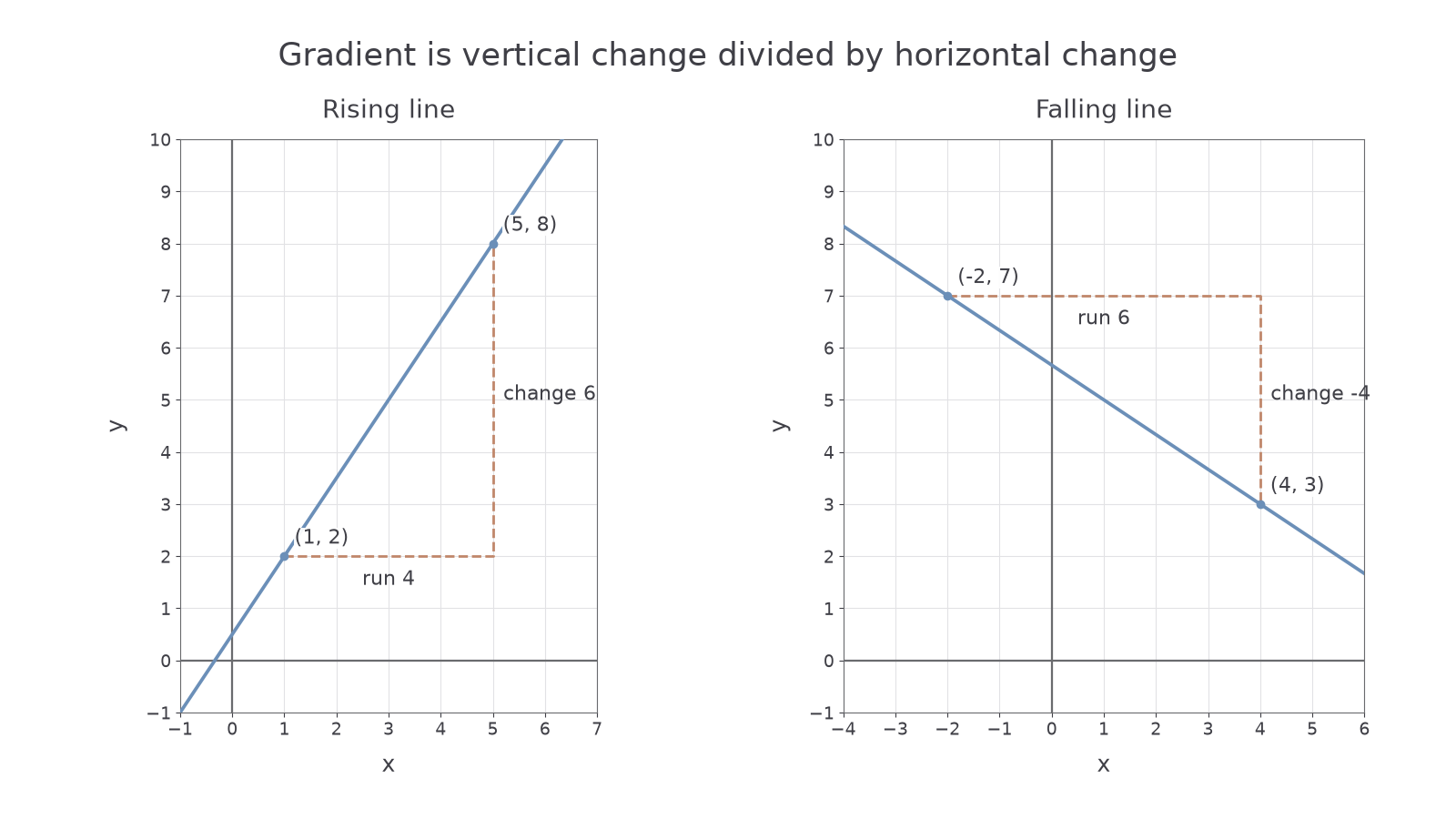
Read axis values, rather than counting squares without checking their scales. Choose two well-separated points exactly on the line and draw a horizontal-and-vertical gradient triangle. Similar gradient triangles have the same rise-to-run ratio, which is why any pair of points on a straight line gives the same gradient.
[DIAGRAM: asset_name: Positive and negative gradient triangles; asset_slug: gradient-triangles; caption: Gradient compares coordinate changes, including a negative change in height.; description: Two scaled coordinate grids show a rising line through (1,2) and (5,8) with run 4 and rise 6, and a falling line through (-2,7) and (4,3) with run 6 and change in y minus 4.]
Worked example 1: a rising line
Question. A straight line passes through and . Calculate its gradient.
Plan. Take the changes from the first point to the second.
The positive numerator and denominator describe a line rising as you move right.
Answer. , or .
Check. Reversing both orders gives , the same ratio.
Now change the direction of the line. The vertical change must keep its sign.
Worked example 2: a falling line
Question. Find the gradient through and .
Plan. Move right from to , recording the fall in .
Answer. . For every three units right, the line falls two units.
Check. Moving six right should give change , taking down to .
A horizontal line has zero vertical change, so its gradient is zero. A vertical line has zero horizontal change; its gradient is undefined, because division by zero is undefined. It does not have gradient zero.
Watch out
Using in the second example reverses only the numerator and wrongly gives a positive gradient. Subtract coordinates in the same order on the top and bottom.
Try another falling line.
The y-intercept
The gradient describes how a line changes; its intercept fixes where the line sits.
Slope-intercept form
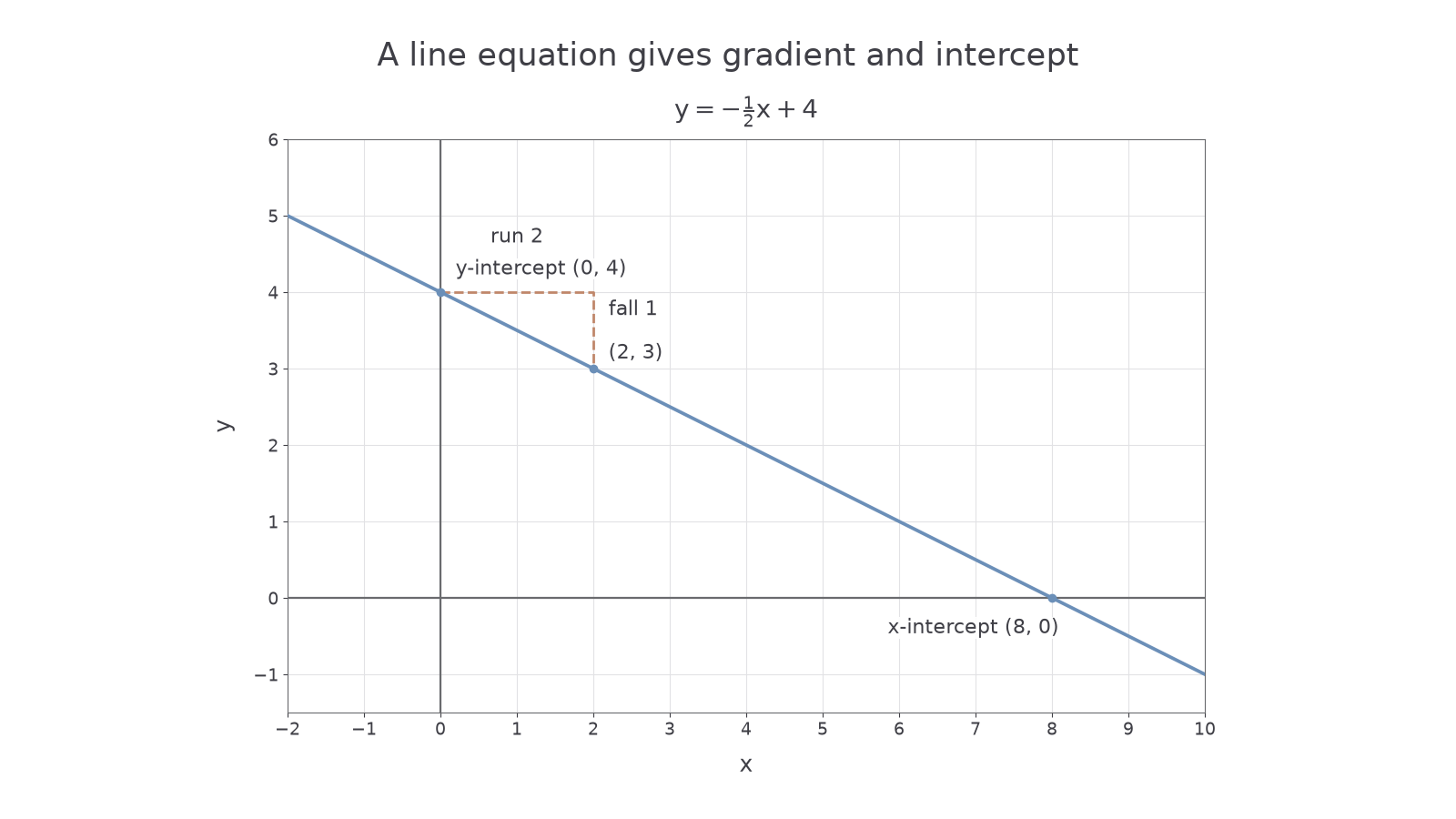
In , is the gradient and is the y-intercept, the value of where the line crosses the vertical axis. The crossing point is , because every point on the y-axis has .
For example, starts at . Increasing by one increases by two. Plot the intercept and use the gradient to locate another point, then join with a ruler. A third substitution checks that the line is correct.
[DIAGRAM: asset_name: Reading a line equation; asset_slug: line-intercept; caption: The intercept locates the line, and the gradient gives its change per unit across.; description: A scaled graph of y equals minus one half x plus 4 marks (0,4), (2,3) and (8,0), with a gradient triangle of run 2 and fall 1. The vertical and horizontal intercepts are distinguished.]
Continue this lesson.
You’re previewing NovaLearn without an account. Create a free account to read the rest.
Create free account