HG20 - Three-dimensional trigonometry
Turn a problem in a solid into a flat triangle with justified lengths and right angles. Use successive Pythagoras or trigonometry calculations, then identify the exact angle requested. This is the Higher three-dimensional contribution to HG20.
Finding right triangles
A cuboid measures by by . How long is a straight internal diagonal joining opposite corners? The answer needs a triangle passing through the interior, not just a rectangular face.
A plane is a flat surface extending in all directions. A triangle's three vertices lie in one plane, even when the triangle cuts through a solid. A line perpendicular to a plane meets every line in that plane through its foot at a right angle.
To project a point onto a plane, drop the perpendicular to the plane. Projecting the ends of a segment gives its perpendicular projection onto that plane. In a cuboid, vertical edges are perpendicular to its horizontal base.
[DIAGRAM: asset_name: A diagonal and its base projection; asset_slug: cuboid-diagonal-section; caption: The internal diagonal AG, base projection AC and vertical edge CG form a right triangle.; description: Perspective cuboid ABCDEFGH with A B C D around the bottom and E F G H directly above, dimensions AB 8 cm BC 6 cm CG 4 cm. The ACG section is highlighted beside its true-scale flat right triangle, right-angled at C.]
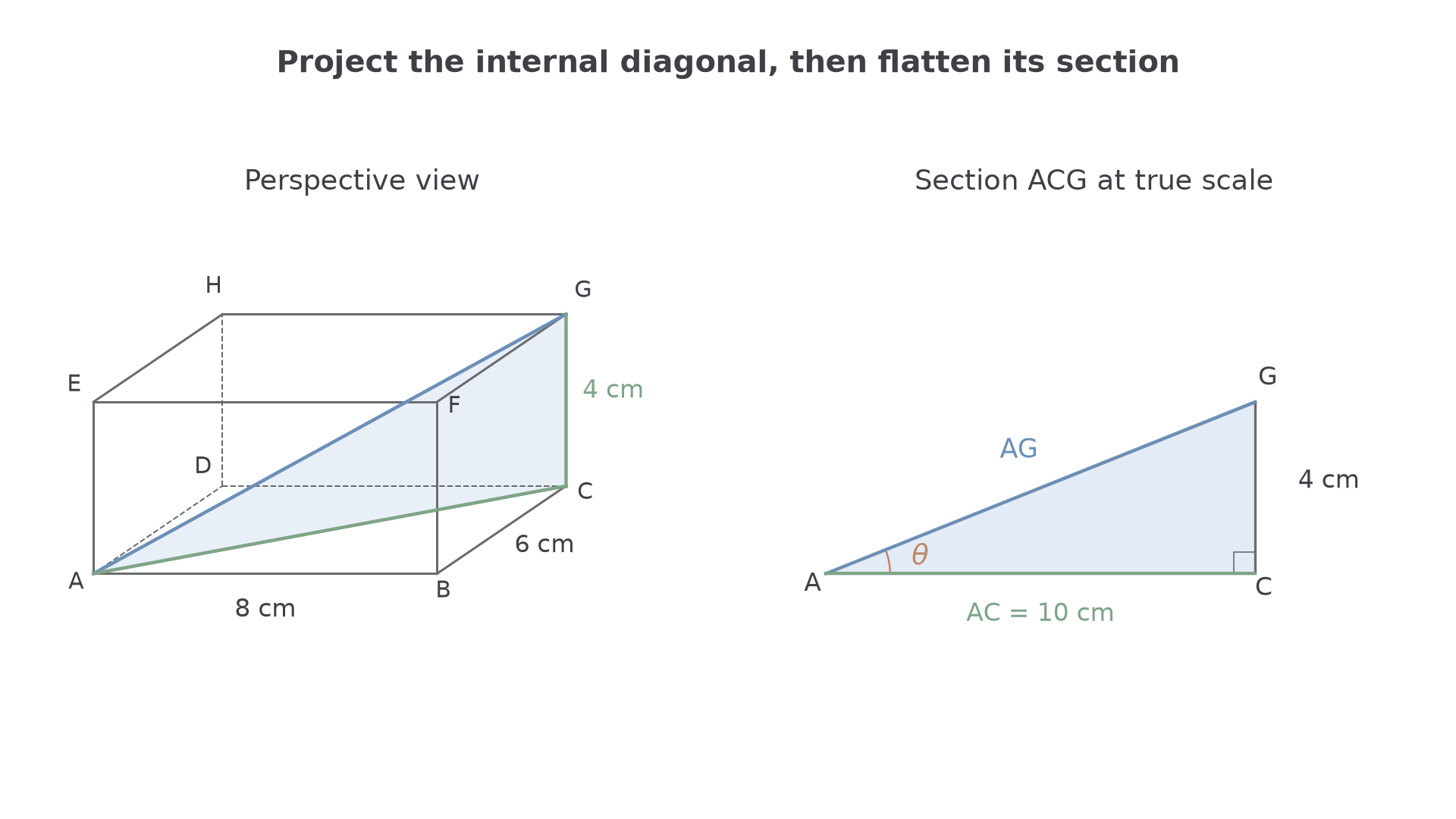
Use a perspective sketch to identify edges and planes, then redraw the selected triangle flat. Apparent angles on a perspective drawing are not reliable measurements. State why the chosen angle is .
Worked example 1: a cuboid projection
Question. In the cuboid shown, , , . Identify the base projection of , calculate its length, and identify a right triangle containing .
Plan. Project vertically to ; already lies in the base.
Answer. The projection is . Triangle contains and is right-angled at , since is perpendicular to the base and lies in that base.
Check. The other base diagonal is also , as opposite sides of the base rectangle have the same lengths. A base diagonal is longer than either or .
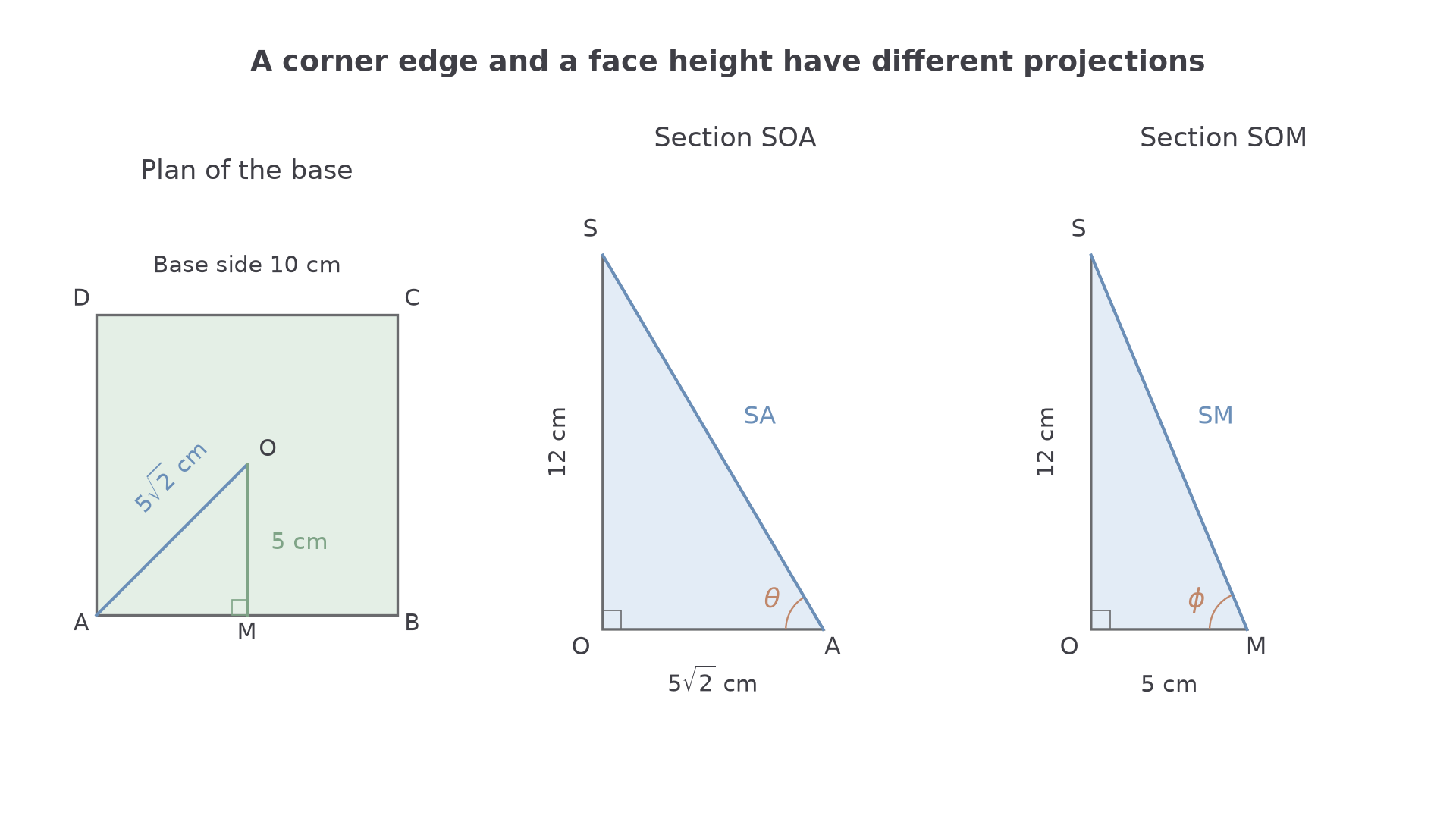
In a right square-based pyramid, the apex lies directly above the base centre. An edge and a face's sloping height have different base projections.
[DIAGRAM: asset_name: Pyramid base projections and sections; asset_slug: pyramid-right-sections; caption: An edge projects to a half-diagonal; the sloping face height projects to a centre-to-midpoint segment.; description: Plan of a 10 cm square base ABCD with centre O and M midpoint of AB, showing AO 5 square root 2 cm and OM 5 cm. Beside it are true-scale right sections SOA and SOM with SO 12 cm, right angles at O, and their different horizontal lengths.]
Worked example 2: two pyramid sections
Question. A right square-based pyramid has base side . Its apex is directly above centre . Let be the midpoint of base edge . Identify the projections of and , and find the projected lengths.
Plan. Project to . Locate and in the square base.
The whole base diagonal is . Its centre bisects it, while the distance from the centre to an edge midpoint is half a side.
Answer. projects to ; projects to . Triangles and are both right-angled at .
Check. In the base, and are perpendicular, so , confirming .
The projection depends on the actual endpoints of the line, not on which base edge looks nearest on the page.
Watch out
Half a square's diagonal is not half its side. For an apex-to-corner edge use the centre-to-corner distance; for an apex-to-edge-midpoint line use the centre-to-midpoint distance.
Choose the two projections in a new pyramid.
Lengths in 3D
Solve the base or face triangle first if it supplies a side of the interior triangle. Carry the exact square root or unrounded calculator value into the next stage.
The current Higher additional formula sheet supplies Pythagoras and the right-triangle sine, cosine and tangent ratios. Choosing a valid triangle and its side roles still requires geometric reasoning.
Worked example 3: the internal diagonal
Question. Find the internal diagonal of the by by cuboid to significant figures.
Plan. First find base diagonal , then use right triangle .
Answer. to significant figures.
Check. Take a different route. Face diagonal . Since is perpendicular to face , triangle is right-angled at ; it gives again.
Continue this lesson.
You’re previewing NovaLearn without an account. Create a free account to read the rest.
Create free account