HA18 - Solving general quadratic equations
A quadratic may have awkward coefficients, irrational roots or a root that makes no sense in its context. HA18 covers rearranging before solving, using the supplied quadratic formula, and choosing between factorisation, completing the square and the formula. Keep exact roots until a decimal answer is requested, then check the original problem.
Rearrangement
Can you insert coefficients straight into a formula when the equation is ? First make one side zero, so every term has the correct sign.
Standard quadratic equation
The standard form is , with constants and . The coefficients include their signs: in , , not . An absent linear or constant term has coefficient zero.
Expand brackets, collect like terms and move all terms to one side before identifying . Any equivalent standard form works: multiplying the whole equation by a non-zero constant does not change its roots.
Worked example 1: a non-zero right side
Question. Write in standard form and state .
Plan. Subtract four from both sides.
Answer. .
Check. Adding four back recovers the original equation. Treating as positive four would instead describe , a different equation.
Now the square term is hidden inside a product and there is another linear term on the right.
Worked example 2: expanding and collecting
Question. Write in standard form and state its coefficients.
Plan. Expand the product, then subtract the whole right side.
Answer. .
Check. At , the original left side minus right side is , matching the constant in the rearranged expression. Re-expanding the product confirms the coefficient of is one.
If the terms cancel completely after collecting, the equation is no longer quadratic; use the resulting equation's appropriate method instead.
Watch out
“Move to the left as ” is a sign error. Subtract the same amount from both sides: the right-side becomes a left-side .
Prepare a fresh equation for a quadratic method.
The quadratic formula
The quadratic formula solves any real-coefficient quadratic equation, including those without convenient rational factors. It comes from completing the square in the general equation, so it is another route to the same roots.
Quadratic formula
For , with ,
The whole numerator is divided by . In the formula booklet.
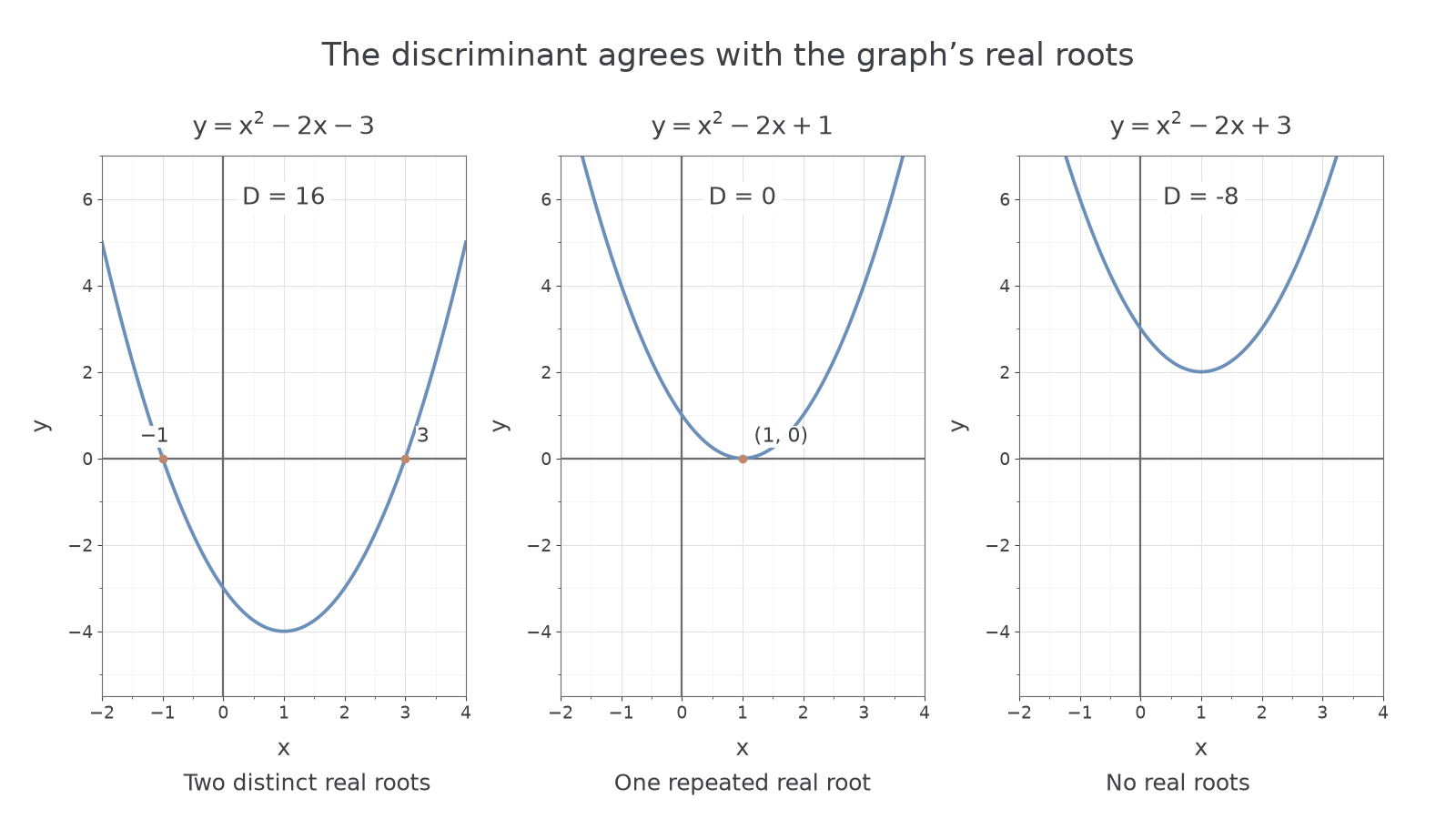
Calculate the quantity under the root, , carefully. It is called the discriminant, written . If it is positive there are two distinct real roots; if zero, both signs give the same repeated root; if negative, there are no real roots. This agrees with a parabola crossing, touching or missing the x-axis.
[DIAGRAM: asset_name: Real roots and the discriminant; asset_slug: quadratic-root-cases; caption: The quantity under the square root determines whether there are two, one or no distinct real roots.; description: Three scaled coordinate grids show y equals x squared minus 2x minus 3 with roots minus 1 and 3 and discriminant 16, y equals x squared minus 2x plus 1 touching at x equals 1 with discriminant zero, and y equals x squared minus 2x plus 3 entirely above the x-axis with discriminant minus 8.]
Worked example 3: exact and rounded roots
Question. Solve , exactly and to two decimal places.
Plan. Use , retaining the square root until the final decimals.
Evaluate the plus and minus cases separately.
Answer. Exact roots and ; approximately and .
Check. Substituting the rounded values gives in each case, close to zero. Their sum is , consistent with the equation's symmetric root positions about .
Now itself is negative. The numerator begins with , so its first term becomes positive.
Continue this lesson.
You’re previewing NovaLearn without an account. Create a free account to read the rest.
Create free account