FA9–FA10, HA9–HA10 - Finding a line equation
Find a straight line's equation from a gradient and point, or from two points, using FA9 and HA9. Interpret the gradient and intercept in models using FA10 and HA10, and check that the equation makes sense for the quantities involved.
A gradient and a point
A line has gradient and passes through . Is its equation ? The is a height at , so it need not be the height where .
You already know
In , is the gradient and is the y-intercept. Every point on the line must satisfy its equation.
Insert the known gradient, substitute the point's and together, and solve for . You are finding the one line of that gradient that passes through the given point.
Worked example 1: a positive gradient
Question. Find the equation of the line with gradient through .
Plan. Substitute the point into to find the intercept.
Answer. .
Check. At , . Moving one right increases the value by three, agreeing with the gradient.
Keep the substitution method, but use a falling line with a fractional gradient.
Worked example 2: a fractional gradient
Question. Find the equation of the line with gradient through .
Plan. Substitute into , keeping the signs.
Answer. .
Check. The intercept is . Moving six right gives a fall of four, reaching .
The opening line is therefore , not .
Watch out
“The line passes through , so ” confuses a general point with a y-intercept. Only a point whose first coordinate is zero gives directly.
Find the intercept of another fractional-gradient line.
Two points
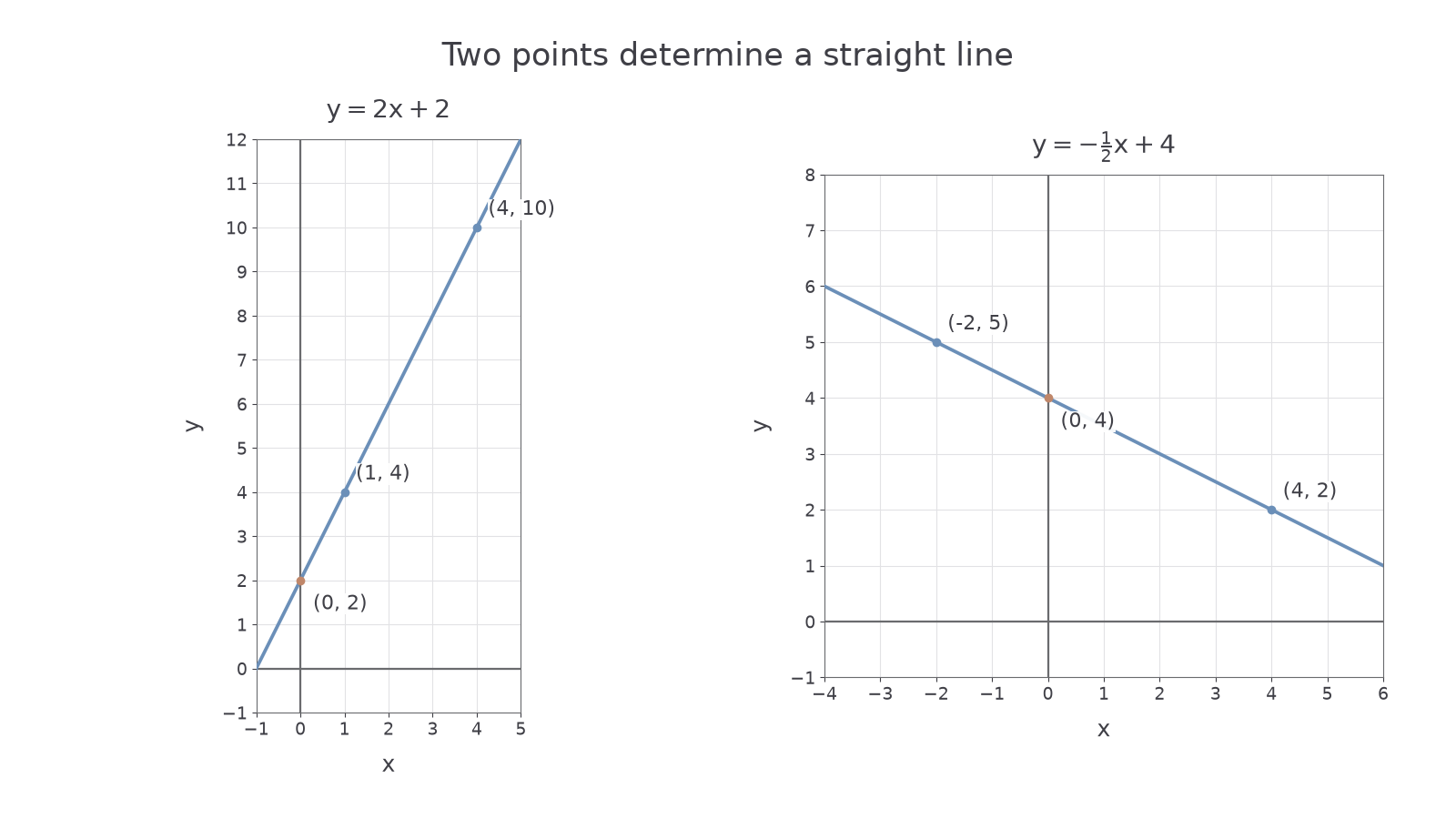
Two distinct points determine one straight line. Find its gradient first, then use either point to find the intercept.
For non-vertical lines, calculate . If the two x-coordinates match, the line is vertical: its equation is . Do not divide by zero. If only the y-coordinates match, the line is horizontal, with equation .
[DIAGRAM: asset_name: Equations from two points; asset_slug: two-point-lines; caption: Find the gradient from two points, then extend to the vertical axis to identify the intercept.; description: Two scaled coordinate grids show y equals 2x plus 2 through (1,4) and (4,10), and y equals minus one half x plus 4 through (-2,5) and (4,2). Their y-intercepts are marked.]
Worked example 3: two positive coordinates
Question. Find the equation of the line through and .
Plan. Calculate the gradient and substitute the first point.
Answer. .
Check. The unused point gives , so both points lie on the line.
Now one coordinate is negative and the line falls.
Worked example 4: a falling line through two points
Question. Find the equation through and .
Plan. Keep consistent subtraction order, then use one point to find .
Answer. .
Check. At the second point, . The line crosses the y-axis at , between the two given heights.
Repeated identical coordinates give only one distinct point, which does not determine a unique line unless its gradient is also given.
Exam tip
Check the point you did not use to find . It is an independent check on both the gradient and the intercept.
Use two new points.
Continue this lesson.
You’re previewing NovaLearn without an account. Create a free account to read the rest.
Create free account