FG16, HG18 - Arc lengths and sector areas
Use a sector's central angle to find its share of a circle. FG16 and HG18 connect that fraction to arc length, sector perimeter and sector area. You will also work backwards from an area to its central angle.
Fractions of a turn
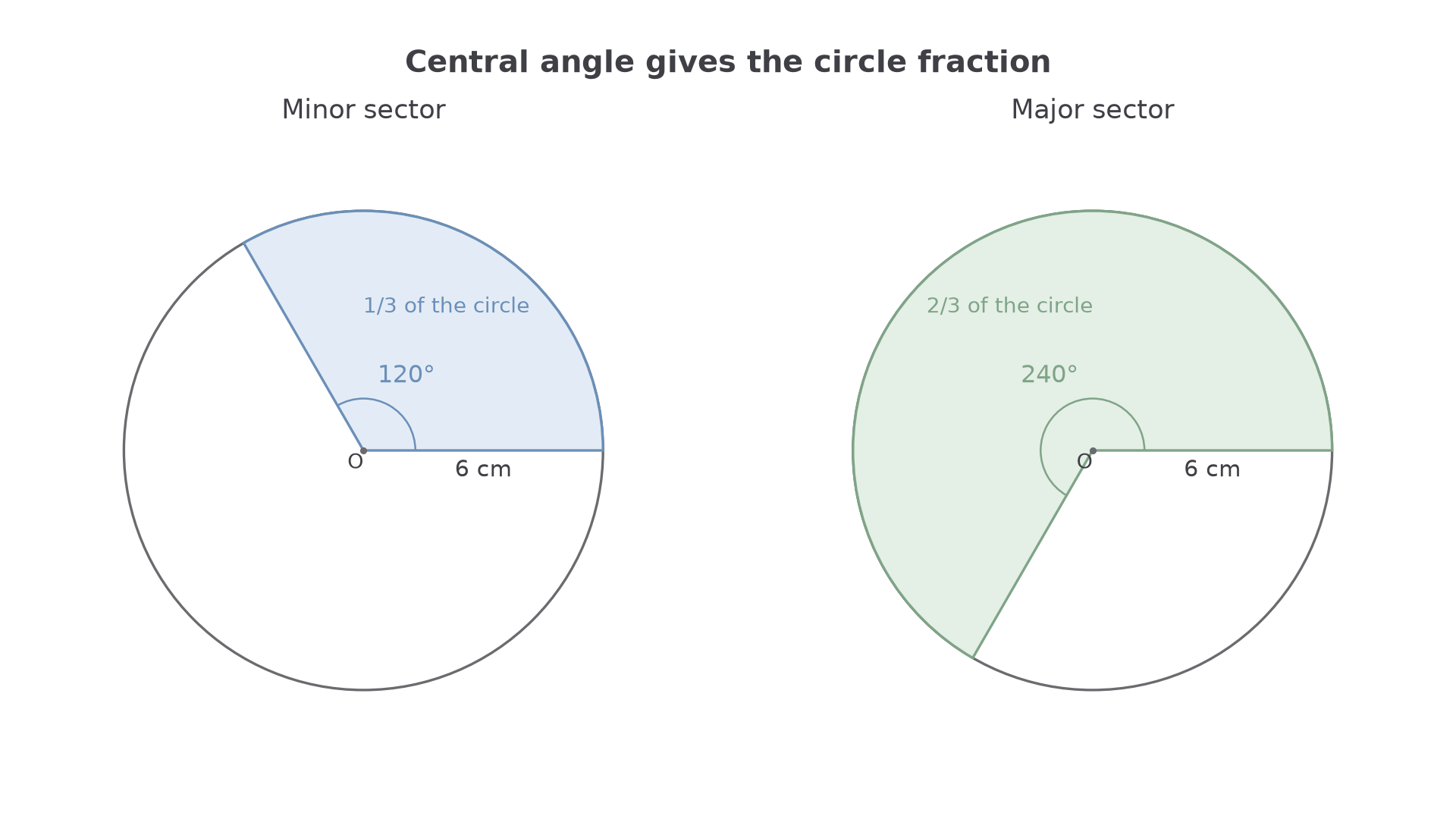
A sector has radius and central angle . Its arc and area are each one third of the full circle's corresponding measurement. Is its complete perimeter also one third of the circumference?
A sector's angle is measured at the centre, between its bounding radii. One complete turn is , so a sector of angle occupies the fraction of the circle. This fraction applies to its arc and area because equal central angles cut out equal arcs and equal areas in the same circle.
Sector fraction
For a central angle measured in degrees,
A major sector has angle greater than ; its fraction is greater than one half. Use the angle for the region actually requested.
[DIAGRAM: asset_name: Minor and major sector fractions; asset_slug: sector-fractions; caption: The marked central angle determines the fraction, including for a major sector.; description: Two exact circles of radius 6 cm: a shaded 120-degree minor sector labelled one third, and a shaded 240-degree major sector labelled two thirds, with bounding radii and central-angle arcs.]
Worked example 1: a small sector
Question. A sector has central angle . What fraction of a circle is it, and how many identical sectors make a full circle?
Plan. Compare the angle with a full turn.
Answer. One fifth of a circle; five sectors make the full circle.
Check. , and five copies of sum to one.
Keep the two bounding radii but choose the larger region instead.
Worked example 2: the major sector
Question. The smaller angle between two radii is . Find the angle and fraction of the major sector.
Plan. Subtract the minor angle from a full turn, then form the fraction.
Answer. ; four fifths of the circle.
Check. The fractions of the two sectors sum to , and their angles sum to .
The fraction belongs to a particular region, not just to the pair of radii.
Watch out
If the major sector is requested, using the smaller marked angle without subtracting from selects the wrong region.
Find both shares for a new central angle.
Arcs
An arc length is the sector fraction multiplied by the full circumference. A sector perimeter also includes its two straight radii.
Arc length and sector perimeter
Here and for a nondegenerate sector; is its central angle in degrees. Both results have length units. At , the whole circle has no exposed radii, so its perimeter is just the circumference. The arc formula follows from the circle fraction and the circumference formula supplied on the additional formulae sheet; it is not separately listed there.
Trace the requested boundary before calculating. If a question asks only for the arc, do not add the radii. If the arc is known, divide it by the full circumference to find the circle fraction; multiply that fraction by to recover the central angle. Keep exact when an exact answer is requested.
Worked example 3: the curved edge
Question. Find the arc length of the opening sector with radius and angle .
Plan. Take one third of the full circumference.
Answer. .
Check. Three equal arcs fit around the circle: , the full circumference.
Continue this lesson.
You’re previewing NovaLearn without an account. Create a free account to read the rest.
Create free account