FG6, FG18, HG6, HG20 - Pythagoras' theorem
Find an unknown side of a right-angled triangle from its other two sides. FG6 and HG6 explain why the square-area relationship works; FG18 and HG20 apply it to lengths, diagonals and distances in two dimensions. You will identify the longest side first and choose whether to add or subtract squares.
Why the theorem works
A by rectangle has a diagonal of length . Why does , rather than , describe that diagonal?
Hypotenuse
The hypotenuse of a right-angled triangle is the side opposite its right angle. It is the longest side. The other two sides meet at the right angle. Rotating a triangle does not change which side is its hypotenuse.
Pythagoras' theorem is an equality between square areas. If the shorter sides have lengths and the hypotenuse has length , the square on has the same area as the squares on and combined.
[DIAGRAM: asset_name: An area proof of Pythagoras; asset_slug: pythagoras-area-proof; caption: The outer square consists of four identical right triangles and the central square.; description: Exact square of side a plus b containing four congruent right triangles of legs a and b around a central square whose four sides are hypotenuses c. Outer edges are divided into a and b; central area c squared and one right angle are marked.]
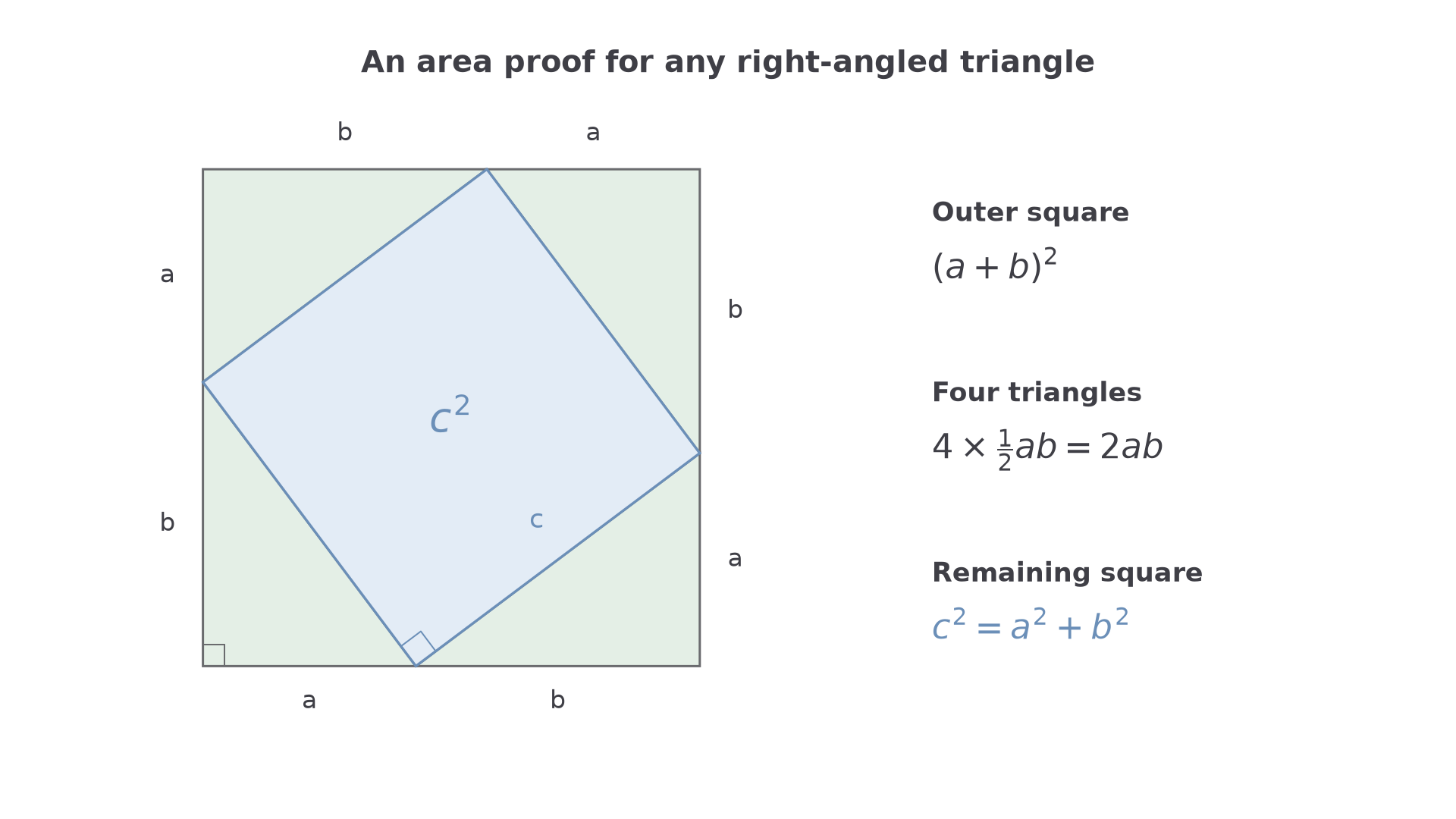
Each side of the central shape is a hypotenuse of length . Its angles are right angles: the two acute angles of the triangles sum to , leaving between them. It is therefore a square.
Calculate the outer square's area in two ways:
Pythagoras' theorem
The triangle must be right-angled, and must be the hypotenuse. Supplied on the additional formulae sheet.
The letters can change; the geometric roles cannot.
Worked example 1: identifying the squared lengths
Question. Triangle is right-angled at , with , , . Identify the hypotenuse and verify the square-area relationship.
Plan. Choose the side opposite , then compare its square with the other two squares.
Answer. is the hypotenuse; the square areas satisfy .
Check. is longer than both and , consistent with its role.
Scale the triangle and change its labels. The relation uses the side opposite the stated right angle.
Worked example 2: a different labelled triangle
Question. Triangle is right-angled at . Its sides are , , . Verify Pythagoras' theorem.
Plan. The side opposite is , so put its square alone on the right.
Answer. is the hypotenuse and the required equality holds.
Check. Doubling the first triangle's sides multiplies every square area by : , agreeing with this calculation.
The theorem concerns squares of side lengths, not the sum of the lengths.
Watch out
The longest side is not automatically whichever line looks most horizontal or diagonal on a page. Locate the right-angle vertex, then choose the side opposite it.
Choose a relation from a new right-angle label.
Missing lengths
Identify the unknown side's role before calculating. For the hypotenuse, add the two known squares. For a shorter side, subtract the other shorter side's square from the hypotenuse's square.
After finding the square of the missing length, take its positive square root. A physical side length is positive, so the negative root is not another possible side.
[DIAGRAM: asset_name: Two missing-side calculations; asset_slug: pythagoras-missing-sides; caption: Add squares for a hypotenuse; subtract from the hypotenuse's square for a shorter side.; description: Two exact right triangles with corresponding side lengths 7, 24, 25. In the first the perpendicular legs 7 cm and 24 cm are known and hypotenuse c is unknown; in the second hypotenuse 25 cm and leg 7 cm are known and the other leg x is unknown.]
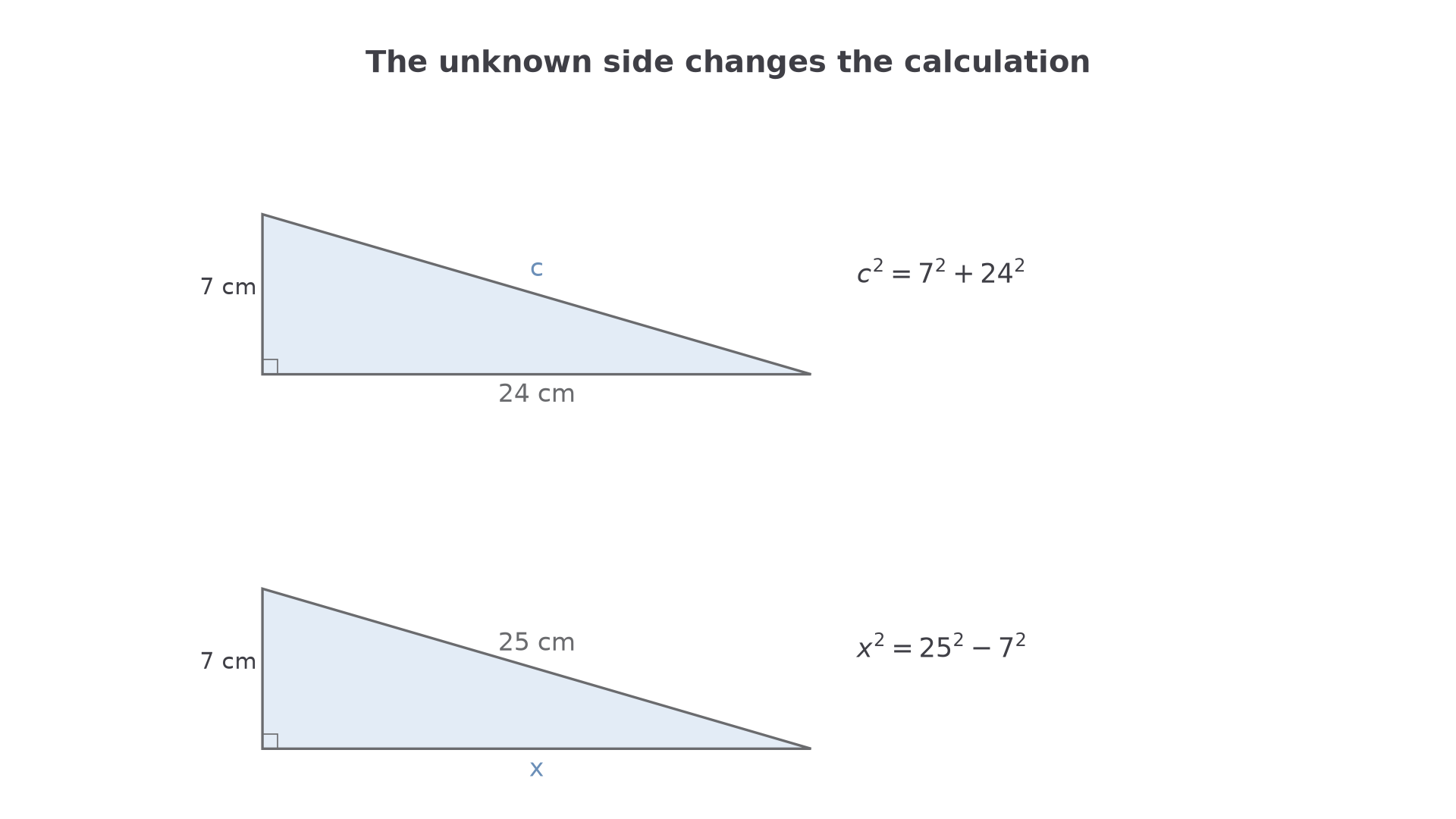
Worked example 3: finding the hypotenuse
Question. A right-angled triangle has perpendicular sides and . Find its hypotenuse .
Plan. Add the squares, then take a positive square root.
Answer. .
Check. , and is longer than both given sides.
Continue this lesson.
You’re previewing NovaLearn without an account. Create a free account to read the rest.
Create free account