HG7–HG8 - Negative enlargements and combined transformations
Learn how a negative scale factor places an image beyond the centre, and how the order of transformations affects the result. HG7 develops negative enlargement; HG8 concerns combined movements, their invariants and equivalent single transformations.
Negative scale factors
Does scale factor mean an image has negative side lengths? No: the minus sign reverses the displacement from the centre, while the magnitude doubles every length.
Negative enlargement
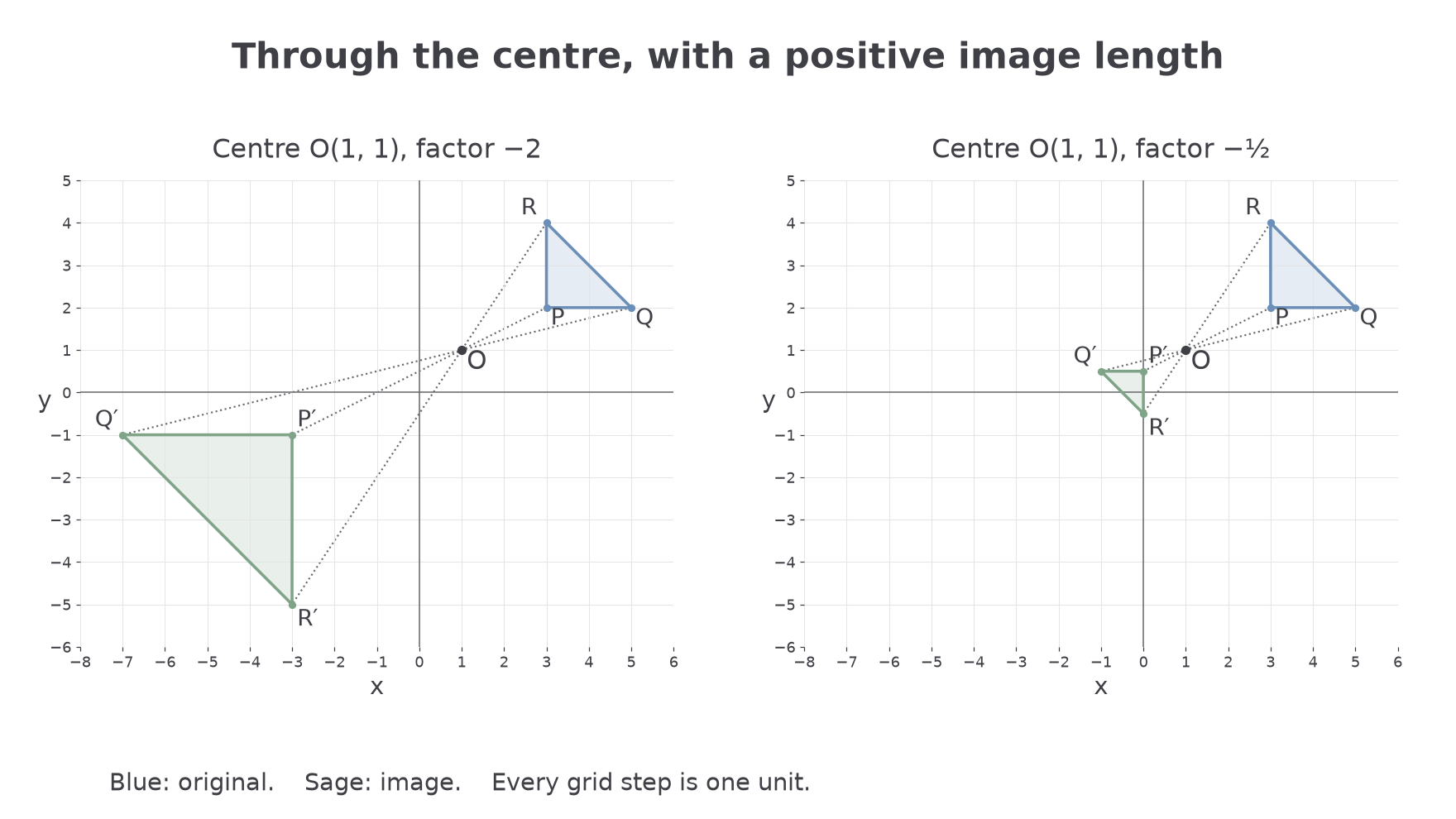
For centre and scale factor , multiply each displacement from by . The image lies on the opposite side of along the same straight line. Distances from the centre and side lengths multiply by ; corresponding angles remain equal.
You can view a negative enlargement as a positive enlargement of factor followed by a half-turn about the centre. It is not a mirror reflection: in the plane a half-turn preserves the clockwise order of the vertices. Factor is exactly a rotation about the centre and produces a congruent image.
Worked example 1: a negative integer factor
Question. Enlarge , , by factor , centre .
Plan. Multiply each displacement from by , then add the centre back.
| Vertex | Displacement from | Multiply by | Image |
|---|---|---|---|
Answer. .
Check. The image side has length , twice the original . Along every point-to-image line, lies between the points and the image is twice as far from .
Keep the original and centre, but change the magnitude of the negative factor to . The direction still reverses; the image becomes smaller.
Worked example 2: a negative fractional factor
Question. Enlarge the same triangle by factor , centre .
Plan. Halve each centre-relative displacement and reverse its direction.
Answer. .
Check. Reversing and doubling each image displacement from recovers the original. The image side has length , half the original .
The centre separates each original vertex from its image in both cases.
[DIAGRAM: asset_name: Negative scale factors through the centre; asset_slug: negative-factor-pair; caption: The sign changes the side of the centre; the magnitude controls size.; description: Exact coordinate panels enlarge P(3,2), Q(5,2), R(3,4) about O(1,1) by factors minus 2 and minus one half. Original and image vertices are joined through O. Correct images are (-3,-1),(-7,-1),(-3,-5) and (0,0.5),(-1,0.5),(0,-0.5).]
Watch out
Do not multiply absolute coordinates unless the centre is the origin. For centre , factor sends to , not .
Use a fresh triangle and centre.
Combining transformations
A sequence of transformations acts on the current image, in the stated order. The second movement uses the first image as its input.
Keep intermediate labels such as , then use for the final image. This makes it possible to check each stage rather than guess a direct movement.
Worked example 3: reflect, then translate
Question. Triangle is reflected in the -axis, then translated by . Find the final image.
Plan. Reflect every vertex first, then add the translation to that reflected image.
| Vertex | After reflection | After translation |
|---|---|---|
Answer. .
Check. Undo the translation, then reflect again. For example, returns .
Now change only the order. A reflection also reverses the direction of a horizontal displacement made before it.
Worked example 4: translate, then reflect
Question. Translate the original triangle by , then reflect it in the -axis.
Plan. Add the vector first, then reflect the translated coordinates.
| Vertex | After translation | After reflection |
|---|---|---|
Answer. , different from the first order.
Check. Reflecting the final image and translating by returns the original. Both final triangles remain congruent to it.
Rotations follow the same stage-by-stage rule, retaining the stated rotation centre.
Continue this lesson.
You’re previewing NovaLearn without an account. Create a free account to read the rest.
Create free account