HA13 - Transforming function graphs
Translate and reflect graphs by following their points, turning points and asymptotes. HA13 concerns translations and reflections of a given function; the input-output distinction explains their directions.
Vertical translations
If , where does this point go on ? The input remains and the output becomes , so the new point is .
The notation means the output of function at input . A graph is the set of its input-output points. Adding outside changes every output by the same amount.
Vertical translation
For , move the whole graph vertically by :
Positive moves up; negative moves down. The translation vector is . The input domain stays the same, and turning points retain their horizontal coordinates.
Use enough labelled landmarks to preserve the original shape. A root is just a point with output zero; after a vertical shift, that point usually no longer lies on the horizontal axis.
Worked example 1: shifting outputs up
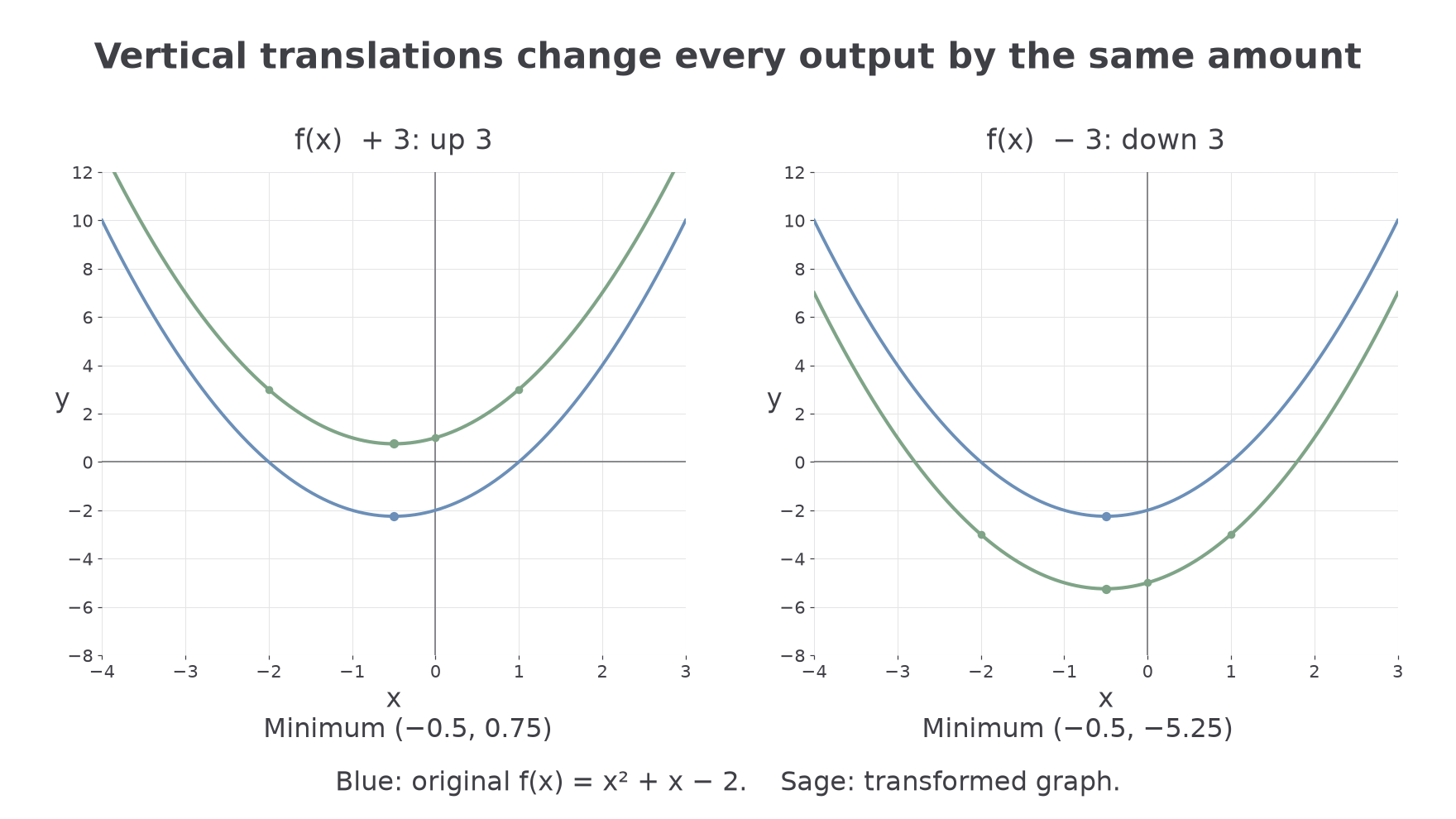
Question. The graph has roots , point and minimum . Sketch , identifying the images of these four landmarks.
Plan. Add to each vertical coordinate, leaving every horizontal coordinate unchanged.
Answer. An upward-opening parabola shifted up , with the four image landmarks above and minimum . It lies above the horizontal axis, so it has no roots.
Check. At input , , matching the new vertical intercept. The minimum output independently confirms no horizontal-axis crossing.
Keep the same original graph but subtract the same amount instead.
Worked example 2: shifting outputs down
Question. Sketch for the same , giving the four image landmarks.
Plan. Subtract from the original vertical coordinates.
Answer. The original parabola translated down , with minimum and vertical intercept .
Check. Adding to each new output recovers its original landmark. Direct substitution gives , confirming the intercept.
Both translations preserve the shape and the horizontal coordinate of the minimum.
[DIAGRAM: asset_name: Vertical translations of a parabola; asset_slug: vertical-translation-pair; caption: An outside addition changes outputs and leaves inputs fixed.; description: Exact graphs of f(x)=x squared+x-2 and its vertical translations plus3 and minus3 use shared scales. Original and image minima are marked, and panel labels state the new minimum coordinates.]
Horizontal asymptotes move vertically too. For example, has horizontal asymptote , while its vertical asymptote remains and its domain still excludes zero. Translate the whole graph, including its limiting behaviour.
Watch out
The old roots do not stay roots after an upward or downward shift. For , the old root point becomes , not another point on the horizontal axis.
Follow fresh landmarks through a new vertical shift.
Horizontal translations
An addition inside changes which input reaches each old output. Suppose is on , so . On , the same output occurs when , hence . This explains the direction without a memorised sign rule.
Horizontal translation
For , the point mapping is
Positive moves left; negative moves right. The translation vector is . Outputs and vertical ranges stay the same, but the input domain shifts with the graph.
Roots move horizontally because their zero outputs remain zero. Turning points keep their heights and their type.
Worked example 3: an inside plus moves left
Question. For , sketch . Use the original roots , point and minimum .
Plan. Solve new input plus equals old input, so subtract from every horizontal coordinate.
Answer. A left translation of ; roots , minimum .
Check. At new input , , confirming the first root directly. At new input , the function receives the old minimum input .
Change the inside sign while retaining the original graph and shift size.
Worked example 4: an inside minus moves right
Question. Sketch using the same original landmarks.
Plan. Solve , giving . Add to each original horizontal coordinate.
Answer. A right translation of ; roots , minimum .
Check. At new root , . Subtracting from each image input recovers the original graph's landmark inputs.
The plus and minus inside the function produce opposite horizontal movements.
Continue this lesson.
You’re previewing NovaLearn without an account. Create a free account to read the rest.
Create free account