HG25 - Geometric arguments with vectors
Use directed routes and position vectors to prove geometric relationships. Convert a division ratio into a fraction of a whole segment, then justify parallelism or collinearity with the correct point and nonzero-vector conditions. This is the Higher proof contribution to HG25.
Vector routes
In a non-collinear triangle , let be the midpoints of . Why must be parallel to , whatever the triangle's shape? Vector routes will give a general argument.
A position vector records the displacement from a chosen origin to a point. Write , . In a non-collinear triangle, are nonzero and non-parallel; they provide two independent directions for describing the diagram. Throughout this lesson, non-parallel vectors are nonzero and neither is a scalar multiple of the other.
Adding vectors joins routes head to tail. Reversing an arrow changes its sign. For any points , travel from back to the origin, then to :
Position-vector difference
The order is destination minus starting point. A closed route adds to the zero vector.
Write the start and destination on each intermediate route; this makes sign errors visible.
[DIAGRAM: asset_name: Directed vector routes; asset_slug: vector-proof-routes; caption: Route through known edges, reverse arrows when necessary, and use the correct fraction of a whole side.; description: Non-collinear triangle OAB with OA a OB b, P dividing AB in ratio AP to PB 1 to 2 and OP highlighted. Beside it a parallelogram OABC with OA a OC b, M midpoint of AB and CM highlighted. All arrows point in the stated directions.]
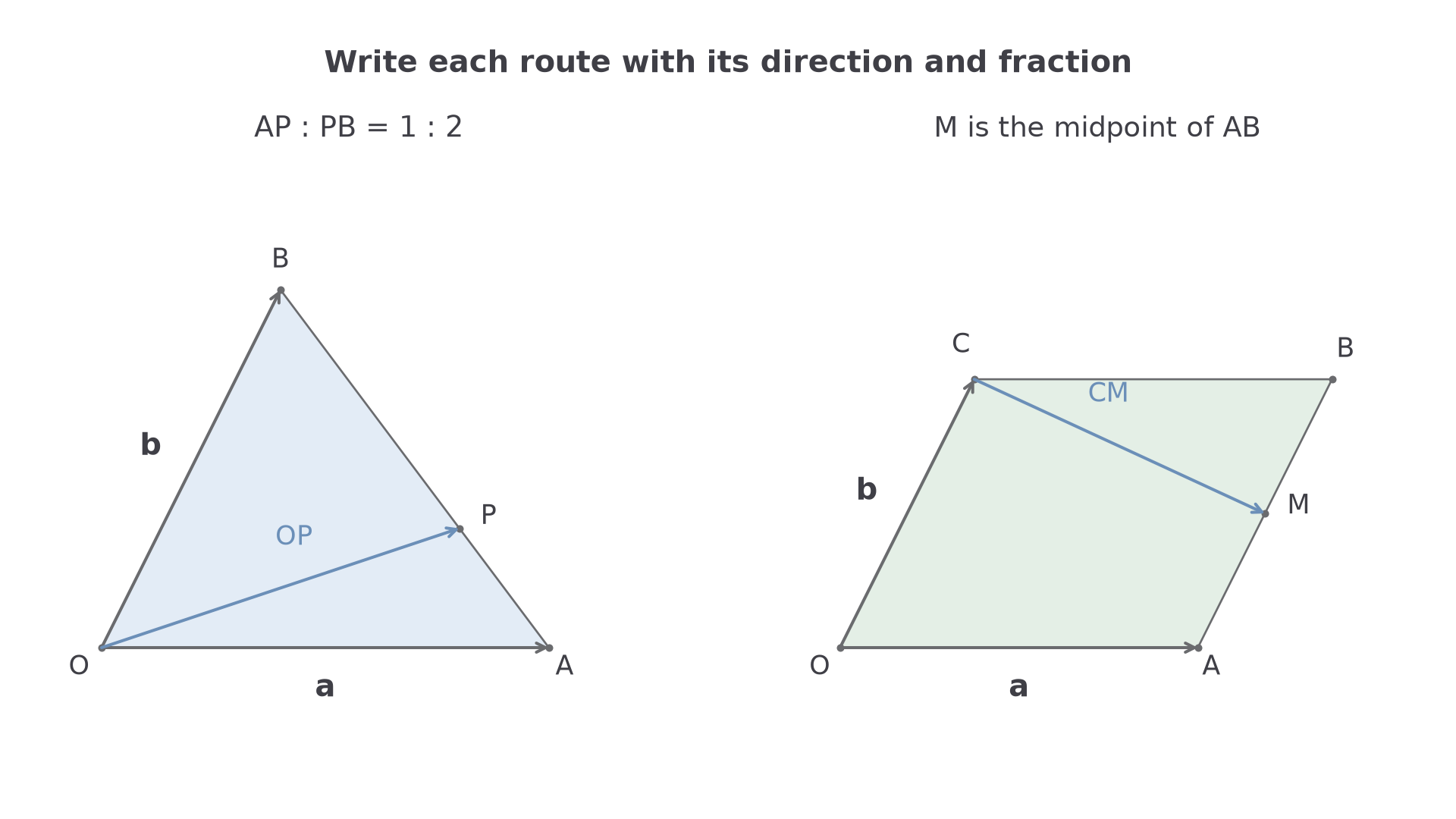
Worked example 1: a divided triangle side
Question. In triangle , , . Point lies on , with . Find and .
Plan. Find the whole directed side , take one of its three equal ratio parts, then route through .
Answer. , and .
Check. The alternative route through gives
.
Adding the two opposite directed vectors gives zero.
A parallelogram supplies equal directed opposite sides; a midpoint supplies a half-side vector.
Worked example 2: a parallelogram route
Question. are the vertices of a nondegenerate parallelogram in that order. Let , , and be the midpoint of . Find .
Plan. Use , so first find the position vector of , then subtract the position vector of .
Answer. .
Check. Route gives . The minus sign is required because runs opposite to .
Routes give the same displacement when their starts and ends agree, even if their intermediate points differ.
Watch out
describes , whereas describes . The letters naming the route are part of the answer.
Use a different internal ratio and reverse the result.
Division and parallelism
For a point internally dividing in ratio , with , the whole side has parts. Therefore is of , not of it.
If , and , routing through gives
The positive coefficients add to , consistent with lying between and .
For nonzero vectors , an equation , with nonzero scalar , proves parallel directions. Positive preserves direction; negative reverses it. Their supporting lines are parallel or coincident. The zero vector has no direction, so a zero-vector equation cannot establish a line's direction.
Worked example 3: the midpoint parallel line
Question. In non-collinear triangle , is the midpoint of , and the midpoint of . Prove that is parallel to , and find the length relationship.
Plan. Express and using the same non-parallel vectors.
Answer. and in length. Vector is nonzero, and the multiplier is nonzero. The lines are distinct because lie strictly inside the other two sides of a non-collinear triangle.
Check. Halving both position vectors is an enlargement of triangle by factor about . It maps segment to , also confirming the parallel half-length segment.
Matching fractions along the two sides produce a parallel segment. Different fractions generally do not. When are non-parallel, two expressions in them are equal only if their respective coefficients match: otherwise rearrangement would make one a scalar multiple of the other.
Continue this lesson.
You’re previewing NovaLearn without an account. Create a free account to read the rest.
Create free account