HG10 - Tangents and chords
Learn to prove and use the relationships between radii, tangents and chords, including the alternate-segment theorem. HG10 connects equal radii, triangle congruence, Pythagoras and the angle theorems already proved.
Radii and tangents
A tangent looks as though it just brushes a circle. What exact angle does it make with the radius, and why must two tangents from one point have equal lengths?
A tangent is a straight line that meets the circle at exactly one point, its point of contact. This is a stated geometric condition, not something to infer from an almost-touching drawing.
Radius and tangent
A tangent is perpendicular to the radius at its point of contact. If a line touches a circle with centre at , then the angle between and the tangent is .
Proof. Let the radius be . Suppose were not perpendicular to the tangent. Drop a perpendicular from to the line at . The perpendicular is shorter than the sloping segment , so : the line passes through a point inside the circle. It would then cut the circle twice, contradicting tangency. More explicitly, the two points on the line at distances on either side of both have distance from , by Pythagoras. Therefore the supposed non-perpendicular tangent cannot exist.
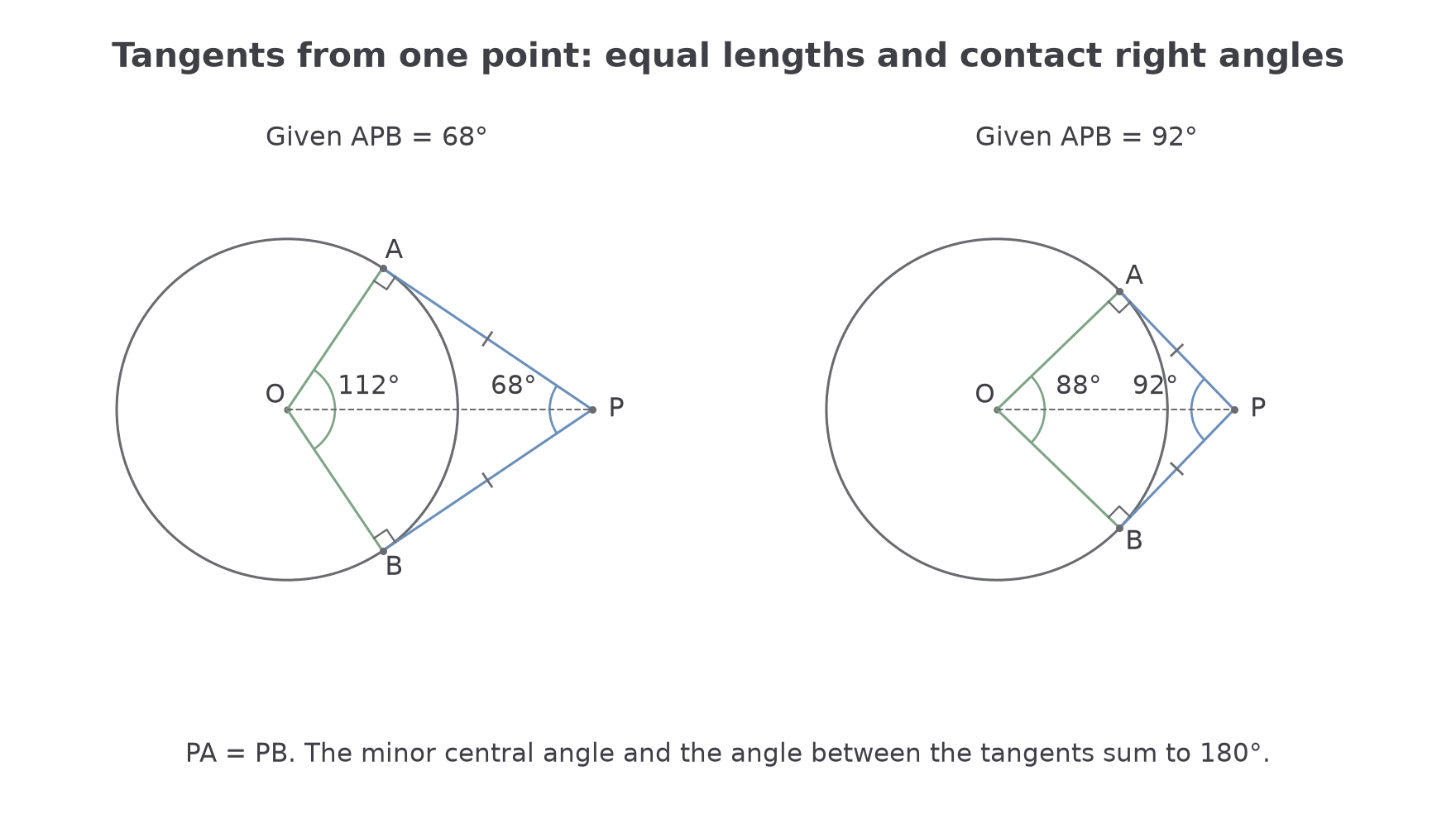
Now take an external point and its two tangents to the same circle, meeting it at distinct points . Join . Triangles and have right angles at the contact points, equal radii and common hypotenuse . They are congruent by RHS. Hence
Their corresponding angles at are also equal: bisects the angle between the tangents. Equal tangent lengths refer to segments from the same external point to the same circle.
Worked example 1: two tangent lengths and an angle
Question. are tangents from to a circle with centre , touching at . Given and , find and the minor angle .
Plan. Use equal tangents for the length and the two contact right angles in quadrilateral for the central angle.
Answer. , minor .
Check. Congruence gives . Triangle then has ; doubling it gives , confirming the quadrilateral calculation.
Keep the tangent length but change the angle between the tangents. The tangent equality remains valid while the central angle changes.
Worked example 2: a wider angle between the tangents
Question. In a two-tangent configuration with the same stated conditions, and . Find and the minor angle .
Plan. Use the same equality and right-angle sum with the new external angle.
Answer. , minor .
Check. bisects the angle, giving at . Each right triangle has at , so the central angle is . It supplements the angle between the tangents.
The contact points locate both right angles; the circle centre need not lie on either tangent.
[DIAGRAM: asset_name: Two tangents from one external point; asset_slug: equal-tangents-pair; caption: Equal tangent segments and two contact right angles link the external and central angles.; description: Exact circle panels construct tangents PA and PB from one external point P. Radii OA and OB meet them at right angles, OP is drawn, and the angles APB68 and92 produce central angles112 and88. Matching marks identify PA=PB.]
Watch out
The right angle is between the tangent and the radius at the contact point. A line through some other point on the tangent need not be perpendicular. Tangents from different external points need not have equal lengths.
Use fresh tangent data and name the reasons.
Chord geometry
A radius drawn to a random point of a chord does not necessarily meet it at a right angle. A perpendicular from the centre, however, finds the chord's midpoint. The reverse statement is useful too.
Centre and chord bisector
The perpendicular from a circle's centre to a chord bisects the chord. Conversely, the line from the centre to the midpoint of a non-diameter chord is perpendicular to it. Equivalently, the perpendicular bisector of every chord passes through the centre.
Proof from the midpoint. Let be distinct endpoints of a non-diameter chord, the centre, and its midpoint. Join . Triangles have (radii), (midpoint), and common side . By SSS they are congruent. Thus ; they also sum to on the straight line . Each is .
Proof from the perpendicular. If meets chord at a right angle, triangles have equal hypotenuses and common side . RHS congruence gives , so is the midpoint. If the chord is a diameter, its midpoint is the centre itself and its two halves are radii; this case does not require a degenerate triangle proof. The perpendicular bisector still passes through that midpoint.
For calculations, let the radius be , the perpendicular distance from the centre to the chord be , and the half-chord length be . The right triangle has hypotenuse , so
Here for a genuine chord with distinct endpoints. At the chord is a diameter. At the intersection has collapsed to a single contact point, rather than a two-endpoint chord.
Worked example 3: finding a chord length
Question. A circle has radius . The perpendicular from centre to chord meets it at , with . Find .
Plan. The centre's perpendicular bisects the chord. Find in right triangle , then double it.
Answer. .
Check. A half-chord of and perpendicular distance give radius . The full chord is less than diameter , as required for a non-central chord.
Keep the radius but move the chord farther from the centre. Its length decreases.
Continue this lesson.
You’re previewing NovaLearn without an account. Create a free account to read the rest.
Create free account