FN1–FN3, FN10, HN1–HN3, HN10 - Equivalent fractions and number order
Use equal scaling to recognise and simplify equivalent fractions. You will convert between improper fractions and mixed numbers, locate signed fractions on a number line, and compare fractions using common denominators or exact decimals.
Equivalent fractions
Which is larger, or ? Comparing the top numbers alone will not answer that: the pieces have different sizes. Begin by seeing how the same amount can have different fraction names.
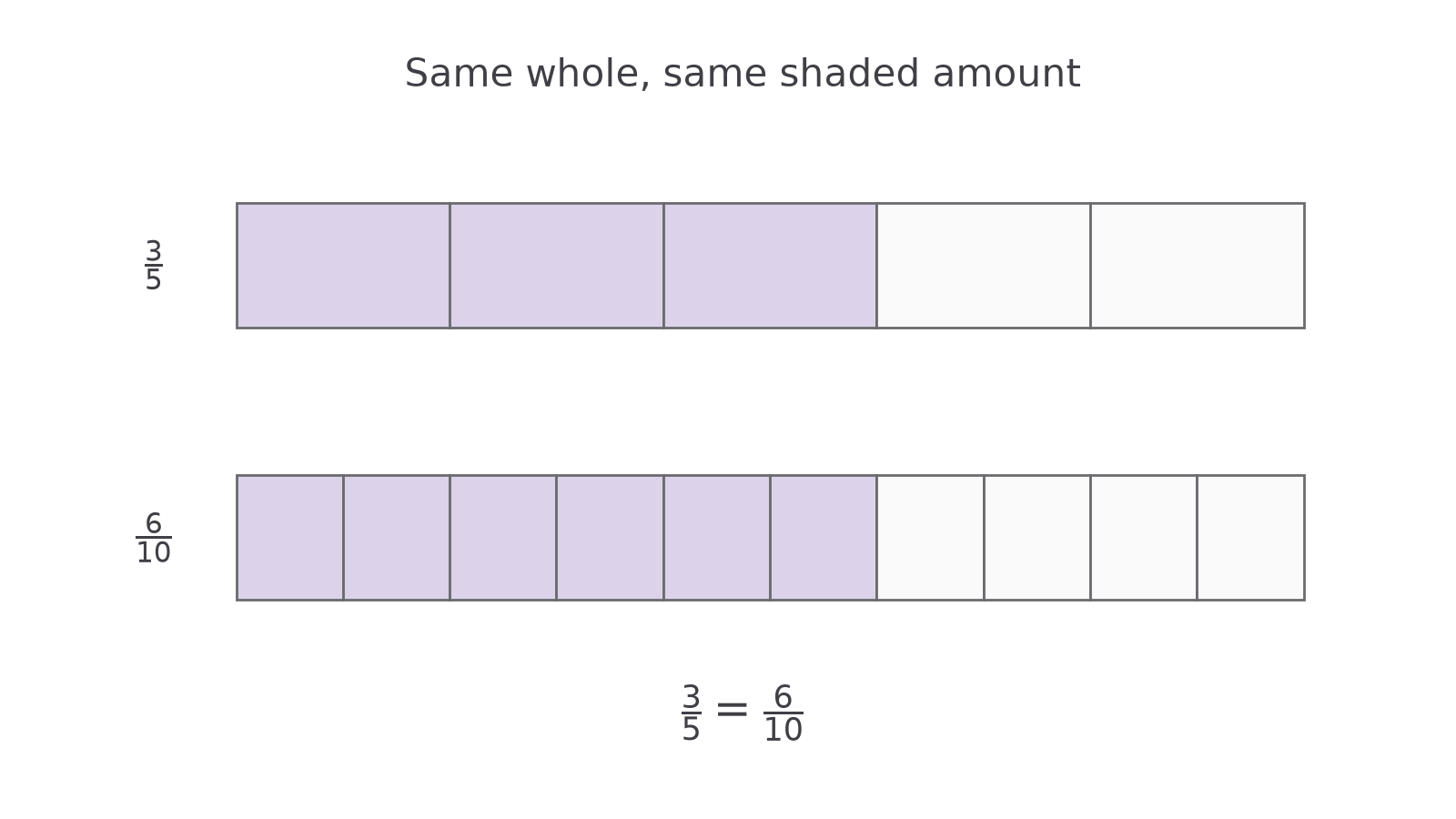
In , the denominator says the whole is divided into five equal parts. The numerator says to take three of those parts. Split every fifth in half: there are now ten equal parts, and the same shaded amount contains six of them.
[DIAGRAM: asset_name: Equal amounts with different fraction names; asset_slug: equivalent-fraction-bars; caption: Three fifths and six tenths cover the same amount of the same whole.; description: Two aligned bars of equal length. The top is split into five equal parts with three shaded; the bottom into ten equal parts with six shaded. Labels show three fifths equals six tenths.]
Equivalent fractions
Equivalent fractions have the same value. Multiply or divide the numerator and denominator by the same non-zero number to preserve the value:
A denominator cannot be zero.
Why does this work? Multiplying the numerator and denominator by multiplies the fraction by . Dividing both by a common factor reverses that scaling. This is cancellation, and it gives a fraction in its simplest form when numerator and denominator share no factor greater than .
Worked example 1: simplifying a fraction
Question. Write in its simplest form.
Plan. Find a common factor of and , then divide both by it.
The only positive factor shared by and is , so the simplification is complete.
Answer. .
Check. Scaling back by gives .
You may cancel in stages instead: . The next example adds a negative sign; cancellation changes the sizes of the integers, but preserves that sign.
Worked example 2: simplifying a negative fraction
Question. Write in its simplest form.
Plan. Simplify the positive fraction, keeping the minus sign attached to the whole value.
The numbers and have no common factor greater than .
Answer. .
Check. . The result is still negative and between and .
Equivalent scaling is different from adding the same amount to both numbers.
Watch out
. Adding does not split every part in the same way. Multiply both numbers by to get the equal fraction .
Simplify a new signed fraction completely.
Mixed numbers
An improper fraction can contain whole units as well as part of another unit.
With a positive denominator, a proper fraction has a numerator smaller in size than the denominator; an improper fraction has a numerator at least as large in size. For instance, is proper, is improper, and is also improper.
Mixed number
A mixed number combines a whole number with a proper fraction. For example,
A minus sign in front applies to the whole mixed number: .
To turn an improper fraction into a mixed number, divide the numerator's size by the denominator. The quotient counts whole units; the remainder counts parts of the next unit. Keep the denominator because the size of each part has not changed.
Worked example 3: an improper fraction on a number line
Question. Write as a mixed number and state where it lies on a number line.
Plan. Group eleven quarters into whole units of four quarters.
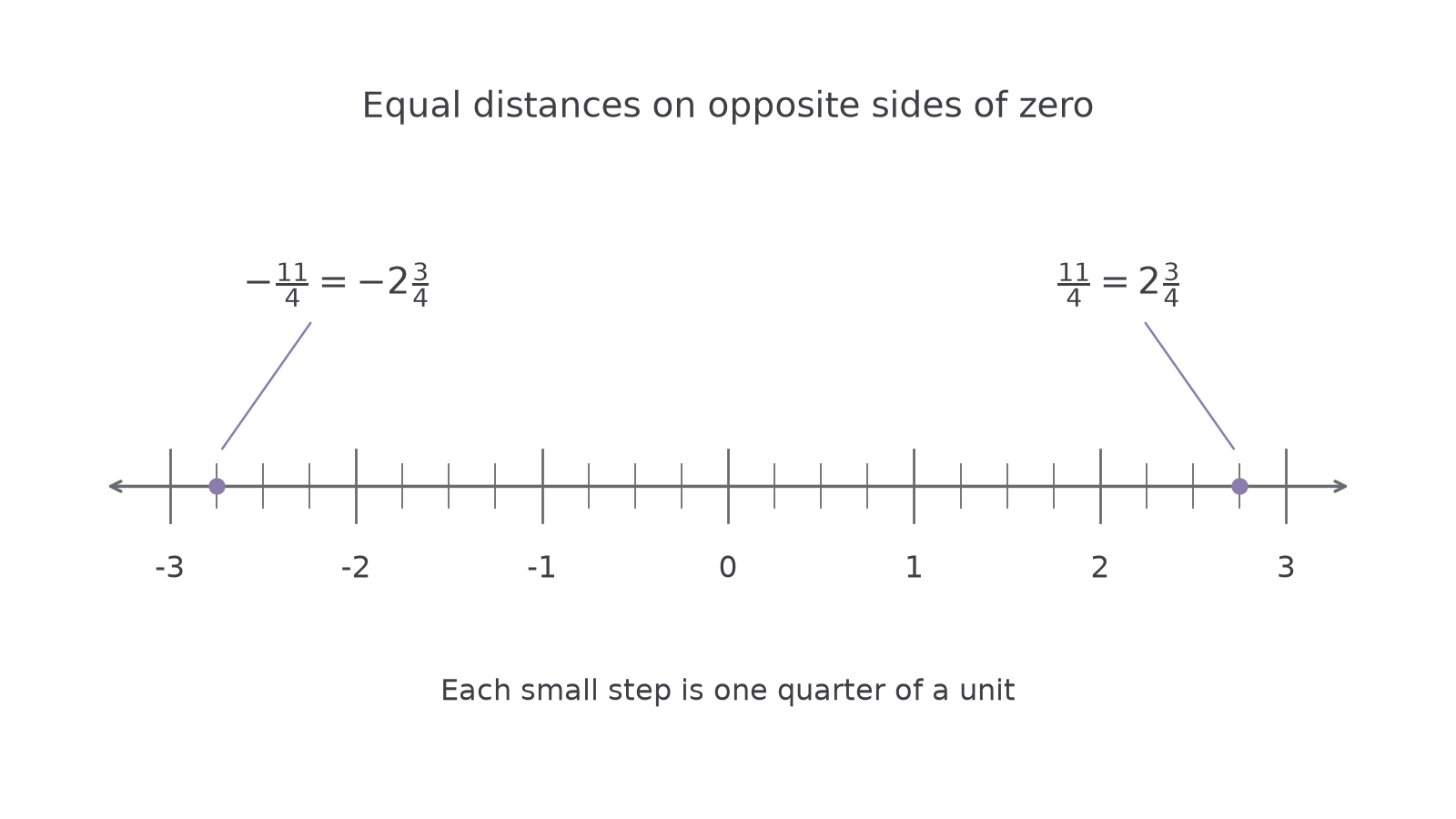
It is three quarters of the way from to , at the third quarter-step after .
Answer. , between and .
Check. Two whole units are eight quarters; eight quarters and three quarters give the original eleven quarters.
For the reverse conversion, count the parts in the whole units and add the remaining parts: multiply the whole-number size by the denominator, then add the numerator. The next example changes the sign and the direction of conversion.
Worked example 4: a negative mixed number
Question. Write as an improper fraction and state where it lies on a number line.
Plan. Count the quarters in , then apply the minus sign to the whole amount.
The value is units left of zero. It is between and , one quarter-step to the right of .
Answer. , between and .
Check. Its opposite, , is at the same distance to the right of zero; the two positions are reflections in zero.
Every interval between neighbouring integers represents one whole, so divide each into four equal steps when plotting quarters.
[DIAGRAM: asset_name: Positive and negative mixed numbers; asset_slug: mixed-number-line; caption: Eleven quarters and negative eleven quarters lie the same distance from zero.; description: One exact number line from minus three to three with quarter ticks. The points minus eleven quarters and eleven quarters are marked at minus two and three quarters and two and three quarters, respectively; zero and all integer ticks are labelled.]
The quotient-and-remainder method also handles exact whole numbers: , with no fractional part left.
Watch out
means , not . Apply the minus sign to both the whole units and the fractional part.
Convert a new negative mixed number and locate its value.
Ordering fractions
Compare fractions by expressing them in equal-sized parts, or by using exact decimal values.
When positive denominators match, the larger numerator gives the larger value: . The pieces are the same size, and seven pieces exceed five. With different denominators, first scale to a common denominator. Any common multiple works; choosing a small one keeps the numbers manageable.
Worked example 5: comparing with a common denominator
Question. Which is larger, or ? Show your working.
Plan. Rewrite both fractions in fortieths, so their numerators count equal-sized parts.
Answer. is larger.
Check. An exact decimal comparison agrees: , while , which is larger than .
To use an exact terminating decimal, scale the denominator to , , or another power of ten. For example, . This works particularly well for halves, quarters, fifths, eighths and tenths. If the decimal would need rounding, a common denominator keeps the comparison exact.
Negative fractions follow the number-line rule from the first lesson. Among two negative numbers, the one closer to zero is greater. Keep each minus sign attached when comparing signed numerators.
Worked example 6: changing both fractions to negative values
Question. Write and in increasing order, using .
Plan. Use fortieths again, then compare the signed numerators.
Answer. .
Check. The exact decimals are and . The first is further left, so it is smaller.
A positive fraction exceeds a negative fraction without any conversion. Equivalent fractions have equal positions: , so statements such as are true because the symbol allows equality.
Watch out
For negatives, the larger positive size gives the smaller value. Since , their negatives satisfy . Do not discard the signs after finding a common denominator.
The opening comparison is now justified: exceeds by one fortieth. The numerators could only be compared directly after the denominators matched.
Quick Recap
- Multiply or divide numerator and denominator by the same non-zero number to preserve a fraction's value.
- In simplest form, numerator and denominator have no common factor greater than .
- Use whole groups and a remainder to convert between improper fractions and mixed numbers; a leading minus sign applies to the entire mixed number.
- Compare fractions using common positive denominators or exact decimals, keeping their signs.
, because twenty-five fortieths exceed twenty-four fortieths.