FG7, FG17, FR13, HG7, HG19, HR13 - Enlargement and similarity
Learn to enlarge a shape from a centre using positive integer and fractional scale factors, and use corresponding lengths in similar figures. FG7 and HG7 supply the transformation; FG17, HG19, FR13 and HR13 connect congruence, length ratios and similarity.
Enlarging shapes
If every side of a triangle doubles, where should the enlarged triangle go? A scale factor fixes its size, but a centre of enlargement fixes its position.
Positive enlargement
An enlargement with centre and positive scale factor places each image point on the ray from through , with . Side lengths multiply by , and corresponding angles stay equal.
For , the image is larger; for , it is smaller, although the transformation is still called an enlargement. The centre stays fixed. At , every point stays fixed.
On squared paper, draw a ray from the centre through each vertex. Multiply the vertex's horizontal and vertical displacements from the centre by , then plot the image and join corresponding vertices. Multiplying coordinates alone works only when the centre is the origin.
Worked example 1: an integer scale factor
Question. Enlarge , , by scale factor , centre .
Plan. Double each displacement from , then add the centre's coordinates back.
| Vertex | Displacement from | Doubled displacement | Image |
|---|---|---|---|
Answer. .
Check. is units horizontally and is . Also each original point is halfway from to its image, confirming the centre and scale factor.
Keep the centre and original triangle, but replace by . The images now lie between the centre and the original vertices.
Worked example 2: a fractional scale factor
Question. Enlarge the same triangle by scale factor , centre .
Plan. Halve each displacement from , keeping it in the same direction.
| Vertex | Displacement from | Halved displacement | Image |
|---|---|---|---|
Answer. .
Check. Each image is the midpoint between and its original vertex. The image side is unit, half the original .
The rays establish position; a shape of the correct size placed elsewhere is not the specified enlargement.
[DIAGRAM: asset_name: Integer and fractional enlargement; asset_slug: positive-enlargements; caption: Positive scale factors keep image vertices on the same rays from the centre.; description: Exact coordinate panels show P(3,2), Q(5,2), R(3,4) enlarged about O(1,1) with factors 2 and one half. Rays join O to corresponding vertices. Images are (5,3),(9,3),(5,7) and (2,1.5),(3,1.5),(2,2.5).]
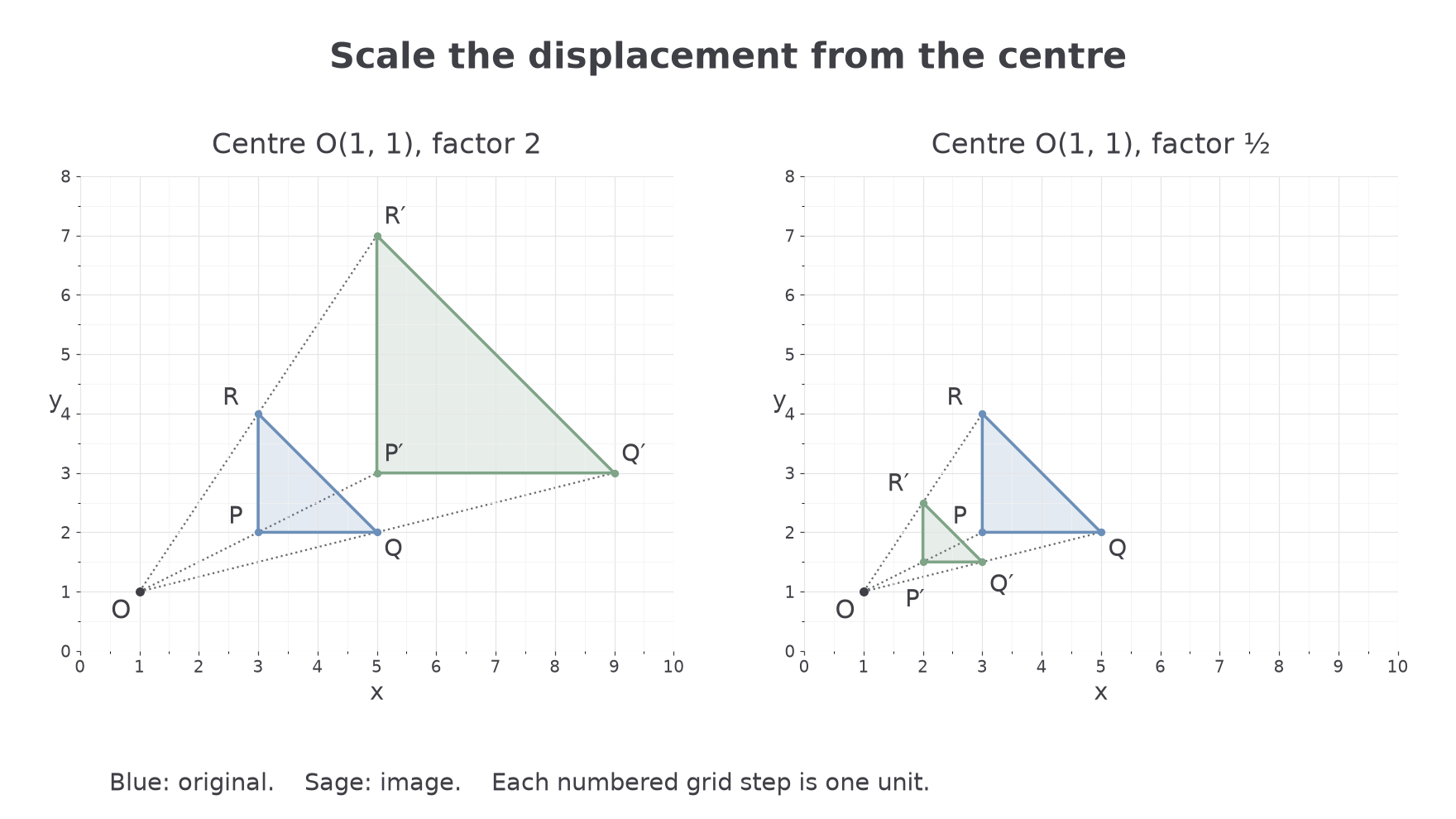
To describe an enlargement from a diagram, compare a pair of corresponding side lengths to find the scale factor, then extend corresponding vertex-to-image lines to locate the centre. For a non-trivial enlargement, distinct such lines meet there. Check the distance ratio from that centre as well as the side ratio.
Watch out
With centre , factor does not send to . Double the displacement from the centre, giving image .
Use a new centre and triangle with a fractional factor.
Similar lengths
In similar figures, every pair of corresponding lengths uses the same multiplier. Identify which vertices and sides match before forming a ratio, even if one figure has been turned or reflected.
Similar figures
Figures are similar when corresponding angles are equal and corresponding lengths are in one common ratio. If the length scale factor from a first figure to a second is , each second length is times its matching first length.
The statement corresponds to matches with , with and with . Thus matches , matches , and matches . Keep the direction of the ratio consistent.
Worked example 3: finding an enlarged length
Question. Similar triangles and have the stated correspondence. , , , , . Find .
Plan. Find the multiplier from to using and , then apply it to .
Answer. .
Check. The independent known pair gives , agreeing with the chosen multiplier.
Keep the triangles and correspondence, but make the smaller matching side the unknown. Reverse the multiplier rather than adding a fixed difference.
Continue this lesson.
You’re previewing NovaLearn without an account. Create a free account to read the rest.
Create free account